AI Daily · November 27, 2026 Friday
2026-11-26 08:00 — 2026-11-27 08:00 (UTC+8)
- 01
OpenAI admits a GPT-6.2 billing mistake: Astra limits now arrive 40% faster, and users get a banked reset as an apology
OpenAI's Thibault Sottiaux said on X that a billing mistake at GPT-6.2's launch wrongly discounted Astra and Sol usage for most users. After the fix, users will hit limits 40% faster on Astra and 25% faster on Sol versus last week, though still slower than GPT-6 Astra and 6.1 Sol. Past usage won't be charged, and Go, Plus, Pro and Business users each get one banked reset.
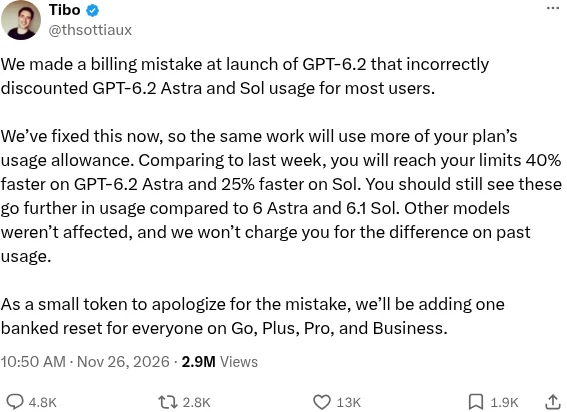
Screenshot of the original post · View full size ↗ Read the full report
Paying OpenAI users running GPT-6.2 will now see their allowance drain faster. OpenAI's Thibault Sottiaux acknowledged on X on the morning of November 26, Beijing time, that a billing mistake at GPT-6.2's launch incorrectly discounted GPT-6.2 Astra and Sol usage for most users.
He said the bug has been fixed, so the same work will use more of a plan's usage allowance: compared with last week, users will reach their limits 40% faster on GPT-6.2 Astra and 25% faster on Sol. He added that both should still go further than GPT-6 Astra and GPT-6.1 Sol, that other models were not affected, and that OpenAI will not charge for the difference on past usage.
As an apology, OpenAI is adding one banked reset for everyone on Go, Plus, Pro and Business plans. A few hours later Sottiaux posted "Banked reset is online," indicating the compensation had gone live.
The post drew more than 13,000 likes and reached the Hacker News front page. For heavy users, it means part of the generous-feeling limits since launch came from a billing error, and usage plans now need to be based on the corrected consumption.
- 02
German consumer group sues OpenAI: ChatGPT subscriptions are easy to start, hard to cancel, and prices can rise 'as needed'
Germany's Verbraucherzentrale Brandenburg has sued ChatGPT operator OpenAI Ireland, arguing that its way of cancelling paid subscriptions does not meet German requirements for a cancellation button and that a clause letting OpenAI change prices 'as needed' is invalid. The group says it sent a warning in July and OpenAI did not sign a cease-and-desist declaration. The case is before the Brandenburg Higher Regional Court.
Read the full report
Whether cancelling a paid ChatGPT subscription in Germany is too hard may now be up to a court. The consumer protection centre Verbraucherzentrale Brandenburg said in a press release that it has sued ChatGPT operator OpenAI Ireland Ltd. over two issues: obstacles to cancelling paid subscriptions, and a clause that lets OpenAI change prices unilaterally "as needed."
The group argues that the cancellation option OpenAI offers on chatgpt.com did not meet German legal requirements for a cancellation button. "Anyone who can take out a subscription online with a few clicks must be able to cancel it just as easily. That applies to big tech companies as much as to any other provider," said Dunja Neukamp, a legal adviser at the centre.
It also objects to a contract clause reserving OpenAI's right to change prices "as needed." The centre says the clause is invalid because it neither defines the conditions for price changes nor ties increases to actual cost rises. It wants OpenAI to stop using the clause and not to rely on it against consumers in Germany, including for existing subscriptions.
According to the release, the centre sent OpenAI a formal warning in July 2026, but even after an extended deadline the company did not sign a binding cease-and-desist declaration, so the group filed suit. Its case page lists an injunction action, case number 7 UKl 7/26, at the Brandenburg Higher Regional Court; no ruling has been issued. The release does not mention a response from OpenAI.
- 03
Pentagon officials reportedly floated using a wartime law to push Nvidia to reinstate Jensen Huang; the Pentagon denies it
According to The Washington Post, citing three people familiar with the talks, Defense Secretary Pete Hegseth and other Pentagon leaders discussed invoking the Defense Production Act to pressure Nvidia into restoring Jensen Huang as CEO, for example by forcing it to shift more production to military projects. The Pentagon denied the report, saying the conversations never happened and no such proposal was made.
Read the full report
The saga of Nvidia CEO Jensen Huang's exit and return has produced a strange new twist. According to The Washington Post, citing three people familiar with the discussions, Pentagon leaders weighed invoking the Cold War-era Defense Production Act to pressure Nvidia to restore Huang as CEO while senior Trump administration officials discussed the company over the weekend.
As recounted by Gizmodo, the discussions involved Defense Secretary Pete Hegseth and Deputy Secretary Steve Feinberg. The law is meant for military procurement and securing critical production, and does not give the government power to appoint company executives. One source said the idea was that, after an economic emergency declaration framed as a national security issue, the DPA could be used to force Nvidia to shift more production to military projects and hurt its profits. The Post said the idea had circulated among Silicon Valley tech leaders before reaching the Pentagon and White House, but could not say for certain whether it was ever presented to Nvidia.
The Pentagon denied the account. According to the Hindustan Times, a Pentagon official said the conversations described between senior department leaders never happened and that no such proposal was made by the Secretary, Deputy Secretary or Under Secretary. The White House referred questions to the Pentagon.
The Post also reported that the government did tell Nvidia that bringing Huang back mattered for national security, though its source said this did not register as a threat to the company. Huang has since returned as CEO.
- 04
Tencent Hunyuan open-sources DFly2, a drafter that speeds up LLM generation, with weights, training code and paper
Tencent Hunyuan fully open-sourced DFly2, its speculative-decoding draft model, on November 26, releasing weights, training code and a technical report. DFly2 reuses the KV cache and selected positions that a sparse-attention target model already computes, keeping no cache of its own. The paper reports 10.0%-31.5% more accepted tokens per step than the stronger baseline on long-context and agentic tasks, based on the team's own tests.
Read the full report
LLMs are often slowed by generating text one token at a time. A common fix is speculative decoding: a small draft model quickly guesses the next few tokens and the large model checks them in one pass, keeping the correct ones. Tencent Hunyuan's AI Infra team said on November 26 that it has fully open-sourced DFly2, the drafter built into Hy4 flash, including the weights, the training code and the technical report.
DFly2 reuses work the large model has already done. Newer models such as DeepSeek-V4 and Hunyuan Hy4 use sparse attention, looking at only a subset of context positions for each token. Each DFly2 layer reads the KV cache of its paired target layer at the positions that layer's indexer selected (up to about 2,048), so it keeps no cache and runs no scoring pass of its own. According to Hunyuan, the roughly 0.85-billion-parameter, five-layer drafter therefore has a constant per-token cost regardless of context length and needs no extra KV memory.
The paper says that on DeepSeek-V4.1-Flash, GLM-5.3-Flash and Hy4 flash, trained with the same recipe, DFly2 accepts more tokens per step than DFlash and DSpark: its margin over the stronger baseline is 3.9%-10.5% on general workloads and 10.0%-31.5% on long-context and agentic ones. At high concurrency on DeepSeek-V4.1-Flash, at matched per-user decode speed, throughput is 62% and 81% higher on two 64K sets. These are the team's own results.
Beyond the Hy4 family, the release includes new MoE drafters for Hy4 flash, DeepSeek-V4.1-Flash and GLM-5.3-Flash, trained with Tencent's open-source AngelSpec framework, which developers can use to train drafters for other models with similar sparse attention.
- 05
An AI-assisted Riemann Hypothesis proof shrinks by two orders of magnitude: Anthropic staff and Claude release a 76,000-line Lean version
GitHub user lsernau released grh-lean, a shorter Lean 4 proof of the Riemann Hypothesis and the Generalized Riemann Hypothesis for Dirichlet L-functions, based on Levent Alpöge's work with Claude and produced with Anthropic colleagues and Claude. The compact edition is about 76,000 lines and builds in one to two hours on a 12-core machine. It has passed machine checks only; no mathematician has read it through.
Read the full report
The machine-checked Riemann Hypothesis proof that mathematician Levent Alpöge produced with Claude, which ran to many millions of lines, now has a version that can be verified on an ordinary computer. GitHub user lsernau published the grh-lean repository on November 25, describing it as a shorter version produced with colleagues at Anthropic and Claude, giving a Lean 4 proof of the Riemann Hypothesis and of the Generalized Riemann Hypothesis for Dirichlet L-functions.
The repository has two editions: a readable one of about 300,000 lines and a compact one of about 76,000 lines, proving the same five theorems. The proof builds on the Mathlib library and uses only Lean's three standard axioms. According to the README, a build takes one to two hours on 12 cores with 24 GB of memory when the Mathlib cache is available. According to QbitAI, the author said the proof shrank from about 15 million lines to about 76,000, roughly two orders of magnitude.
Lean is a proof assistant that has a computer check every step of an argument. Passing a machine check means the chain of logic from axioms to conclusion has no gaps, provided the formal statement of the theorem is itself correct. The repository notes that the proof has passed machine checks only, no mathematician has read it through, and no paper accompanies it.
The repository lists Anthropic, PBC as copyright holder under the Apache 2.0 license and describes itself as a research artifact that is not maintained and not accepting contributions.
- 06
Qwen's speech models understand more Chinese dialects: Qwen-Audio-3.1 adds multilingual upgrades, with speech recognition covering 8 dialects
Alibaba's Qwen team announced on X a multilingual upgrade to its Qwen-Audio-3.1 speech models with a focus on Chinese dialects: ASR now covers 59 languages and 8 Chinese dialects, TTS 65 languages and 6 dialects, and Realtime 53 languages and 6 dialects. All three models are available now.
Read the full report
Alibaba's Qwen team announced on X on November 26 a multilingual upgrade to its previously released Qwen-Audio-3.1 speech foundation models, with a strong focus on recognising and synthesising Chinese dialects.
According to the team, speech recognition (ASR) now supports 59 languages and 8 Chinese dialects; text-to-speech (TTS) supports 65 languages and 6 Chinese dialects; and the Realtime model supports 53 languages and 6 Chinese dialects. Qwen-Audio-3.1-ASR, TTS and Realtime are all available, with links in the post.
For developers building customer service, captioning or voice assistants, dialect support can decide how many users a product reaches. The post does not list which dialects are covered or give accuracy benchmarks, so real-world performance remains to be seen.
- 07
Karpathy had Claude work 7 hours and write 45,000 lines of code to build a Civilization-style map from 31 US public data sources
Andrej Karpathy shared on X that he asked Claude Opus 5.5 to populate a Civilization-style game map with real US data. Claude downloaded and parsed 31 public sources including the Census, BLS and NOAA, and after 7 hours and 45,000 lines of code it worked, turning GDP, industries and workforce into in-game gold, districts and citizens.
Read the full report
How long and how big a job can an AI coding agent take on by itself? Andrej Karpathy shared an example on X on November 26: he asked Claude to populate a Civilization-style game map with real US data, and Opus 5.5 downloaded and parsed a large amount of public data. Seven hours and 45,000 lines of code later, it worked.
By his account, the project draws on 31 real data sources, including the Census, BEA, BLS, EIA, NOAA, USGS, DoD, NPS, FAA, FEMA and CDC, reconciling elevation, land cover, GDP, jobs, power plants, mines, ports, airports, bases, parks, universities, freight flows and disasters onto a single 25 km hex grid.
The data is translated into game terms: gold yield is GDP, a city's districts are its real industry specializations (San Jose gets a Campus, Detroit is "Motor city"), and its citizens are its real workforce, with 1 in 4 San Jose workers being engineers, coders or scientists versus 1 in 14 nationally. The map offers 19 lenses, a City View for 524 metros, and an Explorer that turns any column for any of 3,100+ counties into a table and scatter plot.
Karpathy said he built it with the Claude Code desktop app, running Opus 5.5 on medium with ultracode on. He noted that Claude decided to skip a few states and territories, and that the experiment left him with half of his weekly Claude quota. The project is deployed with a source link on the page; he said he is not sure where it goes next, but it could perhaps become a game. The post drew more than 13,000 likes.
- 08
AI-agent hacking confirmed by a government for the first time: Switzerland reports attacks that breached power, water and telecom operators
Switzerland's National Cyber Security Centre confirmed its first cases of attackers using AI agents to breach Swiss companies and critical infrastructure operators; in every case it knows of, the victims' systems were compromised. Swiss media report five confirmed cases, three targeting critical infrastructure. The agency urges patching critical flaws within 24 hours and universal MFA.
Read the full report
"AI hackers" have moved from security reports to officially confirmed cases in Switzerland. The Swiss Federal Office for Cyber Security (BACS, or NCSC in English) said on November 26 that in recent days it had received its first reports of cyberattacks on organisations in Switzerland carried out with the help of AI agents. Victims include companies and critical infrastructure operators in at least two sectors. In every attack known to the NCSC, the use of AI agents led to a successful compromise of the victim's IT systems.
According to swissinfo, BACS director Florian Schütz told Swiss broadcaster SRF on Thursday that five cases have been confirmed, three of them targeting critical infrastructure and two targeting companies. Reuters, citing SRF, reported that the critical infrastructure targets were electricity, water and telecommunications providers. The attackers have not been publicly identified.
The NCSC said the attackers used so-called "Agentic Offensive Frameworks": AI agents that independently search for vulnerabilities, choose attack tools, evaluate results and plan the next step. Such tools are also used legitimately for penetration testing, making them dual-use. They mostly exploit weak passwords and known vulnerabilities, but need only a fraction of the time a human would, and can switch to other known techniques when blocked, leaving defenders far less time to respond. The agency added that the number of such internet-accessible agents, such as ARTEX and CyberStrikeAI, has almost doubled since October 2026.
The NCSC expects more successful attacks and urged companies to act now: minimise internet-exposed systems, install critical security updates for them no later than 24 hours after release, protect every external entry point such as webmail and VPN with MFA or passkeys, apply least privilege, and regularly test their own infrastructure for vulnerabilities.
- 09
Legally obtained data can train AI: China's data regulator proposes AI data rules and backs paying for data
China's National Data Administration released draft opinions with 12 measures letting legally collected, derived and contract-acquired data be used for AI training and inference. Firms would have the right to retrieve and transfer data generated through smart devices and cloud services; the draft encourages paying for data and calls for risk controls on AI companies' outputs. Comments are open until December 6.
Read the full report
China is spelling out which data AI companies may train on. On November 26 the National Data Administration released draft "Opinions on Improving Data Rules to Empower AI Innovation" for public comment, setting out 12 measures across three areas. The core idea is that legally obtained data can be used, in an orderly way, for AI training and inference. Comments are open until December 6.
The draft addresses different data sources. Data that companies lawfully collect in their business may be used for training and inference, as long as it does not break laws or contracts or infringe others' rights. For data generated when companies use smart devices or cloud services, and which they authorised providers to collect, the companies have the right to obtain or copy and transfer it, then use it themselves or provide it to others for training; providers may also use such data with the company's explicit authorisation. "Derived data" created through substantial processing can likewise be used or supplied for training, with more detailed rules on what qualifies to come.
On transactions, the draft encourages data property registration, supports AI firms buying registered data with clear ownership, and encourages standard data-trading contracts. Xinhua reported that it also supports and encourages paying for data, calls for a risk-control mechanism for AI companies' outputs, and seeks to improve liability and security governance for data circulation.
For AI companies, the significance is clearer rules on which data can be used and who may grant it, especially the provision that data generated through devices and cloud services belongs to the client company and can be transferred. It is still a draft; the regulator said it will next push implementation through pilots.
- 10
Can covert-filming risks get Meta's glasses pulled? Dutch groups ask a court to halt sales and seek €100,000-a-day fines
The Netherlands' largest consumer group, Consumentenbond, together with Offlimits and The Firewall, asked an Amsterdam court on November 26 to halt sales of Meta's AI smart glasses in the country because they allow people to be filmed without their knowledge. Meta argued makers shouldn't be liable for deliberate misuse and pointed to the recording light. A decision is expected in December.
Read the full report
Meta's AI smart glasses, made with Ray-Ban, face a possible sales ban in the Netherlands. Reuters reported that Consumentenbond, the country's largest consumer association, and the foundations Offlimits and The Firewall asked the Amsterdam District Court in summary proceedings on November 26 to halt sales of the glasses in the Netherlands, arguing that they let wearers film people without their knowledge in violation of European privacy law.
The plaintiffs want Meta to allow recording only with explicit consent, to stop using recorded footage to train AI models, and to suspend sales until it complies. According to Reuters, they asked for fines of €100,000 per day per defendant, capped at €100 million, if the companies fail to comply. A lawyer for Offlimits told the court the glasses had been used to secretly film people in exam rooms, changing rooms, swimming pools, hotel rooms and hospitals.
Meta's lawyer asked the court to dismiss the case, saying manufacturers should not be held responsible for every deliberate misuse and that the frame has a recording light visible to others. DutchNews, citing broadcaster NOS, reported that Meta also argued a ban was a matter for politicians or the regulator, not the courts. EssilorLuxottica's lawyer said the company neither processes nor has access to the footage, and that a ban would be disproportionate given similar products on the market.
The civil case covers only the Dutch market, but a ruling could become a reference point in Europe. The plaintiffs say the recording light is not always visible, which is central to the dispute. Earlier the same week, Germany's federation of consumer organisations also sued Meta and Ray-Ban over privacy. The court is expected to decide in December.
- 11
AI designs 'one key for two locks' peptide drugs from scratch: Tencent's Nature paper shows weight loss, glucose control and tumour suppression in mice
Tencent's life sciences lab published its ORIDTP AI platform in Nature as lead institution. It designs peptides that act on two targets at once: GLP-1R/glucagon receptor co-agonists produced marked weight loss and glucose improvement in mice, and zero-shot PD-1/CTLA-4 dual inhibitors cut tumour volume by 94.2%. All efficacy results so far come from animal studies.
Read the full report
Drug developers in obesity and cancer immunotherapy increasingly want a single molecule that hits two targets, but such molecules are hard to design. On November 25, Tencent's life sciences lab, as lead institution, published a Nature paper describing ORIDTP, an AI platform that designs high-potency peptides acting on two therapeutic targets from scratch, without relying on existing molecular templates.
The paper says ORIDTP combines single-target knowledge transfer with dual-target reinforcement learning. For metabolic disease, the team designed co-agonists of the GLP-1 receptor and the glucagon receptor; six of them surpassed the strongest natural binders of each receptor in bioactivity. The lead peptide, GA-Dual.R5.S3, induced substantial weight loss and glycaemic improvement in diet-induced obese mice, showed pronounced antidiabetic effects in db/db mice, and did not induce nausea or aversion.
To test generality, the team ran zero-shot designs for the structurally different immune checkpoints PD-1 and CTLA-4: of 15 designed peptides, 8 blocked both checkpoint interactions and 3 showed antitumour efficacy in human checkpoint knock-in mice. The best, IC-Dual.P3, reduced tumour volume by 94.2% relative to controls.
Tencent said the approach replaces large-scale blind screening with small-sample, AI-driven iteration, testing only about 15 peptides per round, and that ORIDTP is available to researchers on its Tencent Health BioNexus platform. All efficacy results are from mouse studies; human clinical trials are a long way off.
- 12
Fallout from closing the 'rent compute abroad' loophole: Nvidia reportedly pauses server shipments to four Southeast Asian countries as sellers bar neoclouds from renting to Chinese firms
The Wall Street Journal and Financial Times reported that Nvidia told partners including Dell and Super Micro to pause server shipments to Malaysia, Singapore, Thailand and Indonesia. CNBC, citing sources, reported that chip sellers told neoclouds they won't supply Nvidia chips if any capacity will be rented to Chinese companies, following a US remote-access rule effective November 19.
Read the full report
The effects of new US limits on Chinese companies renting advanced AI compute abroad are spreading through the supply chain. The Wall Street Journal reported that Nvidia told manufacturing partners including Dell and Super Micro to pause server shipments to Malaysia, Singapore, Thailand and Indonesia for an unspecified period while it assesses whether regional partners meet US export requirements. The Financial Times, citing three people familiar with the matter, also reported the halt and said it was unclear whether it is temporary.
Why these countries? Chinese companies have been tapping Nvidia chips remotely from data centres there. The think tank Institute for Progress estimates such remote data centres supply about 24% of China's AI computing power. The Commerce Department's Bureau of Industry and Security announced a rule restricting remote access to advanced AI chips on November 16; it took effect on November 19. US Trade Representative Jamieson Greer told CNBC the rules aim to close off indirect access, both smuggling through Southeast Asia and remote access from data centres in third countries.
CNBC reported on November 26, citing two people, that chip sellers have told neoclouds they won't be able to buy Nvidia chips if any of the computing capacity will be rented to Chinese companies. Previously, Nvidia said it would not sell to customers renting more than 50% of their GPUs to Chinese firms. CNBC also reported an unusual surge of Nvidia GPUs listed for resale since the rule, including thousands of B300 chips originally intended for data centres with Chinese renters.
According to the FT, Southeast Asian cloud providers have 90 days to apply for licences, a situation one executive called chaos, and banks have halted about $500 million in loans to Singapore-based provider Aolani, which planned to rent compute to ByteDance.
- 13
Reuters: squeezed by chip curbs and distillation crackdowns, Z.AI's GLM-5.5 and Moonshot's Kimi K4 may slip, with Moonshot turning to Google and Meta models for training data
Reuters, citing sources, reported that US chip restrictions and OpenAI's and Anthropic's crackdown on distillation are delaying Chinese models: Z.AI's roughly 3-trillion-parameter GLM-5.5, planned for November, may slip to Q1 2027, while Moonshot's development cycle could double from six to 12 months, pushing Kimi K4 to mid-2027. Moonshot is reportedly turning to Google and Meta models for training data.
Read the full report
US compute restrictions and American AI labs' crackdown on distillation are starting to slow Chinese model releases. According to The Decoder's account of a November 26 Reuters report, Reuters sources said Z.AI's roughly 3-trillion-parameter GLM-5.5, planned for November, is likely to slip into the first quarter of 2027.
To bridge the gap, Z.AI released the 750-billion-parameter GLM-5.4 on Monday and says a new design lets it keep up with systems of 2 to 3 trillion parameters. Moonshot AI may be hit harder: without foreign compute, its development cycle could double from six to 12 months, likely delaying its next flagship, Kimi K4, until mid-2027.
Training data is the other pressure point. Distillation means training a model on a stronger model's outputs. According to the report, with OpenAI and Anthropic blocking data scraping for distillation, Moonshot is turning to the latest models from Google and Meta for training data and stepping up its search for compute in Europe.
The backdrop is the US closing the cloud loophole that let Chinese firms rent Nvidia compute abroad, and reports that Nvidia has paused server shipments to some Southeast Asian countries. The timelines come from unnamed sources, and it is unclear whether Z.AI or Moonshot responded.
- 14
UK financial watchdog wanted to test Meta's Muse agent first, and Meta said no: official says US agents are 'hitting the streets'
WIRED reports that Colin Payne, head of innovation at the UK's Financial Conduct Authority, said Meta last week declined a suggestion to jointly test its Muse personal AI agent in the FCA's sandbox. The FCA is especially focused on how agents make payments, and UK competition and data regulators have warned Meta to comply with consumer law. Meta says it has engaged constructively with regulators.
Read the full report
Meta's personal AI agent Muse launched in the UK this week, able to shop, request refunds and renew insurance for users, but the UK's financial regulator did not get to try it first. According to WIRED, Colin Payne, head of innovation at the Financial Conduct Authority, said the FCA suggested last week that it and Meta jointly test Muse in the regulator's sandbox, and Meta declined.
Speaking at an industry panel on Tuesday, Payne called it "another force of attack, agents hitting the streets, most of them coming from the US." He told WIRED the FCA wants to see how Muse interacts with ordinary customers, particularly how agents make payments: UK retailers including Sainsbury's, Marks & Spencer, Ocado, Debenhams Group and Currys said they had been working with Meta to smooth Muse's access to their sites. He is concerned about unintended consequences of prompts when users have little understanding of how the product works.
Payne acknowledged that joint testing normally takes weeks or months to plan, and that Meta only told the FCA about its plans last month. A Meta spokesperson told WIRED the company has engaged constructively with the appropriate regulatory authorities and will continue to do so.
Other UK regulators are watching. The Competition and Markets Authority has already made Meta amend its UK terms to say it must exercise "reasonable skill and care/professional diligence" in providing Muse, while acknowledging outputs may be inaccurate and actions may not complete as intended; the CMA said it would not hesitate to act if it has concerns. The ICO stressed that users must understand and control how Muse uses their personal data. WIRED reports more than 10 million users have set up Muse in North America since its September launch.
- 15
An open model for posters, e-commerce images and UI drafts: Ant open-sources Ming-Image-0.2-Design under MIT, topping an open-weights leaderboard
Ant Group's inclusionAI open-sourced Ming-Image-0.2-Design, a 6B-parameter design image model under the MIT license, with improved composition, lighting and text rendering for e-commerce images, UI drafts and spatial renderings. Ant says it ranks first among open-weight models on Artificial Analysis's text-to-image leaderboard; the layer-decomposition Layer model is due next week.
Read the full report
Anyone hoping to generate posters, e-commerce hero images or app UI drafts with an open model has a new option. On November 26, Ant Group's inclusionAI team introduced Ming-Image-0.2-Design and Ming-Image-0.2-Design-Layer, open-sourcing the former on Hugging Face the same day under the permissive MIT license; the Layer model is planned for release next week.
The model is a text-to-image system aimed specifically at design work, with a diffusion backbone of about 6 billion parameters. Ant says the new version improves complex composition, lighting and text rendering, the last being where poster and interface images most often go wrong. The model card lists uses including e-commerce hero images, UI design drafts and spatial renderings, with 2048×2048 output by default. For web design, it can work with Ant's Ling-3.2-flash language model to turn design concepts into interactive pages.
The Layer model handles decomposition: the previous generation could already split design images into transparent layers, and the new version goes down to individual character parts, providing assets for later editing and animation.
Ant says Ming-Image-0.2-Design ranks first among open-weight models on Artificial Analysis's AA-Image-T2I v2.1 leaderboard with 1,095 Elo; the model card notes these are preliminary results from November 23. The ranking is among open-weight models and does not imply it beats every closed product.
GitHub projects
From GitHub Trending, with English descriptions where available. See each project for details. Trending does not imply a new release.
-
jingyaogong/minimind ↗
Train your own 64M LLM from scratch in 2 hours.