AI Daily · November 22 Sunday
2026-11-21 08:00 — 2026-11-22 08:00 (UTC+8)
- 01
On the same day as the Riemann claim, an Anthropic researcher and an NYU professor post an AI-aided Navier-Stokes blowup proof they say closes the loophole in OpenAI's solution
According to Scientific American, NYU professor Tristan Buckmaster and Anthropic employee Levent Alpöge posted an AI-aided proof of Navier-Stokes blowup that does not rely on the finely tuned external force used in OpenAI's September solution. They say the write-up is unpolished, and the proof's certificate has not been released yet.
Read the full report
Hours after claiming a proof of the Riemann Hypothesis with Claude, Anthropic employee Levent Alpöge was part of another major math announcement. According to Scientific American, he and NYU professor Tristan Buckmaster posted an AI-aided proof that the Navier-Stokes equations blow up in finite time without an external force, which they say closes the loophole left by OpenAI's September solution.
The Navier-Stokes equations model how fluids swirl, and the related question is one of the Clay Mathematics Institute's $1 million Millennium Prize problems. "Blowup" means the equations predict an infinite fluid speed, something real fluids cannot do. OpenAI's September proof technically met the problem's conditions, but it relied on an unrealistic, finely tuned force that stirs the fluid just right, an approach many experts saw as a loophole in the problem's wording.
Buckmaster posted the dense, heavily LLM-assisted write-up on Mastodon that morning, saying it was unpolished because "after last time" the pair "couldn't risk waiting." He had earlier accused OpenAI of deliberately scooping their work and said he suspected his user data was taken; OpenAI denied wrongdoing. The certificate for the result has not been released yet; the authors say it will come soon.
Terence Tao listed the three results involving Alpöge on his blog in order of how "digested" they are: a human-readable proof of finite-time blowup for the unforced 3D incompressible Euler equations by Alpöge, Buckmaster and Matei Coiculescu, written with heavy AI assistance, came first, and the Generalized Riemann Hypothesis came last. The claims are at different stages, and none has yet been accepted by the wider mathematical community.
- 02
AI stocks bleed: Nvidia plunges 14% in a day, the Nasdaq turns negative for the year, and Anthropic falls 9.1% a day after its IPO
A Friday sell-off in AI stocks pushed the S&P 500 down 3.7% into a correction and the Nasdaq composite down 5.3%, into negative territory for the year. Nvidia fell 14%, its seventh straight weekly decline, the longest since 2008; Reuters reported the SEC is exploring potential accounting issues at Nvidia. Newly listed Anthropic fell 9.1%.
Read the full report
Fears of an AI bubble hit share prices hard this week. According to the Associated Press via NPR, a sell-off in AI stocks on Friday, November 20, pulled the S&P 500 down 3.7%, more than 10% below its October 6 record and into what investors call a correction. The Nasdaq composite fell 5.3%, wiping out its gain for the year.
Chip stocks took the worst of it. Nvidia, Micron, Broadcom and AMD led the declines, and other AI buildout names such as Corning and Bloom Energy also fell sharply. Anthropic, which listed the day before, dropped 9.1%.
CNBC reported that Nvidia fell 14% on Friday, its seventh straight daily loss, and closed lower for a seventh consecutive week, its longest weekly losing streak since the 2008 financial crisis. The stock is down about 46% over that stretch, erasing roughly $2.6 trillion in market value and leaving it at about $3 trillion, fourth behind Apple, Microsoft and Alphabet. Reuters also reported that the SEC is exploring potential accounting issues at Nvidia.
CNBC noted that Nvidia's slide began before co-founder Jensen Huang resigned on November 12, as investors questioned the sustainability of AI infrastructure spending and watched growing chip competition from Google and AMD. A better-than-expected earnings report with raised fiscal 2028 guidance did not stop the selling.
- 03
SoftBank's Son explored a $1 trillion buyout of SK Hynix, The Information reports; SoftBank says it is no longer considering it
SoftBank CEO Masayoshi Son recently approached Wall Street institutions about financing a possible trillion-dollar buyout of South Korean memory chip giant SK Hynix, The Information reported. A SoftBank spokesperson said the company is no longer considering such a deal; SK Hynix did not respond to Reuters.
Read the full report
Masayoshi Son's AI ambitions have reached a new scale. According to The Information, the SoftBank Group CEO recently approached Wall Street institutions about financing a possible trillion-dollar buyout of South Korean memory chip giant SK Hynix.
SK Hynix is one of the world's largest memory chipmakers and a key supplier of the high-bandwidth memory (HBM) used in AI servers. As AI data centers drive up memory demand, control of that supply means more leverage over the AI infrastructure chain.
The deal is unlikely to happen. The report quoted a SoftBank spokesperson as saying the company was no longer considering it. Reuters said SoftBank and SK Hynix did not immediately respond to its requests for comment.
The report landed during a sharp sell-off in US tech stocks. In discussion on X, some commentators said a deal of this size would be extremely hard to finance and unlikely to win approval from the Korean government.
- 04
Oracle pushes back: the money to build OpenAI's data centers is fully in place, and contrary media reports are 'wrong'
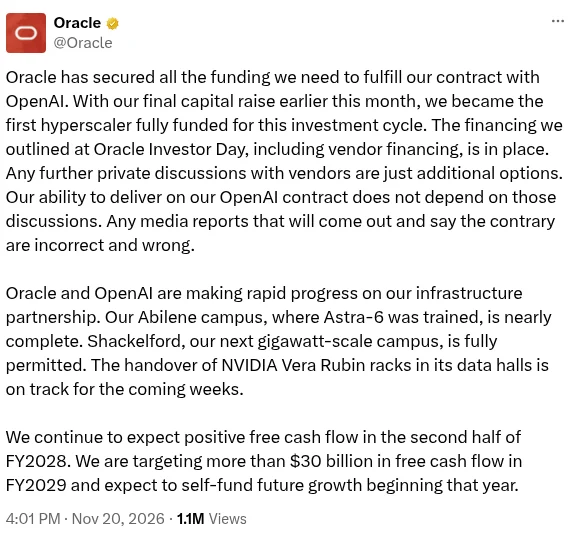
Oracle said on X that it has secured all the funding needed to fulfill its OpenAI contract, making it the first hyperscaler fully funded for this investment cycle, and that further vendor talks are just additional options. Reuters reported its shares rose as much as 3.3% after hours.
Screenshot of the original post · View full size ↗ Read the full report
With investors questioning AI infrastructure spending, Oracle spoke up directly. On November 20, the company said on its official X account that it had secured all the funding it needs to fulfill its contract with OpenAI, and that its final capital raise earlier this month made it the first hyperscaler fully funded for this investment cycle.
Oracle said the financing it outlined at its Investor Day, including vendor financing, is in place, that further private discussions with vendors are "just additional options," that its ability to deliver does not depend on them, and that "any media reports that will come out and say the contrary are incorrect and wrong." Reuters reported that Oracle announced a $20 billion capital raise earlier this month, about half stock and half debt, and that its shares rose as much as 3.3% in after-hours trading after the post.
The statement also gave a progress update: the Abilene, Texas campus where GPT-6 Astra was trained is nearly complete; Shackelford, its next gigawatt-scale campus, is fully permitted; and handover of Nvidia Vera Rubin racks is on track for the coming weeks. Oracle expects positive free cash flow in the second half of fiscal 2028 and targets more than $30 billion in free cash flow in fiscal 2029.
According to Reuters, Oracle and OpenAI plan 4.5 gigawatts of additional US data-center capacity beyond the initial Stargate site in Abilene. The statement came on a day when AI stocks were falling sharply amid worries about funding for AI infrastructure.
- 05
AI funding shrugs off the stock rout: Databricks reportedly in talks at a $225 billion valuation, Cognition at $75 billion
Databricks is in early talks to raise several billion dollars at about a $225 billion valuation, up nearly 20% from August's $190 billion, the Wall Street Journal reported. Separately, Bloomberg reported AI coding company Cognition is in talks to raise $2 billion or more at a $75 billion valuation, up from $48 billion two months ago.
Read the full report
On the same day US tech stocks tumbled, two AI software companies were reported to be raising money at higher valuations. According to Reuters, citing the Wall Street Journal, Databricks is in early talks to raise several billion dollars at a valuation of about $225 billion.
Databricks announced in August that it raised $5 billion at a $190 billion valuation, so the new figure would be nearly 20% higher. Founded in 2013, the company helps businesses store, manage and analyze data and build AI applications, competes with Snowflake, and is widely seen as a future IPO candidate. It has said its Lakebase product passed a $100 million revenue run rate and its data warehousing business passed $1.5 billion. The talks are ongoing and terms could change, the report said.
Separately, Bloomberg reported that Cognition, which develops autonomous software-engineering agents, is in funding talks at a $75 billion valuation and is considering raising $2 billion or more. About two months ago, Cognition raised a $2 billion Series E at a $48 billion valuation, led by Andreessen Horowitz and Accel.
Neither company immediately responded to Reuters. Public AI stocks are falling, but private investor demand for AI software companies has not cooled yet.
- 06
Can AI help medicinal chemists pick molecules? OpenAI launches MedChemBench, with GPT-6.2 Astra scoring 84.5%
OpenAI released MedChemBench, a medicinal chemistry reasoning benchmark of 99 problems drawn from 117 papers and patents, testing whether models can read molecular structures, interpret experimental results and choose which compounds to test next. At the xhigh setting, GPT-6.2 Astra scored 84.5% versus 58.2% for GPT-5.6 Sol.
Read the full report
One of the hardest steps in drug discovery is deciding which of many similar molecules to make and test next. On November 20, OpenAI released MedChemBench, a benchmark that checks whether AI models can help with this kind of medicinal chemistry work.
The difficulty is tradeoffs: a compound may strongly block a disease-related protein yet be poorly absorbed or break down too quickly. Chemists design, make and test related compounds, then decide what to try next. MedChemBench's 99 problems come from 117 published papers and patents and include 761 distinct molecular structures. Most problems give the model the context available at a point in a research program: the target, the goals, compounds studied so far and selected experimental findings.
Grading covers four components: correct molecular structures, explanations supported by the evidence, compound rankings and selections that meet requirements, and property predictions that match the source data. One problem, based on research into PRMT5 inhibitors studied in cancer, asks the model to predict three related compounds' cell potency, ability to cross a cell barrier and breakdown by liver enzymes, while the later experiments that revealed a tradeoff are withheld.
In OpenAI's results at the xhigh reasoning setting, GPT-6.2 Astra earned 84.5% of available credit, GPT-6 Astra 83.3%, GPT-6.1 Sol 82.0% and GPT-5.6 Sol 58.2%. OpenAI said GPT-6 Astra was strongest at reconstructing structures and explaining evidence, and found selecting compounds and predicting numerical properties harder. The scores are OpenAI's own, on a benchmark OpenAI designed.
- 07
A robot finally unfolds a T-shirt: third-party tests show GPT-6.2 Astra doubling its two-arm robot success rate in two months
Robotics infrastructure company XDOF reported Ember-0 results: GPT-6.2 Astra controlling a two-arm robot raised its average success rate on 16 tasks from GPT-6 Astra's 19.6% to 41.2%, and became the first model to complete rope knot tying and T-shirt unfolding. Average decision latency is still about 10 seconds.
Read the full report
General-purpose models directing robots through fine manipulation are getting more reliable. Robotics infrastructure company XDOF reported Ember-0 results showing OpenAI's GPT-6.2 Astra controlling a two-arm robot across 16 manipulation tasks with a combined success rate of 41.2%, up from 19.6% for GPT-6 Astra two months ago.
The standout was two deformable-object tasks: tying a knot and unfolding a T-shirt. According to QbitAI, Ember-0 had logged 143 valid T-shirt unfolding trials with no model succeeding before; GPT-6.2 Astra completed both tasks. Cloth and rope change shape with every grasp, so the robot must keep judging corners and folds from camera views, which is far harder than moving cups or boxes. XDOF said on X that Astra 6.2 improved on almost every task, with "pick up bread with a tong" rising from 10% to 90% success.
XDOF ran trials in parallel on six YAM workstations, repeated each task 30 times, and had humans label substeps, grasp failures and collisions. The 41.2% figure is an equal-weighted average over the 16 tasks. XDOF also said Ember-0 may soon be saturated, and OpenAI president Greg Brockman shared the result.
Limits remain: the hardware has no tactile feedback, and the model pauses for inference between action chunks. Average prediction latency fell from 15 seconds to 10.1 seconds, still slow for robots that need real-time adjustment.
- 08
A local personal assistant that runs a 125B model on a 12GB GPU: former DeepSeek-VL lead open-sources Linger
According to QbitAI, Simplex AI, founded by former DeepSeek-VL project lead Tony Zhang, open-sourced Linger, a personal agent that runs on the user's computer, turns email, calendars and meetings into a local knowledge base, and uses already-logged-in browsers and apps. The team says a 12GB RTX 3060 runs a 125B model at 45.5 tokens per second.
Read the full report
Linger offers an open-source take on an AI assistant with no per-token fees and data that stays on your machine. According to QbitAI, Tony Zhang, former project lead of DeepSeek-VL, announced Linger from his startup Simplex AI and released it as open source.
Linger lives on the personal computer rather than in a phone app, so it can use the Chrome sessions, email, calendar and apps you are already logged into without re-entering credentials, and you can take over when it gets stuck. Its core is an agent system called "Another Me" that each night organizes your inbox, calendar, chats and meetings into a local personal wiki, then decides when to alert you based on urgency. A client email on Monday asking for a quote by Friday might surface Wednesday morning, while a meeting time change is flagged immediately. Your feedback is turned into rules for next time.
Running large models on ordinary PCs relies on the team's PolyStrata inference engine for mixture-of-experts (MoE) models, which keeps the most-used experts in GPU memory, less-used ones in RAM and the rest on SSD, moving them as needed. The team says a PC with a 12GB RTX 3060 and 64GB RAM runs the 125B-parameter Qwen3.8-Flash-Next at 45.5 tokens per second, and an RTX 5090 reaches 179. Linger can also recommend and install a local model suited to the hardware.
The team also claims 95% accuracy on the LoCoMo long-term conversational memory benchmark. These performance figures are the team's own. Zhang previously worked on DeepSeek LLM V1 and later joined Zhejiang University as a faculty member.
- 09
Gemini can now make GIF memes: Google adds animated image generation, free in eight countries
According to IT Home, Google added GIF generation to Gemini, powered by the Gemini Omni 1.2 Flash video model, for looping animations and funny memes. It is available to all Google AI subscribers and free in eight countries including the US, Japan, South Korea and the UK.
Read the full report
Next time you want a reaction meme, you can ask Gemini to make one. According to IT Home, Google added GIF generation to Gemini, powered by the Gemini Omni 1.2 Flash video model, producing looping animations and funny memes.
It is simple to use: type a prompt in the main Gemini chat, or choose GIF in the image and video tools and describe what you want, then wait a moment for the result.
The feature is available to all Google AI subscribers and is free in the US, Japan, South Korea, Australia, Canada, the UK, Germany and France.
- 10
AI 'nudify' apps are still downloadable: three US senators write to Apple, Google and Meta, saying safeguards fall short
According to The Guardian, US Senators Ron Wyden, Ed Markey and Ben Ray Luján wrote to the CEOs of Apple, Google and Meta, saying AI 'nudify' apps used to make nonconsensual nude images still appear in app stores or are promoted through Meta ads, and children can easily reach them. All three companies said they ban and act against such apps.
Read the full report
All three companies' policies ban them, yet AI "nudify" apps are still in app stores. According to IT Home, citing The Guardian, US Senators Ron Wyden, Ed Markey and Ben Ray Luján wrote on November 18 to the CEOs of Apple, Google and Meta, saying their safeguards are not enough to keep such apps off their stores and platforms.
These apps turn photos of people into nude or sexual images without consent. Research cited by the senators found they still appear in Apple's and Google's app stores or are promoted through ads on Meta's platforms, and that children can easily access them. Wyden said AI has greatly increased the ability to create and spread such images, causing enormous harm to women and girls, while big tech companies are cutting the teams meant to protect users; if the companies do not crack down, Congress will need to act.
All three responded. Google said Google Play does not allow such apps and it proactively detects and removes them. Meta said it bans promotion of nudify apps, has taken steps including bans and legal action against advertisers, and has removed 92 million sexual ads. Apple said the research report does not reflect its current software and safety features, pointing to new teen protections and expanded parental controls.
- 11
Dozens of humanoid robots join a phone test line: AGIBOT's Genie G2 handles loading and test equipment at Lens Technology
AGIBOT and Lens Technology announced a strategic partnership deploying dozens of Genie G2 robots on a phone testing line for automatic loading and unloading and test equipment interaction. AGIBOT says the general-purpose robot works across multiple lines, cuts retooling costs and can be replicated at scale.
Read the full report
Humanoid robots in factories are moving from demos to batch deployment. According to IT Home, AGIBOT and Apple supplier Lens Technology formed a strategic partnership and deployed dozens of Genie G2 robots on a phone testing line, simultaneously loading and unloading test stations and interacting with test equipment.
The work covers phone testing stages such as MMI, antenna and camera tests, which are repetitive and change quickly with new models. AGIBOT says that, compared with traditional automation, the general-purpose Genie G2 can work across multiple lines, greatly reducing retooling costs, and can operate around the clock to ease labor shortages. The company says it has completed the full path from process adaptation and line integration to delivery and can replicate it across lines.
Genie G2 launched last October with an Nvidia Jetson Thor chip, force-controlled arms and 19-degree-of-freedom dexterous hands. In June it livestreamed tablet quality-inspection work at Longcheer's Nanchang factory, where AGIBOT claimed a 99.99% success rate. The efficiency and cost claims are AGIBOT's own.
- 12
Tencent's Hunyuan team takes questions on Reddit: small Hy models are on the roadmap, and 'overthinking' is the hardest behavior to fix
According to QbitAI, Yao Shunyu and Tencent's Hunyuan team held a Reddit AMA on Hy4 and Hy4 flash, saying small Hy models and a model for 24GB GPUs are planned and llama.cpp support is in progress. They said overthinking is the hardest behavior to improve in post-training, and agents had to be stopped from searching the web for ready-made answers.
Read the full report
Tencent's Hunyuan team went to Reddit, where many overseas developers gather, to answer questions directly. According to QbitAI, Yao Shunyu and the team held an AMA (ask me anything) early on November 21 about this month's flagship Hy4 and the faster, cheaper Hy4 flash.
Developers mostly wanted to know about running the models locally. The team said small Hy models are on the roadmap and a model targeting 24GB of VRAM is planned. Asked about a 96GB VRAM, 128GB RAM setup, they said it can run Flash, keeping main weights on the GPU and moving some expert layers and the Engram lookup module to system memory. llama.cpp support is in progress. Weights for both models are public.
They also discussed training pitfalls. Asked which behavior is hardest to improve in post-training, the team answered with one word: overthinking. Hy4's reasoning chains can run long, so Flash was distilled from the flagship and then trained with reinforcement learning to shorten them. The trickiest part of training long-horizon agents is loopholes in training environments that let the model game rewards, such as searching the web for an existing answer instead of doing the task.
The team said it is working on HyRA 3.0 and plans to train larger models, while acknowledging that using AI to do AI research, or recursive self-improvement, is still at an early stage.
- 13
Lean and Mathlib communities say they have verified the Claude-assisted Riemann Hypothesis proof and have 'full confidence' it is correct
In a joint statement endorsed by the Lean FRO and the Mathlib Initiative, the Lean and Mathlib communities said that after about a day of verification, both the statement and the proof in Levent Alpöge's 17-million-line Lean library for the Riemann Hypothesis, released November 20, are correct.
Read the full report
The Riemann Hypothesis claim has reached a key milestone: the communities behind the Lean theorem prover and its Mathlib library issued a joint statement saying they have verified Levent Alpöge's proof, have "full confidence" it is correct, and congratulated him.
Lean is a programming language that lets a computer check a mathematical proof line by line; Mathlib is its largest shared math library. According to the statement, Alpöge released the proof on November 20 as a Lean library of about 17 million lines that depends directly only on Mathlib. Over the past day the communities rallied to verify it and "hereby certify" that both the statement and the proof are correct, adding that the four criteria set out earlier on the Xena Project blog are all satisfied. The Lean FRO and the Mathlib Initiative endorsed the statement.
Alpöge produced the proof with Anthropic's Claude. For such a large machine-assisted codebase, the communities' endorsement of the statement as well as the proof means it proves the Riemann Hypothesis itself, not merely that the code compiles.
Formal verification shows the proof is logically valid; it does not mean mathematicians already understand its new ideas. The statement says the communities look forward to the mathematical community explaining them.
- 14
Amazon is nearing a $7.5 billion deal to buy AI startup Decart, which could come as soon as next week, FT reports
Amazon is in advanced talks to buy AI startup Decart for about $7.5 billion, with a deal possibly announced as soon as next week, the Financial Times reported Saturday. Israel's Calcalist earlier reported a mix of cash, stock and deferred payments, with the three founders committing to stay five years.
Read the full report
Amazon may be close to its biggest AI startup acquisition of the year. According to Seeking Alpha, citing a Saturday report by the Financial Times, Amazon is in advanced talks to buy San Francisco-based AI startup Decart in a deal worth about $7.5 billion that could be announced as early as next week. The FT report, as excerpted by Techmeme, says the acquisition would help AWS compete with Nvidia in the race for computing power.
More details came from Israeli business outlet Calcalist on November 18: Amazon is expected to pay more than $7 billion in cash, stock and deferred payments, with part tied to performance targets, potentially bringing the total near $7.5 billion; the original valuation range was about $5 billion to $6 billion. Founders Dean Leitersdorf, Orian Leitersdorf and Moshe Shalev have committed to stay for five years, a significant part of the payment is due only in the fifth year, and they agreed not to start a competing business.
Calcalist said changes to the deal's legal structure had delayed talks, but most outstanding issues were resolved over the past week. Decart is seen as one of Israel's most prominent AI startups; Calcalist first reported the sale talks in August.
Neither Amazon nor Decart has announced a deal, and final terms may differ.
- 15
FT and NYT dig into Alice Huang's network, tying it to Nvidia chip smuggling into China and military suppliers
According to TNW, the Financial Times reported Saturday that hundreds of shell companies and gaming firms linked to former Megaspeed executive Alice Huang formed a network moving Nvidia chips into China, involving an alleged Prince Group figure; a day earlier the NYT said about $3.6bn of Chinese state money flowed through firms tied to her family. Several parties deny wrongdoing.
Read the full report
The scandal that ended Jensen Huang's tenure as Nvidia CEO is turning into an export-control case. According to TNW, the Financial Times published an investigation on Saturday saying a network linked to Alice Huang moved Nvidia chips into China through gaming companies, hundreds of shell companies and a man US authorities call the "second-in-command" of Cambodia's Prince Group. A day earlier, The New York Times tied companies linked to her family to suppliers of China's military. TNW said it had not independently verified either report.
The FT traces the chain to Inspur, one of Nvidia's largest server partners in China. Inspur was put on the US entity list in 2023, but its US unit, renamed Aivres, kept trading with Nvidia. Some customers then turned to Century Huatong, a gaming group turned data centre investor, which set up an offshore "neocloud" called Megaspeed with Huang as its public face. Its Malaysian unit declared about $4.6bn of imports from Aivres in the year to December 2025.
The NYT, citing a confidential analysis by intelligence firm Strider, said about $3.6bn of Chinese state money flowed through companies tied to Huang's family or associates, funding projects including data centres with Nvidia chips. Most links are indirect, and it is unclear whether the military used the computing power.
Responses vary: Nvidia says it put Megaspeed on its block list in 2025 and restricted sales to Aivres; Megaspeed says it runs a lawful business and Huang left in August 2025; a Prince group spokesperson denied the allegations; Tencent, which owns 10.1% of Century Huatong, said it knew nothing of the activities. Jensen Huang resigned on November 12 after admitting an affair with Alice Huang; they are not related.
- 16
After longtime sellers close their shops, Etsy says it will revise terms letting it train AI on their work
According to The New York Times, Etsy's new terms let it and third-party partners use seller content to develop and train AI with no opt-out, prompting longtime sellers to close shops. An Etsy executive said it won't train AI designed to copy or replace sellers' work and will send revised terms soon.
Read the full report
An AI training clause has triggered a seller backlash at Etsy, and the company has backed down. According to TNW, citing a Friday report by The New York Times, Etsy will revise its new terms of use after several longtime sellers closed their shops.
The disputed terms, due to take effect on December 16, let Etsy and its "third party partners and vendors" use sellers' content to "develop, train, test and improve artificial intelligence and machine learning technologies." The previous version had no AI clause, the Times reported. Illustrator Aaron Millard said on Instagram he was deleting the shop he had run for nearly a decade and that sellers could not opt out; the owners of Cognitive Surplus, who sold home goods and stationery on Etsy for 13 years, also closed their shop.
James Ossman, Etsy's vice president for customer operations, wrote on Etsy's website this week that it will not use seller content to train AI models "designed to copy your original work or replace your creativity," and that third parties access content for uses such as fraud detection and advertising. He told the Times revised terms would be sent to sellers soon and that sellers' creative work belongs to them.
Critics remain skeptical. PC Gamer US editor-in-chief Tyler Wilde said the clause reads like blanket permission for any purpose and argued Etsy should exclude all sellers from AI training by default. The revised wording has not been published.
- 17
UN 'killer robot' talks end with countries agreeing only to 'start discussing options' over two years
According to The Verge, UN diplomats spent a week in Geneva negotiating rules for autonomous weapons but agreed only to 'start discussing options,' giving countries two years to propose rules, some of which may stay 'optional.' NPR reported Russia, Israel and the US were the main obstacles.
Read the full report
Another attempt to set rules for AI-driven autonomous weapons has stalled. According to The Verge, UN diplomats meeting in Geneva this week had rules for autonomous weapons, or "killer robots," on the agenda, but after a largely fruitless week they agreed only to "start discussing options."
Before the talks, the International Committee of the Red Cross, guardian of the Geneva Conventions, urged that legally binding rules be drafted within a year, a call backed by the UN secretary-general and Pope Leo. The compromise instead gives countries two years to propose regulations, and negotiations on which to adopt and how to enforce them will likely run well beyond that. Room was also left for some rules to remain "optional."
Humanitarian groups and some countries say binding rules are urgent because semi-autonomous weapons and drones have caused significant civilian deaths in conflicts including Ukraine, Gaza and Sudan. According to NPR, Russia, Israel and the US were the main obstructions: Russia delayed proceedings on day one by objecting to the agenda, and the US proposed a five-year window to discuss nonbinding, optional guidelines.
- 18
Users call GPT-6.2 'lazy'; OpenAI publishes prompts telling it to take authorized next steps instead of stopping to ask
After GPT-6.2's launch, many developers complained it answers too briefly and stops to wait for confirmation. OpenAI published copy-ready prompts in the model docs telling it to carry out authorized next steps and pause only for major scope changes, real blockers or irreversible actions, and advised revisiting old 'be concise' instructions.
Read the full report
In the days since GPT-6.2 launched, "lazy" has been the most common complaint. Developer Robin Ebers posted on X that it is the laziest model he has tested, saying every interaction ends with the model suggesting a step and waiting for confirmation; the post drew hundreds of likes. OpenAI has offered its own fix: according to The Decoder, it published copy-ready system prompts in the documentation for GPT-6.2 Astra and Sol to curb behaviors it observed in both releases.
OpenAI acknowledges that when user intent is unclear, GPT-6.2 sometimes suggests a next step and waits. Its template tells the model to carry out such steps itself whenever authorized, and to stop only for a significant change in scope, a concrete blocker, a decision the user must make, or before irreversible or destructive actions. When details are unclear, it should make reversible assumptions, flag them and keep working. OpenAI adds that higher reasoning effort helps it complete final checks on long tasks.
Style has changed too. OpenAI says Astra writes more briefly and directly by default, so developers should reconsider instructions such as "be concise." On long tasks the model sometimes carries shorthand from its reasoning or subagent messages into the final answer, so a template requires a fully self-contained final response.
The docs also note an API change: starting with GPT-6.2, the Responses API drops reasoning items after mid-conversation edits to history, certain model changes including downgrades, or changes of end user or organization, which can affect answer quality.
- 19
China's tech giants double AI spending to $139bn while model revenue is under 8%; NYT cites leaked call in which DeepSeek's Liang says it 'can't afford' the largest models
According to TNW, citing The New York Times, Rhodium estimates 13 listed Chinese tech firms will raise AI infrastructure capex 103% this year to 932bn yuan ($139bn), with AI lab revenue under 8% of it. The Times cited a leaked investor call in which Liang Wenfeng said DeepSeek can't afford to train the largest models.
Read the full report
China's AI race faces a money problem as well as a chip problem. According to TNW, citing a Friday report by The New York Times, China's biggest tech firms will double their AI spending this year while their AI labs bring in only a fraction of it.
The figures come from a Rhodium Group report on China's AI financing published in September. Rhodium surveyed 13 listed Chinese firms and expects their AI infrastructure capex to rise 103% this year to 932bn yuan ($139bn), and to exceed 1.2tn yuan in 2027; revenue from their AI labs covers less than 8% of this year's spend. It estimates annual recurring revenue across all Chinese AI models at about $10.7bn, roughly a tenth of what OpenAI and Anthropic report combined, and China's build-out at 15% to 20% of the US level. Co-author Logan Wright told the Times financing constraints "will be probably more decisive" than chip curbs in the long run.
Other details: Alibaba, Baidu and Tencent now have negative cash flows; China's STAR 50 index has fallen 43% since late July; by November about 20 providers charged less than Z.ai for its own open GLM-5.3 Flash model; and sellers on Goofish listed Nvidia's DGX B300 server for nearly $3m, about eight times the US price.
The most striking detail is a leaked investor-call transcript cited by the Times: DeepSeek CEO Liang Wenfeng said Huawei's chips are about two years behind Nvidia's, but DeepSeek would need four Huawei 950 chips to match one Nvidia GB300, adding, "We simply can't afford to train the largest models available right now." DeepSeek did not respond to the Times' request for comment.
- 20
Antigravity resets everyone's Gemini quota, saying caching improvements stretch each quota about 22% further
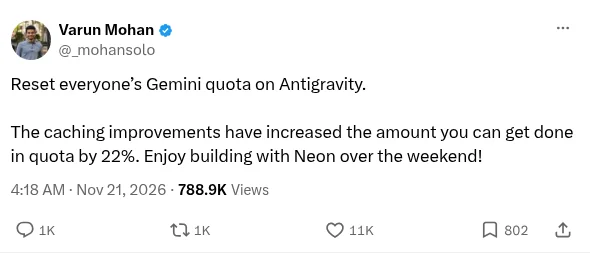
Varun Mohan, who says he is building Google's AI coding tool Antigravity at Google DeepMind, said on X that everyone's Gemini quota on Antigravity has been reset and that caching improvements have increased the work possible within a quota by 22%, encouraging users to build with Gemini 4 Neon over the weekend.
Screenshot of the original post · View full size ↗ Read the full report
Developers using Google's Antigravity have a fresh quota for the weekend. Varun Mohan (@_mohansolo), whose profile says he is building Antigravity at Google DeepMind, said on X on November 21 that everyone's Gemini quota on Antigravity has been reset.
He added that caching improvements have increased the amount users can get done within their quota by 22%. Caching means code and context the model reads repeatedly need not be fully reprocessed each time, so the same quota covers more requests. Mohan also told users to "enjoy building with Neon over the weekend," referring to Gemini 4 Neon, which Google released this week.
Quotas are among the most sensitive issues for users of AI coding tools. The post drew more than ten thousand likes. The 22% figure is Mohan's own claim, and actual gains will vary by usage.
- 21
AI group assistants remember but don't use memory well: Tencent Yuanbao and King's College London build a benchmark from 80,000 real group-chat messages
According to QbitAI, Tencent Yuanbao and King's College London's NLP team released GroupAssistBench, 2,395 questions built from 50 real group chats and 80,299 messages, separating memory recall from memory use. An external memory system that scored higher on recall fell well behind full-context reading on open-ended service tasks.
Read the full report
A nine-person travel group first agrees to leave on May 1, then switches to April 30, and the AI group assistant still sends ticket reminders for the old date. That is the problem Tencent Yuanbao and King's College London's NLP team set out to measure. According to QbitAI, they released GroupAssistBench to test whether AI assistants in group chats can move from remembering to using memory well.
The benchmark draws on 50 real group chats and 80,299 messages to build 2,395 questions on two levels: L1 tests recall with reference answers, such as the originally agreed departure date; L2 tests open-ended service, such as sending travel and ticket reminders, which must respect still-valid group decisions and individual members' constraints. Questions are also grouped by single memories, multi-memory integration, and updates and conflicts.
The study compared 14 configurations including full context, retrieval augmentation and external memory. In one telling contrast, the external memory system EverMemOS scored 0.621 on L1 recall, above full context's 0.570, but only 0.247 on L2 service, below full context's 0.431. Among memories recalled in L1 but not used well in L2, about 36% never reached the model's input and about 64% reached it but were not applied correctly.
The team tried two lightweight fixes: one organizes relations among people, events, times and decisions after retrieval; the other turns facts into reply constraints with subject, scope and current validity. The data was anonymized, and the public version excludes original chat identities.
- 22
How a team shipping 11,000 PRs a month codes with AI: Lauren Tan says don't start by adding rules to AGENTS.md
According to QbitAI, SpaceXSI engineer Lauren Tan's talk at the AI Engineer CODE conference spread widely online. She said the Grok Bot team shipped about 11,000 PRs last month by turning agent mistakes into lint rules, type constraints and architecture changes instead of natural-language rules in AGENTS.md, and shifting much review to screenshots, recordings and formal verification.
Read the full report
As AI writes code faster, how do teams keep quality up? According to QbitAI, Lauren Tan, a SpaceXSI engineer who previously worked at Cursor and now works on Grok Bot, shared her team's approach at the AI Engineer CODE conference, and the talk spread widely online. She said the Grok Bot team shipped about 11,000 PRs last month with a revert rate of about 0.5%.
Her core idea is to treat it as a trust problem: turning a low-trust environment for agents into a high-trust one. The code itself matters most: if a codebase is full of hacks and tech debt, agents treat them as conventions and copy them. She cited a lesson from Cursor, where agents patched architectural conflicts with timers and left long comments explaining why, which later agents then imitated, slowing the app. Her team now bans almost all code comments and uses lint rules to point out problems directly.
She stressed that when an agent writes bad code, the first reaction should not be adding "don't do this" to AGENTS.md, because natural-language rules depend on the agent choosing to follow them. Better options are lint rules, type-system constraints, or redesigning APIs that are easy to misuse; the team, for example, bans React's useEffect in product code.
For review, the team has shifted much of its code review to verification, looking mainly at screenshots, screen recordings, state diagrams and formal verification results, and has begun using TLA+ and Lean to check system states and algorithm correctness. The PR count and revert rate are the speaker's own figures.
GitHub projects
From GitHub Trending, with English descriptions where available. See each project for details. Trending does not imply a new release.
-
mvanhorn/last30days-skill ↗
AI agent skill that researches any topic across Reddit, X, YouTube, HN, Polymarket, and the web - then synthesizes a grounded summary