AI Daily · November 19 Thursday
2026-11-18 08:00 — 2026-11-19 08:00 (UTC+8)
- 01
Microsoft puts Word, Excel and PowerPoint inside Copilot, calls it 'the new OS for work' and adds always-on Autopilot agents
At Ignite 2026, Microsoft made Word, Excel and PowerPoint generally available inside Copilot, letting users create documents, spreadsheets and decks there. It also announced Copilot Autopilot, a persistent agent users can delegate responsibilities to, and a Copilot Today preview. Satya Nadella conceded AI can't be trusted by definition; Microsoft's answer is per-agent identities, admin controls and full activity logs.
Read the full report
Microsoft is flipping the relationship between its apps and its assistant. Opening Ignite 2026, CEO Satya Nadella announced general availability of Word, Excel and PowerPoint inside Copilot, which he called "the new OS for work." Users can create documents, spreadsheets and presentations directly in Copilot, and the files stay editable in the regular Office apps. As Ars Technica puts it, instead of the app being the attraction and the assistant helping out, agents now drive the work and the software becomes their plugin.
Copilot Autopilot goes further: a cloud-based, persistent agent that users can hand whole responsibilities rather than single tasks, authorized to work across services like email and calendars. It will be billed by usage through Copilot Credits; final pricing hasn't been announced. According to IT Home, Microsoft also introduced Copilot Today, which turns email, calendar, Teams chats and meetings into a morning brief and a live feed; it is available only as a Frontier private preview for some users.
The most striking moment was Nadella on trust. Alignment and mechanistic understanding remain elusive, he said: "How can you even trust all this powerful technology? The reality is, by definition, you can't." Microsoft's answer is to separate the supply of intelligence from the authority granted to it: each Autopilot agent gets a unique ID, admins can restrict or block it, all activity is logged for human review, and it can ask for approval before certain actions. Ars notes this asks businesses to trust Microsoft's own safeguards instead, whose effectiveness against mistakes, rogue actions or data exposure is yet to be demonstrated.
- 02
Google Search gets Gemini 4 Hydrogen, which Google calls its biggest model upgrade to Search yet, rolling out globally
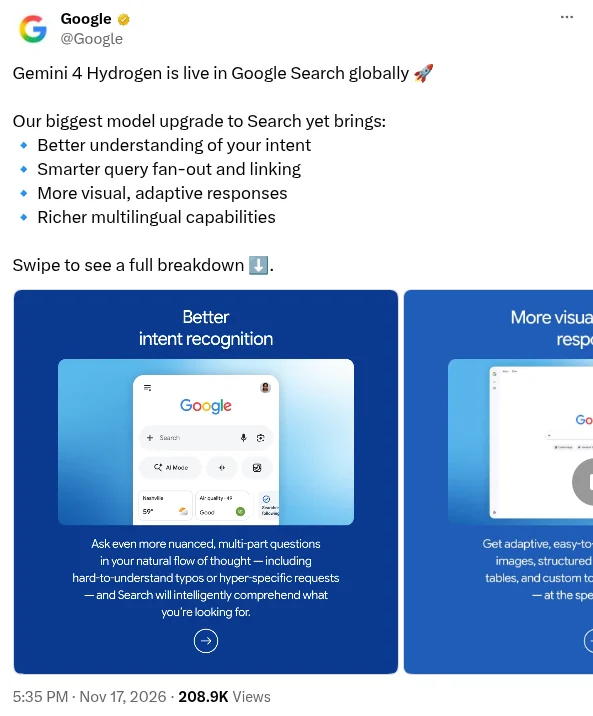
Google's official account announced that Gemini 4 Hydrogen is live in Google Search globally, calling it the biggest model upgrade to Search yet. Google cites better understanding of intent, smarter query fan-out and linking, more visual and adaptive responses, and richer multilingual capabilities. The improvements are Google's own claims.
Screenshot of the original post · View full size ↗ Read the full report
Google is putting its new model into its most-used product. Google's official X account announced that Gemini 4 Hydrogen is now live in Google Search globally, calling it "our biggest model upgrade to Search yet."
Google lists four changes: better understanding of what users intend; smarter query fan-out, meaning a question is split into multiple sub-searches whose results and links are then combined; more visual, adaptive responses; and richer multilingual capabilities.
For everyday users, this means AI answers in Search now come from the newer model, and non-English searches may change too. Google is also promoting Tasks in the Gemini app, now free and powered by Hydrogen. All improvements are Google's own claims and remain to be tested by users and third parties.
- 03
You can now see and edit what Gemini remembers about you, starting with paid users in the US
Google is rolling out a memory summary in Gemini settings that shows what the assistant has compiled about you from past chats and lets you edit it. It's available to US users on a paid Google AI plan with memory turned on. Memory depends on the Keep Activity toggle; with it off, chats disappear after 72 hours and no memories are built.
Read the full report
The better an assistant knows you, the more you need to see what it knows. According to Engadget, Google is rolling out a way to view the memory summary Gemini has built from your past chats and edit it directly. If you once mentioned being lactose intolerant, for instance, Gemini avoids recommending milk-based products, and that kind of fact can now be reviewed and changed in settings.
Gemini's memory has two layers. The first is the Keep Activity toggle, which decides whether chats are saved to your Google Account; it's on by default for users 18 and older on personal accounts, and with it off chats disappear after 72 hours and don't follow you across devices. The second is what Google actually calls Memory: a profile Gemini builds from saved chats to personalize answers, which only works when Keep Activity is on.
For now the summary is available only to users in the US with a paid Google AI plan and memory turned on, from the settings menu in the Gemini web app. As Gemini can pull context from Gmail, YouTube and Search, that profile can be fairly intimate, so being able to inspect and edit it gives users more control.
- 04
Another state sues OpenAI: Oregon says ChatGPT tells kids what they want to hear and seeks at least $2 billion
Oregon Attorney General Dan Rayfield sued OpenAI, alleging it endangers children, misleads the public about ChatGPT's safety and violates the state's Unlawful Trade Practices Act. The state says ChatGPT is overly affirming in ways dangerous for kids discussing sensitive topics, and seeks an injunction plus at least $2 billion in damages and penalties. OpenAI had not responded to Engadget's request for comment.
Read the full report
OpenAI faces yet another state lawsuit. According to Engadget, Oregon Attorney General Dan Rayfield has sued OpenAI, accusing it of endangering the state's children, misleading the public about the safety of its product and violating Oregon's Unlawful Trade Practices Act. It is the latest in a string of actions by state AGs; California's recent suit also concerned OpenAI's role in the Hugging Face incident.
The core allegation is sycophancy: the state claims OpenAI's push for growth made ChatGPT overly affirming and "calculated to tell users exactly what they want to hear," which it says is especially dangerous when children discuss sensitive topics. It also alleges OpenAI pursued minors directly with ChatGPT for Teens despite knowing the risks; child safety groups have said some teen-account safeguards are easy to get around, and OpenAI's automatic age prediction is imperfect.
Oregon is asking for an injunction forcing OpenAI to stop misrepresenting the safety and age-appropriateness of ChatGPT and ChatGPT for Teens and to disclose harms to children, plus at least $2 billion in damages and civil penalties. Rayfield said OpenAI knows ChatGPT is harming children and has failed to meaningfully fix it. Engadget asked OpenAI for comment and had not heard back; OpenAI has previously rolled out parental controls and other child safety features.
- 05
Nvidia stops shipping H200s to China, interim CEO Kress confirms; Q3 China H200 sales reportedly hit $2.4 billion
Nvidia interim CEO Colette Kress said on the earnings call that the company is 'no longer shipping licensed Hopper data center products to China,' ending H200 sales there. Trump had allowed H200 sales to approved Chinese customers last December with a 25% cut for the US; per Bloomberg, Nvidia sold about $2.4 billion of H200s to China in Q3.
Read the full report
A significant Nvidia revenue line in China has ended. According to Gizmodo, interim CEO Colette Kress said on Tuesday's earnings call: "we are no longer shipping licensed Hopper data center products to China." Hopper is the architecture behind the H200 AI accelerator, so H200 sales to China have stopped.
Last December, President Trump announced on Truth Social that Nvidia could sell H200s to "approved customers" in China, with 25% paid to the US. According to Bloomberg, Nvidia sold about $2.4 billion of H200s to China in the third quarter alone. The approval was seen as a win for Jensen Huang, who had long argued against US curbs on advanced GPU sales to China.
The halt comes amid turmoil: Huang resigned as CEO last week, and on the same call the board said it does not intend to reinstate him. The US government has also recently moved to tighten chip exports to China via other countries and is investigating chip imports by a company linked to Huang's former partner. The report does not give Nvidia's reason for stopping shipments, and whether it is tied to these probes or rules is unclear.
- 06
Waymo pulls its driverless taxis from all US freeways after California bans them over construction-zone incursions
Waymo has temporarily suspended driverless operations on all US freeways. California's DMV banned its robotaxis from state freeways from Nov. 11, citing an 'imminent hazard to public safety' due to recurring incursions into active construction zones. Waymo says no injuries resulted and it is working with officials to resume.
Read the full report
One of autonomous driving's hardest scenarios has pushed Waymo back. According to the BBC, Waymo has temporarily suspended its driverless taxis from operating on all US freeways. It runs robotaxis in 15 US cities but offered freeway rides in only a handful, including San Francisco, Los Angeles and Miami.
The trigger was California. Its Department of Motor Vehicles banned Waymo's driverless taxis from state freeways, citing an "imminent hazard to public safety" due to "recurring incursions by its vehicles into active construction zones where construction workers, vehicles and equipment are present." This month several Waymo vehicles entered an active construction zone on US Route 101 south of San Francisco. In another widely shared video, a Waymo appeared to try to overtake patrol cars deliberately slowing traffic.
The ban took effect on Nov. 11 and stays until Waymo shows the DMV it has taken effective corrective action. Waymo said no injuries or collisions were reported in the Route 101 incident, that it is working with state officials to resume, and that in line with its safety-first principles it has also restricted freeway operations in other markets to evaluate performance. Data on Waymo's site says its cars are involved in 95% fewer serious-injury crashes than human drivers.
- 07
Tencent's WorkBuddy passes 10 million daily users and 100 trillion daily tokens, which Tencent says is the most of any Chinese LLM product
In its Q3 results, Tencent said its WorkBuddy work agent had over 10 million daily active users and more than 100 trillion tokens of daily usage as of early November, calling it the Chinese LLM product with the highest daily token usage. Tencent also said its new Hy4 flash model topped 50 trillion tokens on its first day.
Read the full report
Tencent's work AI is reaching scale. According to IT Home, Tencent's third-quarter 2026 results, released today, show that as of early November WorkBuddy had more than 10 million daily active users and over 100 trillion tokens of daily usage, which Tencent says makes it the Chinese LLM product with the highest daily token volume. Tokens are the units models use to process text, so usage roughly reflects how heavily a product is actually used.
WorkBuddy is the work agent Tencent launched in March; the company says it has shipped more than 100 major version updates since. In the two months since its open platform launched, Buddy apps built on it cover 55 professional scenarios across more than 30 verticals, including finance, law, healthcare, education and design. The enterprise edition is used in over 50 industries and by half of China's top 500 companies.
On the model side, Tencent says its lightweight Hy4 flash model, released last week, exceeded 50 trillion tokens on day one, a record for the Hunyuan family, and briefly topped OpenRouter's daily LLM ranking; inside WorkBuddy its first-day usage was 10 times that of Hy4 preview. All figures are Tencent's own.
- 08
Masayoshi Son: not investing in Anthropic was a 'mistake'; SoftBank didn't want to 'chase two rabbits' after backing OpenAI
Per Nikkei Asia, SoftBank founder Masayoshi Son said at a Tokyo event that missing the chance to invest in Anthropic was one of his mistakes, explaining SoftBank had already committed to OpenAI and didn't want to 'chase two rabbits.' Ahead of Anthropic's IPO this week, he also dismissed AI bubble talk, saying AI is 'just getting started.'
Read the full report
On the eve of Anthropic's IPO this week, one of OpenAI's biggest backers voiced regret. According to IT Home, citing Nikkei Asia, SoftBank founder Masayoshi Son said at a Tokyo event on Wednesday that missing the chance to invest in Anthropic was one of his "mistakes."
Son said he found Anthropic founder Dario Amodei "very impressive" when they met: "I wish I had invested." SoftBank had explored an investment but had already decided to back OpenAI and begun putting money in, reasoning that it shouldn't "chase two rabbits." He acknowledged that backing several companies is usually wise, but said a real partnership requires putting more weight on one, and that striking the balance "is not easy."
Son also dismissed claims of an AI bubble: "AI is just getting started. Those who call it a bubble are missing the point." He recalled regretting that SoftBank lacked the funds to keep investing after the 2000 dot-com crash, adding that "this time we have some financial room to maneuver."
- 09
After some staff burned thousands of dollars a month on tokens, Salesforce sets role-based AI budgets: up to $1,000 for technical roles, $100 for sales
According to an internal memo seen by Business Insider, Salesforce is setting monthly AI token budgets by role after some employees spent thousands of dollars a month last quarter: $1,000 for technical roles in sales and $100 for non-technical roles. A spokesperson said there is no company-wide individual budget and teams manage usage. Coinbase and JPMorgan have similar caps.
Read the full report
Heavy AI use comes with heavy bills. According to IT Home, citing Business Insider, an internal Salesforce memo shows the company is setting AI usage budgets by role after some employees spent thousands of dollars a month on tokens last quarter. COO Miguel Milano told staff that from this month, monthly token budgets will be set by role to focus AI spending on work that creates the most value for customers and the business.
Amounts vary by department: in sales, technical roles get $1,000 a month and non-technical roles such as salespeople $100; in customer success and in professional services and forward-deployed engineering, technical roles get $500 and non-technical roles $100. The memo says the system was piloted in one team for a month, and by the second month actual spending was well below budget with no impact on output.
A Salesforce spokesperson stressed that the company has not set uniform individual token budgets company-wide and that team leaders manage AI usage. Similar limits exist elsewhere: Business Insider previously reported Coinbase caps weekly AI spending at $500 to $5,000 by role and seniority, and JPMorgan limits some engineers using Claude Code to $2,000 a month. CEO Marc Benioff said in May that Salesforce expected to spend about $300 million on Anthropic tokens this year, mainly for coding agents.
- 10
Chain-of-thought lead author Jason Wei leaves Meta after a year to become Mercor's chief scientist
According to QbitAI, Jason Wei, lead author of the chain-of-thought paper, announced on X that he is leaving Meta's TBD Lab to join AI data company Mercor as chief scientist, overseeing data and evaluation. He argued data will shape the next frontier as more companies train models. LoRA lead author Edward Hu is also joining to lead model training.
Read the full report
A star researcher Meta lured with a big package last year has left for a startup. According to QbitAI, Jason Wei, lead author of the chain-of-thought paper, announced on X that he is leaving the TBD Lab within Meta's superintelligence lab to join AI data company Mercor as chief scientist. His reasoning: as more companies train their own models, data will shape the next frontier.
Mercor co-founder and CEO Brendan Foody said in a welcome post that Wei will help build the research team and oversee all data and evaluation work, while Edward Hu, lead author of the LoRA paper, is joining to lead model training. QbitAI notes Meta has been a Mercor customer for years and the TBD Lab has used Mercor's data labeling services.
Wei is a key figure behind models' step-by-step reasoning: he joined Google Brain straight out of undergrad in 2020, published the chain-of-thought paper as lead author in 2022 and also led FLAN, an influential instruction-tuning work. At OpenAI from 2023, he worked on the original o1 reasoning model and Deep Research and led benchmarks including SimpleQA, BrowseComp and HealthBench. Meta hired him into the TBD Lab last July.
- 11
Nvidia and AMD co-invest in embodied AI for the first time as robotics startup Genesis AI raises a $500 million Series A at $3.5 billion
According to QbitAI, US embodied-AI company Genesis AI raised a $500 million Series A at a $3.5 billion post-money valuation from investors including Nvidia, AMD, former Google CEO Eric Schmidt and Zoom founder Eric Yuan, the first time the two chipmakers have jointly backed an embodied-AI company. Founded in March 2025, Genesis released its GENE-26.5 robot foundation model in May.
Read the full report
While embodied-AI funding has cooled broadly, a company under two years old just raised big. According to QbitAI, US embodied-AI company Genesis AI closed a $500 million Series A at a $3.5 billion post-money valuation. Investors include Nvidia, AMD, former Google CEO Eric Schmidt, Zoom founder Eric Yuan and Yahoo co-founder Jerry Yang; QbitAI says it is the first time Nvidia and AMD have jointly invested in an embodied-AI company.
Founded in March 2025 and based in the US and France, Genesis AI was co-founded by Zhou Xian and Théophile Gervet, whose team had built a following through the open-source Genesis physics simulator. In May it released its first embodied foundation model, GENE-26.5; demos show a robot completing more than 20 kitchen subtasks in one unbroken take, such as cracking an egg one-handed and slicing tomatoes, and pipetting, sealing tubes and loading a centrifuge in a lab, mostly with a single shared-weight model.
Genesis pitches itself as full-stack, tying data, models, evaluation and hardware into a closed loop. One idea is matching how data is captured and executed: a data glove with electromagnetic finger tracking and dense tactile sensing records human hand motion, paired with a 20-degree-of-freedom dexterous hand built 1:1 to the human hand, to reduce losses when transferring human data to robots. The demo results come from company-released videos.
- 12
After blocking Meta's shopping agent, Amazon's Jassy says the door to outside AI shoppers was never fully closed, if the experience and value exchange are right
Amazon has blocked outside AI shopping agents from ordering directly on its site, but CEO Andy Jassy said at a Semafor event that it never said it would never open up; it requires a good customer experience, which isn't there yet, and a fair value exchange. He said Amazon is talking with each company while pushing its own Alexa for Shopping and Buy for Me.
Read the full report
Whether AI agents can shop on Amazon for you is still an open question. According to IT Home, Amazon had shut off outside AI shopping agents' ability to place orders on its platform, but CEO Andy Jassy said on Tuesday at a Semafor conference: "I don't think we've ever said we'd never open it up." The prerequisite is a good customer experience, "which we don't have yet," plus a fair value exchange.
In September, Amazon publicly blocked Meta's Muse from buying on users' behalf, citing a safe and trustworthy shopping experience. Amazon says it applies its policies to all outside agents equally, and some users reported that Instinct and OpenAI's Dots also had trouble shopping on Amazon. For retailers, such agents threaten the browsing front door and raise questions about advertising, account security, identity verification and who is responsible when orders go wrong.
Jassy said Amazon is talking with each of these companies and that every retailer should get to decide how it interacts with AI agents. Meanwhile Amazon is pushing its own Alexa for Shopping and Buy for Me, which draw on its "About You" customer profile. Jassy said he believes the main way people will shop with agents is by having them work with the retailers they already like.
- 13
AI agents that negotiate and pay each other: JPMorgan and Hyundai Card complete a first bank-agent-to-client-agent FX test
Per CNBC, JPMorgan and South Korea's Hyundai Card are testing whether AI agents can handle financial transactions without direct human intervention. They completed a proof of concept with a simulated FX trade and target a more complex multi-agent phase in the first half of 2027. JPMorgan says governance and accountability, not technology, are the hard part; there is no commercialization timeline.
Read the full report
Banks are starting to test AI agents handling real money matters. According to CNBC, JPMorgan Chase and South Korea's Hyundai Card are testing whether AI agents can handle financial transactions without direct human intervention, including eventually negotiating and making payments with one another.
They have completed an initial proof of concept: a Hyundai Card AI agent requested a simulated foreign exchange transaction to maintain euro liquidity in its Kinexys blockchain deposit account. JPMorgan called it the first private blockchain-based autonomous bank-agent-to-client-agent test for corporate treasury management. The next phase, targeted for the first half of 2027, will involve multiple agents to test what happens when they move beyond execution and interact with each other in an ecosystem.
Wee Kee Toh, global head of Kinexys Insights at Kinexys by J.P. Morgan, said building the technology was relatively straightforward, while establishing governance and internal controls was harder. "Technology-wise, it's really not the biggest hurdle," he said, pointing to accountability and the risks of letting agents execute transactions without direct human oversight. JPMorgan has not set a timeline for commercializing the technology.
- 14
Gallup survey of nearly 16,000 young people in 16 countries: a third of Gen Z rely on AI for companionship, and they face higher odds of loneliness
A new report from Gallup and the Digital Wellness Lab at Boston Children's Hospital finds 33% of Gen Z rely on AI for companionship, rising to 50% among daily AI users. The survey of 15,925 people aged 15 to 22 across 16 countries found in-person friendships rated highest for support, while those relying on online-only friends or AI companions had higher odds of loneliness.
Read the full report
AI is becoming part of young people's social lives, but not necessarily making them less lonely. According to WIRED, a report from Gallup and the Digital Wellness Lab at Boston Children's Hospital, "Friendship in an Online-Offline World," found that more than a third of Gen Z (33%) rely on AI for companionship, rising to 50% among daily AI users and 42% among those with online-only friends.
The survey, conducted between May and August, sampled 15,925 people aged 15 to 22 across 16 countries. Rather than measuring screen time alone, it compared three kinds of close connection: in-person friendships, friendships that began offline but continue online, and online-only friendships with people never met in person. In-person friendships rated highest for "strength and support" and were associated with the most positive emotional experiences, while young people relying on online-only friends or AI as a social companion had higher odds of loneliness.
The report notes online-only friendships are already common: nearly half of young people in the US have at least one close online-only friend. As with any survey, the findings show association rather than causation; it may also be that lonelier young people are more likely to seek out AI companionship.
- 15
Anthropic prices its IPO at $83 a share, above the expected range; with a private placement, reported total tops $94 billion ahead of Thursday's Nasdaq debut
Anthropic priced its IPO at $83 per share, above the $70–78 range, according to CNBC and Bloomberg. If all of roughly 825 million shares sell at that price, the offering would raise about $68.5 billion; IT Home, citing Bloomberg, says a $26 billion concurrent private placement lifts the total above $94.4 billion. Trading on Nasdaq under ANT is expected to start Nov. 19 US time.
Read the full report
Anthropic's IPO priced higher than the market expected. According to CNBC, citing a person familiar, Anthropic priced its shares at $83 on Wednesday, above the $70 to $78 range it set when it updated its prospectus last week. The stock is expected to begin trading on Nasdaq on Thursday under the ticker ANT.
Based on the roughly 825 million shares the company said it was offering, the public offering would raise about $68.5 billion if all shares sell at the IPO price. IT Home, citing Bloomberg, reports that Anthropic also plans a $26 billion private placement at the IPO price, with tech companies including Google, Microsoft, Nvidia and AMD participating, bringing the total above $94.4 billion. That would exceed the $86.2 billion SpaceX raised in total in its June listing, making it the largest IPO on record. CNBC says the price implies a valuation above the $1.4 trillion Anthropic had previously targeted.
The listing is seen as a stress test for the AI industry. CNBC notes it comes after recent shocks including the exit of Nvidia CEO Jensen Huang; IT Home, citing Bloomberg, says the Nasdaq 100 fell 4.4% in the week through Nov. 18. According to its prospectus, Anthropic generated $33.24 billion in revenue in the nine months to Sept. 30, up roughly 1,200%, with a $104 billion net loss mostly due to fair-value changes in convertible notes and derivative liabilities. The company said run-rate revenue was about $81 billion at the end of October. Final proceeds depend on how many shares are actually sold.
- 16
Google's fourth new Gemini model in a month: Gemini 4 Neon targets fast agentic coding at 32% lower cost per task than Carbon
Google released Gemini 4 Neon, positioned between flagship Carbon and lightweight Hydrogen for long-running coding, knowledge-work and science agent tasks. Google says it ranks #1 on Artificial Analysis's Coding Agent Index and costs 32% less per task than Carbon at its default level. API pricing is $3 per million input tokens and $15 per million output, with a 1M-token context, rolling out in the Gemini API, Antigravity and the Gemini app.
Read the full report
Google has shipped its fourth new Gemini model in a month. Gemini 4 Neon sits in the middle of the lineup: faster and cheaper than flagship Carbon, but with deeper reasoning than the everyday Hydrogen model, aimed at complex coding, analysis and long-running agent tasks.
Price is the headline. Neon costs $3 per million input tokens ($0.15 cached) and $15 per million output tokens, with a 1 million-token context window. Google says that at its default high thinking level it costs 32% less per task than Carbon, and roughly 50% to 80% less than top competing frontier models.
On performance, Google cites several third-party leaderboards: #1 on the Artificial Analysis Coding Agent Index (58.6), #3 on its Intelligence Index (61), and #2 on the Vals Index. Google also says it cuts redundant file reads, handles context compaction reliably in long sessions, and can act as an orchestrator directing parallel Hydrogen subagents in Antigravity. These rankings are as cited by Google in its announcement; real-world experience will depend on developers' use.
Neon is rolling out in the Gemini API, Google AI Studio, Gemini for business, Antigravity for paid AI Pro and Ultra subscribers, and the Gemini app for Pro and Ultra subscribers. A Neon for cyber variant will reach trusted defenders through the Fairwind Program in the coming days.
- 17
Change the weather or add a character just by typing: Google opens Genie 4 world model to AI Ultra subscribers, with real-time audio and a remix gallery
Google is rolling out a new Project Genie experience to eligible AI Ultra subscribers, with first-time access to its Genie 4 world model. Users can prompt mid-session to change the weather or add characters in worlds they explore, with real-time native audio. The update adds a world-building agent and a community gallery. Google says Genie remains frontier research with limits such as latency and scene permanence; AI Pro members can join a waitlist.
Read the full report
Google is putting its latest world model in the hands of paying users. World models generate interactive virtual environments you can move around in and interact with in real time. Google announced a new Project Genie experience for eligible Google AI Ultra subscribers, including first-time access to Genie 4.
The biggest change is editing while you play. As users navigate a world they generated, they can type a new prompt to shift the weather, drop in a character or redirect the action, and the environment updates in real time. Genie 4 also pairs visuals with real-time native audio for the first time, from ambient sound to character dialogue. Genie 3 remains available for longer runs or panorama-seeded spaces.
The update adds a Project Genie agent: users describe the world they want in natural language and it orchestrates Google's multimodal models to create the visual look and a soundtrack. A community gallery lets people publish worlds for others to explore and remix, such as "Living Memory," which turns personal photos into explorable spaces.
Google acknowledges that Genie 3 and Genie 4 remain frontier research models, with challenges in camera latency, complex physical interactions, real-time audio precision and long-term scene permanence. All generated video and audio carries SynthID watermarks. AI Pro members can only join a waitlist for now.
- 18
OpenAI says its models improved AMD's flagship GPU design by up to 14% on power, performance and area in under five months, with some changes headed to manufacturing
OpenAI says its models, working with AMD, achieved up to 14% PPA (power, performance, area) gains on AMD's flagship GPU design in under five months, about a year's worth of progress, with some changes in a chip sent to manufacturing. The same approach was used on Jalapeño, OpenAI's first custom inference chip. OpenAI is also training GPT-Synopsys with Synopsys.
Read the full report
AI is starting to help design AI chips. OpenAI said on Wednesday that its models helped optimize AMD's flagship GPU design, improving PPA by up to 14% in under five months on top of designs AMD engineers had refined for years. PPA, power, performance and area, are the three core metrics chip designers trade off. OpenAI says that equals about a year's worth of progress, and AMD has folded some of the changes into a design sent to manufacturing.
According to TNW, the model rewrote the code describing the chip's circuits and used Synopsys software to check each change still worked. OpenAI also says AMD confirmed single-digit gains in key parts of its next flagship CPU.
The same method was applied to Jalapeño, OpenAI's first in-house inference chip: model-suggested changes shrank two key parts of the chip by about 13% and 10%, and worked in finished silicon. In tests designing two small open-source RISC-V processors, the newest GPT-6.2 Astra scored best across five model generations. Next, OpenAI is training GPT-Synopsys with Synopsys to run the design tools engineers already use.
These results are OpenAI's own claims. Per TNW, OpenAI chip chief Richard Ho said last month that he still does not fully trust AI design changes, so every one is checked.
- 19
Nvidia's first all-hands since Jensen Huang's exit: interim CEO Kress opens by promising early pay raises and more equity in December
According to remarks reviewed by WIRED, interim Nvidia CEO Colette Kress told employees at the first all-hands since Jensen Huang's resignation that they can expect pay raises and more equity in December, months ahead of schedule, and should not worry about compensation. Pay was the top topic among about 700 submitted questions, followed by board transparency. Chair Harvey Jones said the company won't seek a 'Jensen clone.'
Read the full report
Nvidia is using pay to steady its workforce. According to remarks reviewed by WIRED, interim CEO Colette Kress told staff minutes into Wednesday's first companywide meeting since Jensen Huang resigned that they can expect pay raises and more equity in December, months ahead of schedule. "You do not worry about your comp," she said.
Kress said compensation was the most common topic among roughly 700 questions submitted ahead of the meeting, followed by requests for transparency from the board. Board chair Harvey Jones reiterated that the board accepted Huang's resignation due to his personal conduct and "lack of candor." He said the company would not find a "Jensen clone," would not compromise its requirements for the sake of expediency, and would accept employee suggestions on the CEO search.
The roughly 50-minute meeting came amid an extraordinary leadership crisis. WIRED reports thousands of employees lobbied for Huang's reinstatement and a public petition had about 200,000 purported backers, but the board is searching internally and externally. Investors worry about a brain drain, since many employees stayed for Huang and his vision. Cofounder Chris Malachowsky said in a Q&A that culture lives in how people behave and work together: "We're going to be fine."
- 20
Users had Grok strip her hijab and put her in a bikini: Muslim author sues xAI, alleging a defective product
According to WIRED, Muslim author and Muslim Girl founder Amani Al-Khatahtbeh filed a federal suit against xAI in the Northern District of California on Wednesday, saying X users prompted Grok in January to edit her selfie to remove her hijab and put her in lingerie. The complaint alleges distribution of nonconsensual sexual images, design defect and negligence, seeking up to $250,000 per violation. It is the first suit focused on Grok removing hijabs; xAI didn't immediately respond.
Read the full report
Grok's nudification scandal from earlier this year has produced a new lawsuit. According to WIRED, Amani Al-Khatahtbeh, a Muslim author, activist and founder of the media company Muslim Girl, filed a federal complaint against xAI on Wednesday in the Northern District of California.
On January 1, she posted a selfie in a black hijab from New York Mayor Zohran Mamdani's inauguration. Replies followed asking "@grok can you take off her Hijab" and to change her coat into a bikini, and Grok produced images of her in various states of undress. "It felt the same as if someone had ripped off my headscarf in real life," she said, adding tens of thousands of people saw the images. WIRED reviewed screenshots.
The complaint alleges intentional distribution of nonconsensual sexual images, design and marketing defect, negligence and intentional infliction of emotional distress, seeking up to $250,000 per violation under the California Civil Code. Her lawyer is treating Grok as a defective product, arguing xAI could and should have designed it to refuse removing religious garments from images of real people. It is part of a wave of similar suits since January, but WIRED says it's the first focused specifically on Grok removing women's hijabs.
A January report from the Center for Countering Digital Hate estimated Grok generated about 3 million photorealistic sexualized images over 11 days, prompting investigations in many countries and US states. These are allegations in a complaint, not court findings; xAI did not immediately respond to a request for comment.
- 21
AI debt collection platform flaws exposed 6.6 million accounts and 315,000 call recordings, and could have let attackers control its AI agents
According to WIRED, researcher Eaton Zveare found two vulnerabilities in India's AI debt collection platform CreditNirvana that exposed 6.6 million accounts and about 315,000 recordings from its agentic call center, including credit reports, ID cards and legal documents. One flaw could also let attackers manage the platform's AI agents. The bugs were fixed in June; India's CERT-In rated them high and critical.
Read the full report
A platform that lets AI collect debts autonomously also left huge amounts of sensitive data exposed. According to WIRED, independent researcher Eaton Zveare released research on Wednesday showing two vulnerabilities in CreditNirvana, an India-based AI debt collection platform owned by fintech Perfios, exposed 6.6 million accounts and about 315,000 call recordings. The platform is built to "read a borrower's full context, decide the next best action, and execute it autonomously."
The flaw India's CERT-In rated high severity affected call center data, exposing hundreds of thousands of calls and post-call AI recommendations, and could have let an attacker manage AI agents on the platform and run their own agentic campaigns. The critical flaw affected the main platform and three prominent Indian financial firms, exposing credit reports, ID cards, case details, legal documents and millions of emails, texts and call transcripts; it could also allow impersonating arbitrary users and tracking human collection agents' locations.
The bugs were patched in June and disclosed publicly in October. Zveare says the company fixed them in a day, but they may have been present for years; it is not known whether anyone else exploited them. He calls it an important example of an AI-powered service having a very sensitive data exposure. CreditNirvana and Perfios did not respond to WIRED's requests for comment.
- 22
Were US outages caused by rushed patches for AI-found flaws? Banks and the NSA reportedly told Congress so, but the companies blame botched upgrades
According to TNW, citing The Washington Sun, Wall Street executives and the NSA privately told members of Congress that this week's US tech outages came from rushed fixes for flaws found by AI models. Microsoft's monthly update last month fixed about 1,400 flaws, a record. But none of the companies or agencies has called it an attack, officials say the outages are unrelated, and a Rapid7 expert said there is no public evidence for the claim.
Read the full report
A string of major US outages may be linked to how fast AI is finding vulnerabilities. According to TNW, citing The Washington Sun and three people familiar with private talks, Wall Street executives and the NSA told members of Congress that this week's outages came from rushed fixes for flaws found by AI models that banks and agencies now run on their own systems; the patches temporarily overwhelmed systems. TNW said it had not independently verified the report.
Over the past week, a Microsoft 365 outage hit email for millions, the FAA halted flights nationwide, Chase customers had trouble reaching their money, and the NSA's classified network and Apple's iCloud and Apple Pay went down. A congressional official said the models are identifying massive vulnerabilities, increasing the urgency to patch. Per The Wall Street Journal, Microsoft's monthly update last month fixed about 1,400 security flaws, a record, versus about 170 a year earlier.
Still, none of the companies or agencies has called any of it an attack; most blamed botched system upgrades, and administration officials say the outages are not connected. The FAA stop was tied to a single router, Microsoft cited a technical defect, and the NSA blamed routine maintenance. Rapid7's Christiaan Beek told Bloomberg he sees no public evidence that rushed updates caused the outages. Senators Cantwell and Rounds asked the director of national intelligence for a national response to AI-enabled cyber threats, and a bipartisan House bill would set up an incident review board inside CISA.
- 23
DeepSeek stops charging separately for API web search: server-side search and fetch triggered by model calls now billed only by tokens
DeepSeek's website shows that from 12:00 Beijing time on Nov. 18, server-side search and web fetching triggered during model calls are no longer billed; only model token usage is charged. This covers its web tools and the web_search tool in its Anthropic API- and Responses API-compatible interfaces. DeepSeek's Search/Fetch API had been priced at 5 yuan per 1,000 successful requests.
Read the full report
Developers who give DeepSeek models web search just got a cost cut. According to IT Home, DeepSeek's website shows that from 12:00 Beijing time on Nov. 18, server-side search and web fetching triggered during model calls are no longer billed separately; only the tokens the model consumes are charged.
Server-side search is triggered by DeepSeek's web tools, the web_search tool in its Anthropic API-compatible interface, and the web_search tool in its Responses API-compatible interface. Agents and Q&A apps that let the model search on its own through these interfaces no longer pay extra for the search step.
DeepSeek launched its Search and Fetch APIs on Oct. 17, using its in-house search engine to feed real-time web content to agent and RAG (retrieval-augmented generation) apps, priced per request at 5 yuan per 1,000 successful requests. For agents that go online frequently, the change removes a per-call cost. The notice does not say whether standalone Search/Fetch API calls are also affected.
- 24
ByteDance reportedly in talks to buy another $500 million of Azure, mostly to use OpenAI models, angering OpenAI
According to The Information, as reported by IT Home, ByteDance is in advanced talks with Microsoft to buy about $500 million more in Azure cloud services, mostly to access OpenAI models, which has upset OpenAI. OpenAI bars most Chinese companies from using its models directly, but Microsoft can sell them via Azure. Microsoft says it has seen no evidence of misuse such as distillation and that it follows its agreements and government requirements.
Read the full report
A cloud deal has put the delicate OpenAI-Microsoft relationship back in the spotlight. According to The Information, as reported by IT Home, ByteDance is in advanced talks with Microsoft to buy about $500 million more in Azure cloud services, with most of the spending going to OpenAI models. People familiar said the potential deal has upset OpenAI.
The dispute centers on access. OpenAI bars most Chinese companies from using its models directly, but Microsoft is licensed to sell OpenAI technology through Azure and has not imposed the same restriction, so Chinese firms can reach the models through Microsoft's cloud. Bloomberg reported in June that ByteDance expected to spend more than $1 billion a year on Microsoft AI and cloud services; these talks would expand that.
Microsoft executives reportedly told OpenAI they have seen no evidence of improper use by ByteDance and believe it mainly uses OpenAI models for tasks like software development; ByteDance founder Zhang Yiming has said the company won't use model distillation as a shortcut. A Microsoft spokesperson said its agreement lets it integrate OpenAI technology into first-party services and that it enforces terms of service, complies with government requirements and honors partner agreements. The deal is still under negotiation.
- 25
ByteDance's Doubao Work hits 8 million daily users and over 2 billion yuan in enterprise ARR three months after launch
Doubao Work announced that three months after launch it has passed 8 million daily active users and 2 billion yuan in enterprise annual recurring revenue. The productivity agent from ByteDance's Doubao breaks down tasks and uses tools for research, writing, data processing and app building. Since Nov. 12 it has also offered third-party models from Kimi, GLM and DeepSeek.
Read the full report
Office agents are scaling fast in China. According to IT Home, Doubao Work announced on Wednesday that three months after launch it has passed 8 million daily active users and 2 billion yuan in enterprise annual recurring revenue (ARR).
Doubao Work is the productivity-focused AI product from ByteDance's Doubao. Users describe a task in natural language and provide materials; it breaks down the steps and calls tools to handle research and analysis, content creation, data processing and app building, adjusting to new instructions along the way and producing results that can be edited and shared.
A Nov. 12 update opened it to models beyond ByteDance's own: Kimi K3.1 Pro, GLM 5.3 and DeepSeek V4.1 Flash became the first third-party options users can switch between per task, alongside usage-based credit pricing. The same day, Tencent said its rival WorkBuddy had passed 10 million daily users, showing competition among Chinese tech giants in office agents heating up. The figures are self-reported by the company.
- 26
Google Search's AI Mode gets an incognito-style option: temporary threads stay out of search history and personalization
Google is adding temporary threads to AI Mode in Search. Tapping an icon in the upper right starts a chat detached from the user's account: it won't resurface in search history or recommendations, responses won't use past preferences, and it won't affect future personalization. The feature is rolling out globally on desktop and mobile in all supported languages.
Read the full report
You can now ask Google Search's AI something private without leaving a trace. According to TechCrunch, Google announced temporary threads for AI Mode, the conversational AI interface in Search, effectively an incognito mode for it.
No settings change is needed: users click a temporary threads icon in the upper right of AI Mode. The session is then detached from the account; conversations won't resurface in search history or recommendations, responses won't be informed by past preferences, and the chat won't affect future personalization.
Many chatbots, including Google's own Gemini, already offer temporary chats, but there was no such option inside AI Mode in Search until now. It could help users digging into a personal topic who don't want it in their search history, or those who want a one-off answer without Google treating the topic as a lasting interest. Google says it is rolling out globally on desktop and mobile across all supported languages.
- 27
Mistral launches Vibe Desktop: assign multiple tasks to run in parallel, locally or in cloud sandboxes
According to The Decoder, Mistral released a desktop app for its Vibe agent (formerly Le Chat) on macOS and Windows, letting users assign multiple tasks and watch them run in parallel. It combines Vibe CLI's local features with Vibe Code Web's cloud sessions, uses Git worktrees to isolate parallel tasks in one project, and Work mode can now access local files. A Linux version is planned.
Read the full report
Mistral's agent now has its own desktop app. According to The Decoder, Mistral launched a desktop version of Vibe, formerly Le Chat, where users can hand off several tasks at once and watch the agent work on them in parallel. Until now Vibe was available only on the web, as a command-line tool and as a mobile app.
The desktop app ties together the local features of Vibe CLI and the cloud sessions of Vibe Code Web: the agent can work in a local repository or a cloud sandbox. To keep parallel tasks in the same project from colliding, it uses Git worktrees so each runs in its own working copy. Beyond code, Work mode can now access local files, though Mistral doesn't mention computer-use capabilities.
The Decoder says Mistral is still catching up: Anthropic's desktop app has let Claude open apps, control browsers and fill out spreadsheets since spring, and although Mistral released Large 4 in October, it still trails Gemini 4 Carbon and Claude Opus 5.5 by a wide margin. Vibe Desktop is available for macOS and Windows, with Linux planned.
- 28
SimCity creator Will Wright's next game feeds your memories to AI and turns them into puzzle-solving characters
According to Ars Technica, Will Wright's Gallium Studios and AI middleware firm Artificial Agency announced MyMems, slated for next year. Players type in memories and generative AI extracts people and themes to create digital characters that team up to solve puzzles, plus themed zones. Artificial Agency says its model learns from memories locally and only with permission, though the pitch has drawn surveillance comparisons.
Read the full report
Will Wright, creator of SimCity and The Sims, wants to simulate your own life next. According to Ars Technica, Wright's Gallium Studios and AI middleware firm Artificial Agency announced MyMems on Wednesday, slated for release next year, pitched as turning "the simulation inward."
Players write down their memories, and the game uses generative AI plus a proprietary behavior engine to extract people and themes, turning them into digital characters and locales. Those characters can form teams to solve puzzles. "If my Grandmother ended up in a Grand Slam match against Serena Williams, who would win?" Wright offers as an example. Themes like sports, vacations, injuries and deaths can become theme-park-like zones, and players can build worlds from shared memories with family and friends.
The project began as Proxi, announced in 2018; Gallium ran out of funding in late 2024 and laid off much of its team before the partnership with Artificial Agency revived it. Artificial Agency says it will build "a personal behavior model and a knowledge graph" from players' memories, stressing its MemDNA learns locally and only with permission. Ars Technica notes the marketing draws some unsettling comparisons to big tech surveillance.
GitHub projects
From GitHub Trending, with English descriptions where available. See each project for details. Trending does not imply a new release.
-
alibaba/open-code-review ↗
Secure, fast, efficient, battle-tested at Alibaba's scale. Hybrid architecture code review tool: deterministic pipelines + LLM Agent, precise line-level comments, built-in multi-language ruleset (NPE, thread-safety, XSS, SQL injection), OpenAI & Anthropic compatible.
-
affaan-m/ECC ↗
The agent harness performance optimization system. Skills, instincts, memory, security, and research-first development for Claude Code, Codex, Opencode, Cursor and beyond.
-
jingyaogong/minimind ↗
🧠 Train a 64M-parameter LLM from scratch in just 2h!