AI Daily · November 16 Monday
2026-11-15 08:00 — 2026-11-16 08:00 (UTC+8)
- 01
Korea's top tax-accountant exam scorer, who missed 1 of 160 questions, admits sending exam photos to AI; presidential office meets on countermeasures
According to Yonhap, the top scorer in this year's Korean certified tax accountant exam turned himself in to police, admitting he used a micro camera to send questions to a generative AI and got answers via smartphone in the tax accountant and CPA exams. The presidential chief of staff said a meeting on countermeasures would be held on Nov. 15, with the national college entrance exam on Nov. 19.
Read the full report
A Korean exam candidate with a near-perfect score has turned fears about AI cheating into a real case. According to Yonhap, as cited by IT Home, the top scorer in this year's certified tax accountant exam turned himself in to police on Nov. 15, admitting he photographed questions with a micro camera, sent them to a generative AI and received the answers on a smartphone.
His results had already drawn suspicion: he missed just one of 160 multiple-choice questions in the first round and got perfect scores in three of four subjects (97.5 in public finance; 100 in introduction to tax law, introduction to accounting and commercial law). After he published his scores, people online questioned whether he had used AI devices. He reportedly told a lawyer in an interview that he cheated this way in the April and July rounds of the tax accountant exam and in the first round of the CPA exam.
The case has reached the presidential office. South Korea's presidential chief of staff said a meeting chaired by the chief of policy would be held on the afternoon of Nov. 15, and with the national college entrance exam set for Nov. 19, authorities are working on preventive measures.
The method was simple: a hidden camera plus a general-purpose AI that can read images and solve questions was enough to top a professional licensing exam. It suggests that conventional no-phone rules may not be enough against wearable devices combined with real-time AI. The case remains under police investigation.
- 02
After Nvidia: Huang is reportedly helping pick his successor (WaPo), while Politico says Silicon Valley expects a comeback
The Washington Post, citing a source, reports that Jensen Huang, who resigned as Nvidia CEO, is quietly involved in the succession process and has spoken with at least one candidate. Politico, citing Silicon Valley insiders, says many expect him to return to a leadership role, though hiring by a large public company faces resistance and starting a new company is seen as easier.
Read the full report
Jensen Huang has left the Nvidia CEO post, but his influence over the company and Silicon Valley may not be over. Two U.S. reports over the weekend point to his lingering role at Nvidia and to speculation about what he does next.
According to The Washington Post, as cited by IT Home, a source said Huang, while keeping a low profile, is taking part in the succession process and has spoken with at least one potential candidate. The report quotes Harvard Business School professor Andy Wu calling it "the hardest CEO vacancy to fill in the past 10 to 20 years," given Nvidia's highly technical chip business and its reach into autonomous vehicles and robotics. Tae Kim, author of "The Nvidia Way," argues that Nvidia's future depends partly on keeping the senior executives Huang developed.
Separately, Politico, as cited by IT Home, reports that several Silicon Valley executives and insiders expect Huang to make a comeback. Anduril founder Palmer Luckey and Perplexity CEO Aravind Srinivas have defended him publicly, and Elon Musk has floated recruiting him. Five insiders said they expect a high-profile return, but others noted that, after the controversy and congressional hearings, large public companies would face resistance hiring him as an executive, and that starting a new company with his own capital would be easier.
These claims come from anonymous sources and insiders' expectations; neither Nvidia nor Huang has publicly addressed his role in the succession or his plans.
- 03
TechCrunch asks "Where was Nvidia's security team?": its CSO left in August, and a former intelligence officer says such risks are hard for corporate security to catch
TechCrunch notes that Nvidia's longtime chief security officer David Reber left in August for health reasons, two and a half months before Jensen Huang resigned over relationships, including one with an executive at a Singapore company U.S. investigators suspect of funneling chips to China. It asks what security knew, while stressing nothing public links the two.
Read the full report
Amid the fallout from Jensen Huang's exit, an overlooked detail has surfaced: Nvidia's chief security officer had already left in August. A TechCrunch analysis on Saturday asks how much Nvidia's security team knew about the risks.
According to TechCrunch, David Reber, who spent seven years at Nvidia and four as CSO, said on LinkedIn in late August that he was leaving for health reasons, disclosing a diagnosis of young-onset Parkinson's more than two years earlier. His replacement, Saša Zdjelar, spent 17 years at ExxonMobil before stints at Salesforce and ReversingLabs. Two and a half months later Huang left over his extramarital relationships, starting with an executive at Megaspeed, a Singapore data center company that U.S. investigators suspect of funneling Nvidia chips to China (Megaspeed denies wrongdoing).
TechCrunch says nothing public connects the security leaders' role changes to the Megaspeed matter, but argues it is fair to ask what the security team knew about government scrutiny of Megaspeed and Huang's relationships, and whether anyone raised concerns. Reber and Zdjelar did not respond, and Nvidia did not answer related questions.
The piece quotes retired senior intelligence officer Nicholas Eftimiades, who says intelligence services gather much information through everyday conversation rather than hacking, which most corporate security teams are poorly equipped to catch. It also notes The New York Times reported that Nvidia's top lawyer engaged with the government's Megaspeed inquiry more than a year ago.
- 04
MathArena has a new leader: Gemini 4 Carbon passes GPT-6.1 Sol, at roughly 15 times the cost
According to The Decoder, Google's Gemini 4 Carbon has taken the top spot on the MathArena AI math benchmark, with Anthropic's Claude Fable 5.2 second, pushing OpenAI's GPT-6.1 Sol off first place. Under the reasoning settings used, Carbon and Fable 5.2 cost roughly 15 and 40 times as much as GPT-6.1 Sol.
Read the full report
For the first time in a while, a non-OpenAI model leads the MathArena math benchmark. According to The Decoder, Google's Gemini 4 Carbon is now first, knocking GPT-6.1 Sol from the top, with Anthropic's Claude Fable 5.2 in second. MathArena evaluates models on competition-level math problems and is widely watched as a gauge of reasoning models' problem-solving.
The scores come at a price. The Decoder reports that with the reasoning settings used in testing, Gemini 4 Carbon and Fable 5.2 cost roughly 15 and 40 times as much as GPT-6.1 Sol. For developers running large volumes, the strongest model and the most cost-effective one are not the same.
Testing also revealed Carbon's temperament: its most common failure mode was exceeding the time limit, and it almost never gave up on a task. In one case it launched a script that ran for more than eleven hours without checking on progress, persistence that can help on hard problems but hurt under time and cost limits.
The report notes that OpenAI's newer models, which reportedly solved demanding problems such as the Navier-Stokes equations, are not publicly available, so the ranking reflects publicly available models only.
- 05
Claude Code's experimental Code Mode goes viral: Claude writes JavaScript to batch tool calls, but the '37% fewer tokens' claim is misattributed
Since v2.1.323, Claude Code includes an off-by-default experimental Code Mode in which Claude writes JavaScript to run several tool calls at once instead of one at a time. The docs list limits such as terminal-only use and a 10-minute code timeout. Several developers note the viral '37% fewer tokens' figure comes from Anthropic's 2025 API test of a different feature; the Code Mode docs give no savings figure.
Read the full report
An experimental Claude Code feature became a weekend talking point among developers. According to the official docs, with Code Mode on, Claude no longer requests Bash, Read or Edit one call at a time and reads each result before deciding the next step. Instead it writes a piece of JavaScript that makes the tool calls in one step: it can run commands in parallel, feed one result into the next call and return only the output Claude needs to read.
The docs suggest trying it on tasks with many related tool calls, such as a change repeated across many files, a search whose results need filtering, or several independent commands that can run together. It requires v2.1.323 or later and the environment variable CLAUDE_CODE_EXPERIMENTAL_CODE_MODE set to 1; a cloned repository's project settings can't turn it on, and organizations can disable it through managed settings.
The limits are explicit: it works only in interactive terminal sessions, not with -p, the Agent SDK, the VS Code panel, the Desktop app or cloud sessions; code stops after ten minutes unless it runs in the background; and it can't be used with Remote Control, Claude in Chrome or computer use. Anthropic says the feature is experimental and may change or be removed.
Misinformation spread alongside it. Many posts claimed Code Mode saves 37% of tokens, but several developers pointed out that the Code Mode docs give no savings figure; the 37% matches Anthropic's November 2025 test of Programmatic Tool Calling on the API (43,588 to 27,297 tokens on complex research tasks). Some users report their own small tests showing 40% to 55% savings. Developer Rhys Sullivan compared implementations: Claude Code runs code with node:vm in-process in Bun, Codex uses V8 and OpenCode a custom interpreter.
- 06
After a near-day-long Microsoft 365 outage, customers push for SLA credits, but credits cover only affected services and must be claimed by Dec. 31
A recent global Microsoft outage lasting nearly a day hit Outlook, Exchange, Teams and SharePoint. According to Neowin, many customers on Reddit are urging SLA credit claims. Under Microsoft's rules, credits apply only to the services and time actually affected, not the whole subscription, and must be filed by Dec. 31, 2026.
Read the full report
After a global outage lasting nearly a day, Microsoft customers are tallying the cost. According to IT Home, drawing on Neowin, Microsoft's recent large-scale service disruption affected Outlook, Exchange, SharePoint and connected platforms, and some affected customers are now seeking compensation.
Many managed service providers have gathered in a thread on Reddit's r/msp urging affected customers to file service level agreement (SLA) claims: submit the incident IDs, tenant GUID and evidence of the outage through Microsoft Partner Center from their own company domain. Among Microsoft's incident IDs, EX1550543 covers the Exchange Online failure affecting mailbox access and email; MO1550821 covers broader Microsoft 365 problems including Teams, SharePoint, Defender XDR, Intune, Planner and Power BI.
Getting credits won't be easy. Per Microsoft's documentation, credits depend on the specific affected service and outage duration; even with a multi-service Microsoft 365 subscription, customers can claim only for services that qualify, not the whole bundle. Approved credits appear on the next bill, and for non-Azure services claims must be filed within one month after the end of the billing month of the incident, which puts the deadline at Dec. 31, 2026.
Japan was hit hard. According to The Japan Times, as cited by IT Home, the outage began on the morning of Nov. 13 Japan time, affecting government information systems and IT services at universities including Kyushu University and Waseda; one user said that with email down, their company sent routine updates normally shared as PDFs by fax instead.
- 07
SamMobile: Samsung's One UI 9.5 to add a system-level AI agent that can schedule meetings, track replies and update your calendar
According to SamMobile, Samsung is designing a feature called Personal Agent Core to bring a system-level AI agent to high-end Galaxy phones and tablets with One UI 9.5, handling multi-step tasks in natural language, such as checking a calendar, setting up a meeting with a contact, tracking replies and adding it to the calendar. Samsung has not announced it.
Read the full report
Samsung's phone assistant may move from answering questions to getting things done. According to SamMobile, as cited by IT Home, One UI 9.5 will bring a system-level AI agent to high-end Galaxy phones and tablets through a feature called Personal Agent Core, designed to integrate the assistant deeply with built-in apps.
Unlike a traditional voice assistant, the report says it can manage multi-step workflows through conversation and follow up proactively. A user could ask it to check the calendar, arrange a meeting with a contact, track the reply and add the plan to the calendar once confirmed. It can also gather emails, deliveries and reservations into one overview, an apparent extension of the existing Now Brief feature.
The system can reportedly work across Google and One UI apps, drawing on contacts, email, messages and recorded calls to identify meeting commitments and to-dos from past conversations. Users could also adjust settings, control media, manage notes, send emails and messages and set alarms in natural language, and turn call, lecture and meeting recordings into transcripts and actionable summaries.
This information comes from a media report; Samsung has not officially announced One UI 9.5's features or timing, and final capabilities and supported devices may change.
- 08
Australia's central bank: AI's labor impact is showing up first among young workers in software and customer service
According to The Decoder, an analysis for the Reserve Bank of Australia built a monitoring system for AI's job effects and found job postings have fallen since ChatGPT launched, most steeply in the most AI-exposed occupations, where 15- to 24-year-olds and recent graduates fare worse. The author cautions it does not establish causation; business cycles and remote work may also explain it.
Read the full report
AI has barely displaced jobs in Australia so far, but young people entering the workforce may already be feeling it. According to The Decoder, an analysis by Mike Major for the Reserve Bank of Australia (RBA) focuses on where effects are likely to appear first: entry-level workers and highly AI-exposed occupations such as programming, clerical work and customer service.
The analysis finds job postings have fallen across all groups since ChatGPT launched in late 2022, with the steepest drop in the highest-exposure group. Within that group, workers aged 15 to 24 and recent graduates show weaker employment and higher unemployment than older workers.
Major cautions against early conclusions: the study does not establish direct causation and measures theoretical exposure, not actual use by companies; post-pandemic business-cycle shifts and remote work trends could also drive the numbers. SEEK data suggests AI is complementing existing work while creating new demand for AI skills.
The findings echo U.S. research. The report notes an August 2025 Stanford study based on payroll records found employment among 22- to 25-year-olds in AI-exposed occupations fell 13% in relative terms, and nearly 20% among young software developers; a March 2026 Anthropic study found job-finding rates for that age group down about 14%, with no systematic rise in overall unemployment.
- 09
A 97KB underwater world in the browser: developer says Claude wrote all the code, with kelp forests, shipwrecks and fish generated on load
According to XDA, a developer used Claude to build Abyssal Garden, a 97KB browser-based underwater exploration project in which kelp forests, a shipwreck, manta rays, fish schools and light beams are all generated by code at page load. The developer says one prompt produced a base version, with a main menu, collision detection and quality settings added later. The code is on GitHub.
Read the full report
With no image assets, a 97KB web page can generate an explorable underwater world. According to XDA, as cited by IT Home, developer Any-Reputation8118 used Anthropic's Claude to build Abyssal Garden, a browser-based underwater exploration project in which every visual element is generated by code when the page loads.
The demo shows kelp forests, a shipwreck, a stone whale-tail sculpture, manta rays, schools of fish and light beams from the surface, all with a high level of polish. Because the scene is procedurally generated, computed by code rather than drawn in advance, the file can stay tiny.
The developer says Claude wrote all of the code and even checked it to avoid visual glitches. A single prompt produced the base version, and follow-up prompts added a main menu, collision detection and graphics settings. The code is public on GitHub.
Cases like this show that individual developers can quickly build visually polished small interactive works with AI coding, though the number of prompts and the extent of manual edits rest on the developer's own account.
- 10
WSJ: Megaspeed, the firm linked to Jensen Huang's ex-lover, arranged nearly $12B in Nvidia chip orders for Chinese buyers; the company denies the claims
Citing documents reviewed by the Wall Street Journal, The Decoder reports that Singapore cloud firm Megaspeed arranged nearly $12 billion in Nvidia high-end chip orders for Chinese companies between March 2024 and June 2025. Megaspeed says Alice Huang left in August 2025 and that the allegations lack verifiable evidence.
Read the full report
The scandal around Jensen Huang's exit is shifting from his private life to chip export controls. According to documents reviewed by the Wall Street Journal, as reported by The Decoder, Singapore cloud company Megaspeed arranged nearly $12 billion worth of Nvidia high-performance chip orders for Chinese companies between March 2024 and June 2025, covering several hundred thousand chips the US had sought to keep out of China. Megaspeed is controlled by Alice Huang, the former lover of ousted Nvidia CEO Jensen Huang.
The chips reportedly went to buyers in China with long-standing ties to local tech giants. As an Nvidia cloud partner, Megaspeed apparently gained preferential access to scarce AI chips because it counted Alibaba as a major client. For comparison, Nvidia officially reported $12.4 billion in China revenue over six months, 7% of the total, while short seller Culper Research estimates more than 20% of Nvidia's revenue last fiscal year came from Chinese customers, much of it possibly via indirect channels.
Megaspeed responded on Sunday. Citing Reuters and the South China Morning Post, The Decoder and TNW report the company said Alice Huang officially left on August 30, 2025 and has no current role, that it conducts "legitimate and lawful business," that the allegations about its supply chain are not supported by verifiable evidence, and that it has hired outside lawyers for an internal investigation. Singapore's home affairs ministry, however, said police had investigated her as the then CEO, chairperson and a key controller, and found she knowingly gave inaccurate information to downplay her role; she left Singapore in February 2026 and is barred from returning.
Nvidia says it cut off Megaspeed in 2025. Claims that Alice Huang is a Chinese spy stem from suspicions by US officials and have not been confirmed; Beijing denies them.
- 11
FT: Jensen Huang is discussing a return to Nvidia, while Treasury Secretary Bessent demands a 'dramatic shakeup' and an outside CEO
Citing the Financial Times, TNW reports Jensen Huang has been discussing a possible comeback days after being pushed out, with some investors lobbying for it. Meanwhile, Treasury Secretary Scott Bessent told Fox News Nvidia needs a 'dramatic shakeup' and an outside CEO, questioning whether it pushed seemingly illicit chip sales to boost earnings.
Read the full report
Nvidia's CEO seat is turning into a tug-of-war between Silicon Valley and Washington. Citing the Financial Times, as relayed by Bloomberg on Sunday, TNW reports that Jensen Huang has been discussing a possible return as chief executive days after the board pushed him out. Several Silicon Valley allies have begun lobbying, including two Nvidia investors: Altimeter's Brad Gerstner and Atreides' Gavin Baker, who earlier urged the board in an open letter to choose a successor slowly and consider "the potential return of Jensen Huang."
Washington is pulling the other way. According to CNBC, Treasury Secretary Scott Bessent told Fox News on Sunday that Nvidia needs a "dramatic shakeup," that its board should look outside the company for the next CEO, and that other executives should face scrutiny over export-control compliance. "I want to keep coming back to what was the culture at Nvidia, and were they pressing these seemingly illicit sales to goose their revenues and their earnings?" he said, adding that if a bank had such compliance failures, regulators would already be in and many executives removed.
Bessent also questioned Nvidia's disclosures, pointing to a surge in reported Singapore revenue as China sales fell; Nvidia stopped reporting Singapore revenue separately in November 2025, citing a switch to counting by customer headquarters rather than billing address. CNBC says a feud between Bessent and Commerce Secretary Howard Lutnick over chips reaching China is deepening; both are expected to accompany President Trump to China this week.
Any comeback faces hurdles: the board's inquiry, run by law firm Wachtell Lipton, is ongoing, and Huang is expected to testify before Congress. Nvidia reports results on Tuesday under interim CEO Colette Kress. Neither Huang nor Nvidia has publicly addressed the return reports.
- 12
Bloomberg: Nvidia raised concerns with Taiwan officials after one of its managers was indicted in a chip-smuggling case, and was rebuffed
Citing Bloomberg, TNW reports that after Taiwanese prosecutors indicted an Nvidia manager surnamed Chang in a server-smuggling case, Nvidia representatives told political officials they disagreed with the charges and he should not be investigated; officials said they had no role. Nvidia says its probe found no sign the employee knew of the diversion.
Read the full report
Another thread has emerged in Nvidia's export-control troubles. Citing Bloomberg, TNW reports that after Taiwanese prosecutors charged one of Nvidia's managers in a chip-smuggling case, Nvidia representatives raised concerns with political officials, saying they disagreed with the charges against the manager, surnamed Chang, and that he should not be under investigation. The officials replied that they had no role in the case.
Chang was reportedly detained in July and indicted in August on forgery and breach-of-trust charges. Keelung prosecutors call him the core figure in a network that sent 74 servers with Nvidia chips to China, with another 56 seized. They allege he helped win Nvidia's approval to sell 130 servers to a buyer without the data-center space for them, and hid that payment came from a Chinese entity.
Nvidia told Bloomberg it investigated thoroughly "as is our standard practice" and found no indication its employee knew of the alleged diversion by employees at other companies, and that it engaged with authorities to provide information and look after its employee. A Keelung prosecutors' spokesman said the office was unaware of Nvidia's contacts with the government. Nvidia also sought TSMC's advice, which TSMC declined to give; Nvidia has no government relations director in Taiwan and only recently advertised the role.
The episode echoes Washington, where Nvidia's general counsel reportedly called a Commerce official about the Megaspeed probe, which was later paused. Chang faces up to five years in prison; Bloomberg could not reach him.
- 13
Fireworks AI breach reaches Uber: drivers' licence data stolen, with nearly 7,900 people notified so far
Citing TechCrunch, TNW reports Uber is warning drivers that their personal and driver's licence information was stolen from a vendor, identified as AI inference provider Fireworks AI. Notices in three states list 7,870 people, with California and Illinois residents notified without counts. Fireworks' breach previously hit Cursor and Notion.
Read the full report
A security incident at an AI infrastructure company is now reaching ride-hailing drivers. Citing TechCrunch, TNW reports Uber is warning drivers that hackers stole their personal and driver's licence information from one of its vendors. TechCrunch identified the vendor as AI inference provider Fireworks AI, and Uber confirmed it.
Uber said Fireworks told it on October 9 that hackers had stolen internal credentials, which were then used to reach Uber's data. Uber has not said how many people were affected, but notices filed with state attorneys general this week list 2,567 people in Massachusetts, 3,430 in South Carolina and 1,873 in Rhode Island, 7,870 so far. California and Illinois residents were also notified without a count, so the total is likely to rise. It is unclear why driver licence data sat with an AI inference provider; Uber referred questions to Fireworks, which did not answer TechCrunch's specific questions.
Fireworks, valued at $17.5 billion in July, sells developers access to open AI models. It has disclosed two October incidents: one involving misused internal credentials, and another in which intruders reached its development machines through a breach at a cloud provider. Fireworks says attackers took billing data and, for some customers, secrets, datasets and unfinished model weights. Notion has said AI chat transcripts from fewer than 1% of its workspaces were exposed, and Cursor's investigation this month traced its own incident to a key leaked on Fireworks' side.
Fireworks blamed a group that sells stolen access to AI models, a practice known as LLMjacking. No group has claimed the theft. The case is a reminder that any link in an AI vendor supply chain can become an entry point.
- 14
An unexpected cost of the Microsoft outage: a German hotel pool's chlorine dosing failed, the alert email never arrived, and 15 guests suffered respiratory irritation
According to Germany's WDR, a faulty automatic dosing system pumped too much chlorine into the pool at Phantasialand's Hotel Ling Bao near Cologne; 15 guests reported respiratory irritation and four were taken to hospital. The park said its system had sent an email alarm, but it never arrived because of the Microsoft outage.
Read the full report
Last week's large-scale Microsoft outage did more than delay work email. According to Germany's public broadcaster WDR, the Hotel Ling Bao at Phantasialand in Brühl, near Cologne, had a pool chlorine incident, and the park says the alarm emails meant to alert staff never arrived because of the Microsoft outage.
The pool's automatic dosing system malfunctioned and pumped in too much chlorine. Guests felt unwell after using the pool: 13 initially reported respiratory irritation, rising to 15. WDR reported that five were initially said to have been taken to hospital, later corrected to four, with one kept for observation with a moderate injury. After firefighters confirmed the dosing defect, the pool was closed and the water replaced; it has since reopened.
The key failure was the alert chain. Phantasialand told WDR on Saturday that the facility's maintenance safety system had already raised the alarm by email, but because Microsoft services, including Outlook, were down on Friday, the emails were never delivered and no one noticed the abnormal chlorine levels in time.
The incident sparked discussion on Hacker News and elsewhere: many critical alarms rely on a single email channel, which can fail silently when a cloud service goes down. For companies that route operational alerts through SaaS, backup channels such as SMS, phone calls or on-site alarms for safety-related alerts are hardly an extravagance.
- 15
No image model needed: Claude Fable 5.2 paints stroke by stroke in Python, using about 700,000 strokes for a photorealistic parking garage
According to The Decoder, Anthropic staff showed Claude Fable 5.2 painting by driving a simulated brush with code: no image model, each piece a 1,000 to 2,000-line Python program, the most photorealistic using about 700,000 strokes. Anthropic says it beats GPT-6 Astra on an internal robotics benchmark, though it lagged in speed and fine motor control in a real-arm test.
Read the full report
Image models like Midjourney denoise a picture out of noise. Anthropic's new Claude Fable 5.2 has been shown painting another way: stroke by stroke, like a person. According to The Decoder, several Anthropic employees shared examples on X of Fable 5.2 placing brushstrokes on a virtual canvas through Python code, simulating bristle texture, how paint goes on, and even painting over its own mistakes.
Anthropic's Jake Eaton asked the model for a painting as close to a photograph as possible; Fable 5.2 used roughly 700,000 simulated strokes to depict a shopping cart in a parking garage. He says no external image model, pre-rendered or traced source images were used; each piece is a Python program of 1,000 to 2,000 lines driving a simulated paint engine. Responding to criticism that the earlier Opus 5.5 merely imitated existing art, he had Fable 5.2 develop fictional artist personas with consistent styles.
Engineer Michael Graczyk's experiment was stricter: the model had to output each stroke as its own coordinate line, with no undo. Its sunrise bird took 111 strokes; the first was color #30346a, 90 pixels wide, with five slightly wobbling waypoints. The model said it added about seven pixels of wobble on purpose because a human arm can't draw a perfectly straight line. When the bird's back came out too thin, it laid a bolder stroke over it so the stray bristle marks read as ruffled feathers.
The same plan-paint-check-correct loop carries over to robots. Anthropic reports Fable 5.2 scored 64.9% on its internal RoboDojo Sim benchmark versus 29.8% for OpenAI's GPT-6 Astra. But when researcher Aris Zhu had each control a real robot arm to paint The Starry Night, Astra was faster, and so far only Astra has managed to stand a domino on end, showing Fable still trails in fine motor control.
- 16
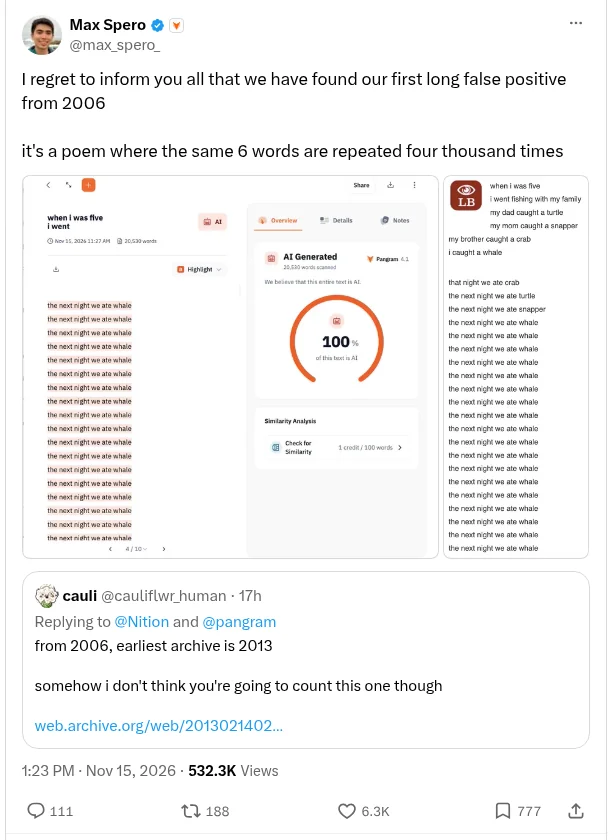
An AI detector rated a 2006 poem '100% AI': it repeats 'the next night we ate whale' about four thousand times
Max Spero of AI text detector Pangram posted on X that they had found their first long false positive from 2006: a poem repeating one six-word line about four thousand times. Pangram 4.1 scanned 20,530 words and concluded the entire text was AI. The post drew thousands of likes and renewed debate over detector reliability.
Screenshot of the original post · View full size ↗ Read the full report
An AI detection company has publicly shared one of its own misfires. Max Spero of AI text detector Pangram posted on X: "I regret to inform you all that we have found our first long false positive from 2006." It is a poem in which the same six words are repeated four thousand times.
His screenshot shows Pangram 4.1 scanning 20,530 words and returning "AI Generated," saying "We believe that this entire text is AI," at 100%. The poem starts normally: at five, the narrator went fishing with family; dad caught a turtle, mom a snapper, brother a crab, and "I caught a whale." That night they ate crab, then turtle, then snapper, and then thousands of lines of "the next night we ate whale." The lead came from another user, who pointed out the poem was posted on a university student blog in 2006, with the earliest web archive from 2013, well before ChatGPT.
The post went up in the early hours of Nov. 16 Beijing time and had more than 6,000 likes and over 500,000 views when read, with replies split between memes and serious discussion. One user reported that keeping the opening, at about 874 words, was rated human, while only the repeated line, about 828 words, was rated AI, suggesting heavy repetition can skew the verdict; that is a single user's test.
AI detector false positives have long been contested, with poetry, repetitive phrasing and non-native writing seen as vulnerable. This case is extreme and funny, but it is a reminder for schools, publishers and prize committees that a detection score is a reference point, not proof of cheating or ghostwriting on its own.
- 17
Huawei's open-source openPangu-2.1-Pro arrives on Huawei Cloud, targeting agents, HarmonyOS app development and Ascend operator generation
Huawei Cloud says its MaaS platform now offers the open-source openPangu-2.1-Pro model. The update uses 100,000+ specialized samples to improve skill triggering and tool calling, tunes coding for HarmonyOS ArkTS development and Ascend operator generation, and will be integrated into Huawei Cloud's AgentArts, CodeArts and other products.
Read the full report
Huawei has put a new version of its open-source Pangu model on its own cloud, with a clear focus: building agents, writing HarmonyOS apps and writing operators for Ascend chips. According to IT Home, Huawei Cloud announced on Nov. 15 that its MaaS (model-as-a-service) platform now offers openPangu-2.1-Pro.
For agents, Huawei says the model was tuned on more than 100,000 specialized samples to improve skill triggering, tool selection and calling, and complex task planning and execution, with gains in deep research and HarmonyOS device control. Coding improvements target two in-house ecosystems: HarmonyOS app development, with more accurate and usable ArkTS code, and Ascend operator generation, the low-level compute code for Huawei's AI chips, a demanding and specialized task.
On deployment, Huawei Cloud says optimizations to key operators and the inference pipeline substantially raise throughput in typical setups, and users can access it via preset MaaS APIs with rate limiting, usage statistics and performance monitoring. The model will also be integrated into Huawei Cloud's AgentArts, CodeArts and OfficeAce products for agent development, AI coding and enterprise office work.
For developers, its value lies mainly within the HarmonyOS and Ascend ecosystems, where it may know the territory better than general models. The announcement gives no specific benchmark scores, so the size of the gains remains to be tested in practice.
- 18
Gartner forecasts AI will add a net 1.7 million jobs by 2030: first a hiring pause, then cuts, then growth
Citing Business Insider, IT Home reports Gartner forecasts AI will create 10.6 million jobs and eliminate 8.9 million globally from 2025 to 2030, a net gain of about 1.7 million. An analyst says companies are in a wait-and-see hiring pause, while more than 20% of workers, about 435.5 million people, will need to adapt to AI-driven changes.
Read the full report
Will AI take our jobs? Research firm Gartner's answer is more optimistic than many expect, but the path is bumpy. Citing Business Insider, IT Home reports Gartner forecasts that from 2025 to 2030, AI will create 10.6 million new jobs worldwide and eliminate 8.9 million, for a net gain of about 1.7 million by 2030.
Gartner distinguished VP analyst John Lovelock describes three phases: early in AI adoption, companies think "let's pause hiring"; at more advanced stages they begin cutting roles; and only in the final stage do they add jobs and reach net growth. He says what people feel now is mainly companies waiting to see.
Beyond headcount, the bigger change is in the work itself. Gartner estimates jobs eliminated by AI amount to less than 2% of workers, but more than 20% of the global workforce, about 435.5 million people, will need to adapt. Lovelock put it this way: if you have 10 tasks today, tomorrow you may only need to do six of them, and differently.
The pain is already visible. The report cites Challenger, Gray & Christmas data showing US companies had announced more than 100,000 AI-related job cuts this year through October, making AI the second most cited reason after market and economic conditions. ZipRecruiter economist Nicole Bachaud expects more turnover in professional services, finance and information industries, with employers favoring AI experience and soft skills. It echoes a recent Reserve Bank of Australia finding that AI is hitting young workers first: net growth is a long-run outcome, and transition pressure is uneven.
- 19
Owners rewrote a $70 synth's firmware with AI, even porting Doom; a Google PM argues AI agents will favor hackable hardware
In a blog essay, Google AI agents product manager Geoff Stearns says owners of the M-Vave FM-1 pocket synth wrote multiple custom firmwares within weeks using AI coding tools, after which the maker open-sourced its firmware under GPLv3. He argues cheap AI-written code means agents shopping for users will favor devices whose firmware can be replaced.
Read the full report
A pocket FM synthesizer selling for about $70 has become a case study in how AI coding is changing hardware. Geoff Stearns, a Google product manager building AI agents and skills, writes on his blog that almost no M-Vave FM-1 owners still run the stock firmware: owners started writing their own in September, and by October there were too many to cover in one article, including a virtual analog synth, a multitrack groovebox, a dark ambient sampler and a port of Doom. Going by developers' forum posts, nearly all were written with AI coding tools.
It used to be hard: the FM-1 runs on a JieLi chip with little public documentation, and writing firmware meant reverse engineering, learning a vendor toolchain and weeks of trial and error. Stearns argues AI made each step cheaper, reading undocumented code, writing code for an unfamiliar chip and building editors, installers and emulators. M-Vave then did something unusual for a hardware company: in October it published its firmware as open source under GPLv3, with a development kit, a browser emulator and a tool to restore stock firmware in about ten seconds. He notes Behringer and other music gear makers have since published or promised to open some firmware.
His central argument is that as more buying decisions go through AI agents, agents will lean toward devices they can modify and fix, making openness a selling point. He also addresses security versus lock-in, proposing the test of who controls the signing keys: a device can refuse unsigned firmware while still letting its owner add their own key.
This is an opinion piece and its market predictions are the author's own, but the FM-1 case shows AI coding has turned firmware hacking from a niche pursuit into a weekend project. The essay drew discussion on the Hacker News front page.
GitHub projects
From GitHub Trending, with English descriptions where available. See each project for details. Trending does not imply a new release.
-
dream-num/univer ↗
Build your own AI office with Univer Office SDK. Bring editing, calculation, collaboration, and file processing into your product for people and AI agents. Built on an extensible open-source core.
-
Tencent/LoopForge ↗
Self-hosted workflows for coding-agent delivery. Orchestrate CodeBuddy, Codex and Claude Code with scripts and human approval gates. Includes Local workflows for coding assistants.