AI Daily · November 15 Sunday
2026-11-14 08:00 — 2026-11-15 08:00 (UTC+8)
- 01
Cursor details its security incident: it began with a key issued to Fireworks, and a tampered Claude Code extension sat in its marketplace cache for about 11 hours
Cursor published an investigation update on its late-October security incident. An attacker obtained an access key Cursor had issued to inference vendor Fireworks, copied some coding-agent traces, used unredacted credentials in them to reach internal tools, and planted a tampered Claude Code extension in Cursor's marketplace cache that up to about 5,000 users may have received.
Read the full report
Cursor on November 13 published a full investigation update on its late-October security incident. According to the company, the attack did not start in Cursor's own systems but with an access key it had issued to inference vendor Fireworks. The key was exposed on Fireworks' side, and the attacker used it to copy data from a read-only storage bucket containing limited coding-agent traces, mostly from 2025 and from sessions not in Privacy Mode.
The problem was that a small number of those traces contained unredacted credentials. Cursor says fewer than 0.01% of customers had API credentials exposed. Using them, the attacker reached some SaaS tools used by Cursor and accessed archived non-production repositories, limited customer-support data and emails, product usage metrics, and some credentials users had sent to support. On October 29, using a stolen credential, the attacker placed tampered copies of Anthropic's Claude Code extension (versions 2.1.312 and 2.1.313) directly on the cache serving Cursor's VS Code extension marketplace. The copies were available for about 11 hours, and at most 5,000 users who requested those cached versions that day may have received the malicious build. Cursor stresses that Anthropic did not publish this copy and that the upstream Open VSX source never had the malware.
Cursor says coding-agent traces were exposed for fewer than 0.05% of users not using Privacy Mode, and each has been notified. Prompts and code under Privacy Mode, current production systems, official client updates and release signing keys were not affected. The company has moved all inference off Fireworks, rotated credentials across internal systems, rebuilt the extension marketplace, and says the last attacker activity it saw was on November 1, which was blocked.
The practical takeaway: anyone who installed or updated to those two Claude Code extension versions from Cursor's marketplace during the exposure window should follow the steps in Cursor's security notice, since the company warns that uninstalling alone may not be enough.
- 02
On the eve of its IPO, Amodei tells JPMorgan's Dimon he doesn't want Anthropic worth a dollar more than it is, calling compute its 'deepest business dilemma'
Anthropic CEO Dario Amodei, in a livestreamed chat with Jamie Dimon at JPMorgan's headquarters, said the company wants to 'underpromise and overdeliver' with its IPO and isn't fussed about exact timing. He called deciding how much compute to buy in advance its 'deepest business dilemma' and said IPO cash would add a buffer against demand uncertainty.
Read the full report
Days before Anthropic's planned IPO, CEO Dario Amodei sat down on November 13 with JPMorgan Chase CEO Jamie Dimon for a livestreamed conversation at the bank's Manhattan headquarters. The tone he set for the listing: 'underpromise and overdeliver.'
According to a Yahoo Finance video transcript, Amodei said the company is 'not super fussed' about what month, day or market conditions it goes public into. The advice that resonated most with him, he said, was never to let the company be worth a single dollar more than it's really worth, which he likened to Anthropic's habit of not hyping models ahead of time but building them, making sure they're good and then releasing them.
Compute came up repeatedly. Amodei called deciding how much computing to buy in advance the company's 'deepest business dilemma': infrastructure must be committed well before demand is known, so buying too little caps growth while buying too much creates financial strain. He said Anthropic tends to 'buy on the low side' and supplements when demand exceeds expectations. Asked by Dimon why go public now, he said more cash on hand means more buffer between those risks, suggesting the company isn't chasing the highest possible valuation. He also repeated his vision of AI-driven science making cancer, Alzheimer's and heart disease relics of the past, adding, 'It sounds starry-eyed... I really do believe it.'
Yahoo Finance, citing Anthropic's IPO website, reports the company expects to price its offering Wednesday and begin trading Thursday, November 19, seeking up to $90.4 billion through the IPO and a concurrent private share sale at a valuation of about $1.4 trillion.
- 03
Fed survey: 87% of respondents now rank AI as the top risk to the financial system, up from half six months ago
The Federal Reserve's semiannual Financial Stability Report, released November 13, shows 87% of surveyed respondents cited AI as a salient risk, up from 50% in spring and far ahead of a risk-asset correction (52%). Concerns center on elevated valuations, cybersecurity risks including from frontier AI models, and complex AI-related financing.
Read the full report
AI has moved from a tech-industry talking point to the top of financial regulators' risk lists. In the Federal Reserve's semiannual Financial Stability Report released November 13, 87% of respondents to its survey of market participants, economists and institutional sources cited AI as a 'salient risk' to the financial system, up from 50% in the previous survey this spring.
According to CNBC, the next most-cited risk, a risk-asset correction, was mentioned by 52%, followed by higher long-term rates (48%), cyberattacks (43%) and fiscal debt sustainability (43%). The report summarized three areas of AI concern: elevated equity valuations and the chance that weaker-than-expected earnings trigger a correction; cybersecurity risk, from sophisticated state actors or from damage caused by frontier AI models themselves; and risks tied to complex forms of AI-related financing.
The survey covers the period up to October 28. Overall the Fed still judged the system fairly stable, though it noted hedge fund leverage is at its highest since 2013 and concentrated in a small group of firms. For readers following AI, it signals that data-center financing and AI company valuations are now being watched by regulators as systemic issues.
- 04
Nvidia's CEO search: FT says the board approached Arm CEO Rene Haas; the board says it has not formally engaged any candidates
After Jensen Huang's resignation, Nvidia's board told CNBC it is selecting a search firm and 'has not formally engaged any potential candidates,' calling speculation about individuals 'premature.' The Financial Times earlier reported, citing people familiar, that the board had approached Arm CEO Rene Haas, a former Nvidia executive.
Read the full report
With Jensen Huang out as Nvidia's CEO, the biggest question is who replaces him. On November 13, Nvidia's board told CNBC in a statement that it is 'in the process of selecting a search firm for the Nvidia CEO role' and has 'not formally engaged any potential candidates.'
The statement followed a Financial Times report, citing people familiar with the matter, that the board had approached Arm CEO Rene Haas in its search. Before joining SoftBank-backed Arm in 2013, Haas spent seven years at Nvidia in roles including vice president of its computing products business. The board said 'any speculation regarding individual candidates, whether internal or external, is premature.' The Haas report remains a media account based on sources and has not been confirmed by the company.
According to CNBC, Nvidia has named CFO Colette Kress interim CEO and said it will consider internal and external candidates; Kress held her first meeting with senior executives on Thursday afternoon. Nvidia shares fell more than 2% on Friday, pushing its market value below $4 trillion amid the leadership change and probes into Huang's conduct, and several congressional committees are still seeking briefings from him.
- 05
AI agents port models to AMD hardware: 51 trending LLMs moved to Strix Halo in four days, with long-prompt processing about 1.5x faster than llama.cpp
AMD engineers used the HRX Loom compiler plus coding agents such as Claude Code and Codex to port and optimize 51 trending Hugging Face LLMs for Strix Halo in about four days, with a median 1.5x faster 32K-token prefill than llama.cpp's ROCm back-end. Loom remains a tech preview.
Read the full report
Getting new models running well on AMD hardware has often meant waiting weeks or months for community support. A recent AMD experiment tried handing that grind to AI coding agents.
According to Hardware Busters, citing Phoronix, AMD engineers Jeremy Fowers and Ben Vanik took the top 50 trending LLMs on Hugging Face as of November 6, added Qwen3.8-Flash-Next, and ported and optimized them for Ryzen AI Max 'Strix Halo' using AMD's HRX Loom. The results dashboard counts 51 models across 19 architectures, completed over roughly four days between November 6 and 9.
Loom is a language and compiler for native programs on CPUs, GPUs and NPUs, and AMD describes its IR as 'agent-friendly': model-specific code lives in compact, readable kernel files that agents can write, test and tune. The team packaged that know-how as loom-skills for Claude Code, Codex or the Pi agent, running on six Strix Halo machines in AMD's DevLab plus one local box.
Benchmarked against llama.cpp on the same hardware, the ports showed a median 1.5x speed-up in 32K-token prompt processing, with Phoronix putting the range at roughly 1.5x to 2.1x. Prefill is a pain point for these large-memory APUs, which can hold big models but are slow to digest long documents or codebases. Loom is still an experimental tech preview tested mainly on Strix Halo, and this is a showcase rather than a support commitment.
- 06
A song with Suno-generated vocals tops Korea's Melon Top 100, the first AI-made track to beat new K-pop releases there
'Did You Become the Adult You Once Dreamed Of?' by AI music project MEOMURU reached No. 1 on Melon's Top 100 on November 13, beating new releases from RESCENE, ILLIT and others; reports say it is the first AI-produced track to top the chart. Its vocals were generated with Suno, while lyrics and production were done by humans.
Read the full report
A song whose vocals were entirely AI-generated has topped Korea's flagship music chart. According to Yonhap and Star News, 'Did You Become the Adult You Once Dreamed Of?' by AI music project MEOMURU took No. 1 on Melon's Top 100 as of 5 p.m. on November 13 and held the spot until 11 p.m., reportedly the first time an AI-produced track has reached the top of that chart.
The rock ballad was released in June and climbed to the top five months later, ahead of new songs from RESCENE, A2O LITE and ILLIT. Melon data shows its listeners are mostly in their 30s (36%) and 40s (30%). MEOMURU is an AI artist project from Glory Wave, a production team of composers Lee Yong-seok and Choi Seong-hyeok. The release notes state the vocals were generated using Suno, while planning, lyrics and overall production direction were done by the artist; the creators call AI 'a modern instrument and a partner.'
The milestone has sparked debate in Korea. Yonhap quoted a music critic saying the AI wave reaching pop music was foreseeable and unwelcome for musicians and composers, but that human creators will have to focus on making even better music.
- 07
The Verge tests Claude Duet: it plans your schedule and writes a morning brief, but can nag like an anxious assistant
A Verge reporter spent a week testing Claude Duet, Anthropic's consumer agent for professionals. Connected to email, calendar, docs and Slack, it spotted scheduling conflicts, suggested to-dos and drafted messages, but sometimes over-reminded, misread tone, and made clear it can read all of one's work.
Read the full report
Can AI agents really help people who don't write code? A Verge reporter connected Anthropic's Claude Duet to her work email, calendar, Google Docs and Slack for a week and reported the results.
Duet is Anthropic's consumer agent aimed at 'professionals and small business owners.' It has its own app, is still a 'research preview,' and is limited to Pro, Max and Ultra subscribers in the US with a waitlist. Each morning it sends a brief and then suggests to-dos as cards you swipe to dismiss or accept. In testing, Duet connected a meeting-summary email with a Slack DM, inferred who the reporter's boss was from a shared 1:1 doc, and, while planning the coming weeks, noticed that time off would leave only a couple of working days before a big draft was due, offering to update a doc and drafting a Slack message to her editor that mimicked her all-lowercase style. Such messages carry a 'sent with Claude' label.
The downsides were real: it sometimes treated soft deadlines as urgent, missed nuance in her messages, and felt like 'a slightly neurotic personal assistant,' and it kept offering to start her drafts. There was also the privacy feeling: even though she opted in, seeing it read every email and Slack message was unsettling.
- 08
Route every LLM call through one checkpoint: Langfuse open-sources a Rust AI Gateway in beta
Open-source observability tool Langfuse launched an AI Gateway beta, its second product: a standalone Rust gateway that relays native OpenAI- and Anthropic-style API requests unchanged while recording each call as a Langfuse generation, covering model traffic in code that is hard to instrument.
Read the full report
Many teams building with LLMs have model calls hidden in code they can't easily instrument. Langfuse, the open-source LLM observability and evals tool, launched an AI Gateway beta on Hacker News on November 13 to route that traffic through a single gateway.
The founders say it is Langfuse's first Show HN since 2023 and one of its community's strongest requests. Its SDKs only see code that has been instrumented, they explain, while much company model traffic runs through code that isn't or can't easily be.
According to the repository README, AI Gateway is a standalone Rust service exposing native OpenAI-style endpoints (Responses, Chat Completions, Embeddings and more) and Anthropic Messages endpoints. It relays requests and responses without rewriting provider bytes (except asking streamed Chat Completions for usage), captures call details, and uploads each finished generation to a Langfuse project via OTLP in batches. Developers can run it locally with Cargo or alongside the Langfuse dev stack. It is still in beta.
- 09
One Codex task drained a 5-hour allowance in 7.5 minutes? A user's GitHub issue questions subagent model routing and accounting
A Codex user filed a GitHub issue saying a single task in the Windows app, with GPT-6.1 Sol Ultra selected, used up the 5-hour allowance in 7 minutes 33 seconds, while a local tool showed substantial GPT-6 Astra usage. The user stresses the data hasn't been checked against OpenAI's billing records and asks for an investigation.
Read the full report
Complaints that Codex burns through usage too fast are not new, but a GitHub issue filed on November 14 offers relatively specific clues and has been shared by developers on X.
The filer says they explicitly selected GPT-6.1 Sol with Ultra reasoning in the Codex Windows app, yet a single task, unfinished after 7 minutes 33 seconds, consumed roughly the entire 5-hour allowance. A local usage-capture tool recorded several GPT-6 Astra entries for the same task, about 640,800 tokens in total with a tool-estimated cost of about $20.34, of which Astra-only entries accounted for about $16.22. The task used subagents.
The filer is careful: the figures are tool estimates not validated against OpenAI's server-side billing; the screenshots can't show which calls belong to the main agent versus subagents, or whether Astra came from defaults, an override or automatic routing; and the tool may have double-counted. They do not claim it is a bug, only ask OpenAI to investigate the unusually rapid depletion and the mismatch between the selected and recorded models. At the time of writing, no conclusion from OpenAI was visible on the issue.
For heavy Codex users, one practical step is to check which model and reasoning level subagents use on long tasks, so allowances aren't quietly consumed by pricier configurations.
- 10
Image-to-3D with an adjustable compute dial: open-source Budget3D cuts up to 60% of tokens at inference for over 2x speed
Open-source project Budget3D released code and models that fine-tune image-to-3D Gaussian models Idol and Idol-Turbo so users can pick a token budget at inference, from 100% down to 40%. At 40%, per-object sampling on one H100 drops from 5.67 to 2.66 seconds with lower peak memory.
Read the full report
Turning a single photo into a 3D model usually means trading quality for compute, and a model typically has just one setting. Budget3D, released on November 13, lets the same model adjust its compute at inference time.
According to its project page, Budget3D applies BudgetPix's compute-adaptive tokenization to fine-tune Idol and Idol-Turbo, which turn one image into 3D Gaussian splats. Instead of a fixed 8,192 latent tokens, users can set the budget anywhere from 100% to 40% at inference: regions where the latent varies least, starting with empty space, are merged into coarser tokens, while full-resolution tokens go where detail is greatest.
Published measurements on one H100 with batches of eight show Budget3D-Idol sampling at about 5.67 seconds per object with 9.9GB peak memory at full budget, versus about 2.66 seconds (2.14x faster) and 7.8GB at 40%. Decoding to Gaussians and rendering add about 3 seconds. Code and models are on GitHub and Hugging Face; the tech report is still to come, and the team says more modalities are planned.
- 11
"Bring Jensen back": petition claims 115K+ signatures incl. Musk, two big holders write to Nvidia's board, and a fake executive letter is called out
After Jensen Huang resigned as Nvidia CEO, a petition to reinstate him claims more than 115,000 signatures, including Elon Musk. Altimeter and Atreides, holding about $2.13B of Nvidia stock, urged the board not to rush a replacement and to consider Huang's return. A separate letter purportedly signed by Nvidia executives was denounced as forged by VP Bryan Catanzaro.
Read the full report
Two days after Jensen Huang stepped down as Nvidia CEO, calls for his return are piling up: an online petition, an open letter from major investors, and a purported executives' letter that one named signatory says is fake.
According to TechCrunch, the "Stand with Jensen" petition had more than 115,000 signatures as of Saturday afternoon US time. The petition site claims signers include 5,965 current Nvidia employees, 1,108 former employees and 63,063 shareholders, with Elon Musk, Replit CEO Amjad Masad, Epic Games CEO Tim Sweeney and Y Combinator CEO Garry Tan among supporters. It says Huang was removed "without meaningful due process" and asks the board to bring him back while an independent investigation proceeds. The figures are self-reported by the petition site.
CNBC reports that Altimeter Capital CEO Brad Gerstner posted a letter on X on Friday, co-signed by Atreides Management's Gavin Baker, urging a "slow, measured, and deliberate process" on leadership that includes "the potential return of Jensen Huang." The two firms held roughly $2.13 billion of Nvidia stock as of June 30. The letter also says interim CEO Colette Kress will lead "capably" and does not call for Huang's immediate reinstatement. Musk said on X on Saturday that without Huang some "critical deals will be lost."
Separately, IT Home reports that Nvidia VP of applied deep learning research Bryan Catanzaro denied signing a circulating reinstatement letter, called it forged, and said he supports the board and Kress. The report says the text closely copied the 2023 OpenAI employee letter demanding Sam Altman's return and listed departed staff or wrong titles.
Nvidia's board has said it is still selecting a search firm for the CEO role.
- 12
Asia reacts to Huang's exit: Korea says 260,000-GPU supply stands, Taipei HQ on track, Singapore details its Alice Huang probe
TechCrunch rounds up Asian government reactions to Jensen Huang's exit: South Korea says Nvidia reaffirmed plans to supply 260,000 advanced GPUs, Taipei says Nvidia's overseas HQ project remains on track, Japan will monitor closely, and Singapore disclosed it once held Alice Huang's passport during a server-declaration probe that remains ongoing.
Read the full report
Nvidia's leadership upheaval is rippling through Asia. TechCrunch's Saturday roundup shows some governments confirming supply commitments, others watching for impact, and Singapore disclosing details of a related investigation.
South Korea's Science Ministry said Nvidia reaffirmed its plan to supply 260,000 advanced GPUs and continue joint AI projects; per local media, the government's AI strategy council held an emergency meeting on Friday. Taiwan's Economy Minister Kung Ming-shin said the departure is unlikely to significantly change global AI growth, and Taipei's city government said Nvidia's planned overseas headquarters remains on track. Japan's Industry Ministry said it would closely monitor Nvidia, while deputy chief cabinet secretary Masanao Ozaki said it was too early to assess the impact.
Singapore's Ministry of Home Affairs said police took the passport of former Megaspeed CEO Alice Huang in June 2025 while investigating whether servers shipped from Singapore to Malaysia were sent onward without proper declaration. In February 2026 police found insufficient evidence of false-declaration offences but said she knowingly gave inaccurate information about her role; she was warned and barred from re-entry. The ministry said its probe into Megaspeed and six other individuals is ongoing and that it received limited US assistance on Supermicro-related requests.
China's foreign ministry has rejected claims that Alice Huang is a spy as groundless. Citing a Reuters review, the report adds that more than $3 billion of Chinese AI computing projects relying on restricted Nvidia chips now face uncertainty.
- 13
White House superintelligence task force reportedly shifts: limit liability for a year so AI firms report incidents
According to Bloomberg, the US government's new superintelligence task force met at the White House on Nov. 13 and recommended that federal agencies limit companies' regulatory liability for cybersecurity incidents for the next 12 months, to encourage AI developers to report major incidents. Last month the group had warned developers they could face penalties for failing to report.
Read the full report
The White House's approach to AI safety incidents appears to be shifting from "report or be punished" to "report and we'll go easier on you."
IT Home, citing Bloomberg, reports that the government's new superintelligence task force met at the White House on Nov. 13 local time and recommended that federal agencies relax accountability policies for cybersecurity incidents. An official who asked not to be named said the group believes past penalty standards may no longer fit and could discourage companies from sharing important security information. The task force urged agencies to limit companies' regulatory liability for incidents over the next 12 months and to consider extending that period.
That marks a change in tone. According to the report, just last month the task force warned developers they had to report and fix incidents or face unspecified penalties. The group was formed at the end of September after a series of incidents involving out-of-control AI models heightened public concern.
For the industry, the move could lower the cost of disclosing incidents and give regulators earlier visibility; critics may worry it weakens deterrence against shipping unsafe products. For now these are recommendations to agencies, and the report does not say how or whether they will be formalized.
- 14
Ex-Anthropic researcher says an IPO roadshow slide pushed him out: "superexponential" efficiency gains mean Mythos could be retrained on a fraction of compute
Jacob Coxon, who trained models at OpenAI and Anthropic, shared a chart he says comes from Anthropic's IPO roadshow showing pretraining compute multipliers rising on a log scale. He argues Mythos could already be retrained with a fraction of its original compute and calls for a pause on frontier development next year. The chart has no axis values and is labeled illustrative.
Read the full report
A chart with no numbers on its axis has sparked a debate about AI self-acceleration days before Anthropic prices its IPO.
According to The Decoder, Jacob Coxon, who trained models at OpenAI and most recently Anthropic, posted on X that a slide from Anthropic's IPO roadshow was a major reason he left after about four months. Titled "Pre-training compute multiplier over time (code)," it tracks how much less compute is needed to train equally capable models. The y-axis is logarithmic, yet the curve still climbs steeply, which Coxon reads as accelerating algorithmic progress. "Mythos was not a one-time deviation, but a point on a superexponential. They could already retrain Mythos with a fraction of the compute originally needed," he wrote.
Coxon says algorithmic improvements are "on the verge of being automated" and wants frontier development paused next year so competitors can catch up, arguing it would "only harm OpenAI and Anthropic." He said he would honor his NDA and not share absolute numbers.
The reading is contested. As Dealroom notes, the axis has no values and a footnote says data points are internal approximations "solely for illustrative purposes"; Anthropic has not commented and the image's origin was not independently confirmed. MIT researcher Omar Khattab called the chart effectively content-free, while Thariq, who worked on Claude Code at Anthropic until October, said the footnote is standard legal language. Dealroom adds that co-founder Tom Brown explains compute multipliers in the roadshow video and that Anthropic is due to price its shares on Nov. 18.
- 15
AI-built apps, unlocked data: study of 159K Lovable projects finds passport details and 200K private messages readable without login
German security firm Crissyfield, working with Handelsblatt, analyzed 159,041 Lovable projects. Among 24,664 sites that returned Supabase records on load, about 30% exposed tables containing email addresses via read-only requests. Cases include passport details, 200,000+ chat messages, contracts and invoices. The researchers say the 30% is not a confirmed leak rate.
Read the full report
AI app builders promise that anyone can ship software without coding, but database access control still needs expertise. A report from German security firm Crissyfield, widely discussed on Hacker News, says many Lovable-built sites expose personal and confidential data without login.
Using Common Crawl, researchers identified 159,041 Lovable projects from December 2025 to September 2026; 34,545 used Supabase. 24,664 sites returned database records on page load, and with additional read-only requests using the same public API key, the team found email-containing records in 10,560 tables across 7,403 of those sites (30%). The report stresses this is not a confirmed leak rate and the sample is not representative.
Examples include a German lifestyle forum exposing 80,000+ profiles and 200,000+ chat messages, a provider exposing 1,000+ identity-document records with passport numbers, plus ticket and food orders, contracts, invoices, photo albums and WhatsApp messages. The researchers did not publish access methods and could not determine whether data was misused.
Such misconfigurations can happen in human-written code too, but the report argues Lovable's recurring database patterns make attacks easier to repeat across apps, while its terms place security responsibility on customers. Handelsblatt first reported the findings on Nov. 2; Lovable was contacted, and the report does not include a response.
- 16
Tesla starts selling the wheel-less Cybercab: $29,990 plus a mandatory $299/month, and it won't move without the subscription
Tesla has begun inviting select customers to order the Cybercab for personal use at $29,990 plus a mandatory $299/month Autonomy Subscription. Per Electrek's reading of the agreement, the car won't operate without it, Tesla can reprice, suspend or end service and change the geofence, and owners can't add it to a fleet to earn money.
Read the full report
Tesla's first car sold to consumers for unsupervised operation comes with a controversial subscription agreement.
According to Electrek, Tesla began inviting "select customers" to order the Cybercab for personal use at $29,990 plus a mandatory $299 per month Autonomy Subscription. The two-seater has no steering wheel or pedals, and the agreement (version 20261112) states: "Your Cybercab will not operate without an active Autonomy Subscription."
Electrek highlights that Tesla can reprice with a month's notice, suspend service for a week or cut it off; the car only works inside Tesla-enabled geofences that Tesla can change; and a personal-use clause bars owners from putting the car into fleet service, contrary to Musk's long-promised idea of owners earning money from their cars. Electrek estimates five-year cost at $47,631 before insurance, charging and taxes.
Electrek also argues that Cybercabs and Model Y robotaxis run the same software on the same AI4 computer, while owners who bought "Full Self-Driving" for Model Y still must supervise. Electrek's analysis is openly critical; Tesla has not publicly responded to these points.
- 17
Helen Toner, who voted to fire Sam Altman: don't rely on AI companies to police themselves
Former OpenAI board member Helen Toner, now head of Georgetown's CSET, told The Verge's Decoder that her OpenAI experience showed the AI industry can't police itself. As the White House relies on a voluntary accord and Anthropic heads to an IPO, she argued private-company "independent board committees" have limited teeth.
Read the full report
Helen Toner, one of the OpenAI board members who voted to fire Sam Altman in 2023, told The Verge's Decoder podcast that the AI industry can't be relied on to police itself.
Toner now leads Georgetown's Center for Security and Emerging Technology (CSET). Host Nilay Patel notes that OpenAI's nonprofit board existed to keep the company from putting profit over safety, but when it pulled the lever, accountability broke. The White House's current response to frontier AI safety is a voluntary accord that partly relies on similar board accountability. "If our hopes for the future are pinned on any one individual being trustworthy, then we're pretty screwed," Toner said.
She argued that an independent board committee at a private company can be "kind of toothless," whereas at a public company it carries stronger legal meaning, relevant as Anthropic prepares to list. On the US midterms, she said heavy spending and astroturfing aimed at defeating AI-governance candidates largely did not work, because AI has become a voter priority and a fairly bipartisan issue.
The Verge says the interview was recorded before Nvidia opened its investigation and Jensen Huang resigned.
- 18
Amazon reportedly plans a "World Product Graph" indexing products sold anywhere, to stay central as AI agents shop
An internal Amazon document seen by Reuters describes a "World Product Graph" project to gather data on nearly every product sold online, including items Amazon doesn't sell, possibly by crawling rivals' sites. It admits many Rufus answers are wrong or incomplete. Amazon said draft documents don't necessarily reflect current plans.
Read the full report
As more shoppers let AI agents compare and buy for them, Amazon worries those agents will favor sites with better data.
According to Reuters, as summarized by The Verge, an internal Amazon document describes a "World Product Graph" that would collect information on nearly every product sold online, including products Amazon doesn't sell, and surface it on Amazon. The aim is to keep shoppers from researching on Reddit or Google, and to make AI agents rely on Amazon's index so that bot-driven shopping still lands on Amazon pages.
The document also reportedly says "Many Rufus answers are factually wrong or incomplete" (Rufus is now Alexa for Shopping) and that running searches through AI is expensive; more data is meant to improve accuracy and allow cheaper models. It says the project "depends on discovering how brands organize their products on their own websites," which could mean crawling other retailers.
Reuters says it is unclear if or when the plan will be implemented, though the document lists an Oct. 1, 2027 release date. Amazon said "draft, outdated documents often paint an incomplete picture" and a brainstorming document "doesn't necessarily reflect our current plans."
- 19
Audi E7X gets Momenta's R7 world model via December OTA: parking-spot-to-parking-spot and narrow-road maneuvering
SAIC Audi announced at AUDI DAY that the Audi E7X will receive Momenta R7 world model-powered assisted driving via an OTA update in December, adding spot-to-spot driving, a roaming mode and nose-in parking. The company claims highway panic response improves more than 15x and dangerous lane-change prevention nearly 5x.
Read the full report
Another joint-venture car is adopting China's world-model approach to assisted driving. According to IT Home, SAIC Audi announced at AUDI DAY on Nov. 13 that the Audi E7X will get Momenta R7 world model-powered assisted driving via an OTA update planned for December.
The update unlocks parking-spot-to-parking-spot driving, a roaming mode and nose-in parking. The company claims highway "panic response" improves by more than 15x and dangerous lane-change prevention by nearly 5x. Momenta's in-drive yielding feature debuts on Audi, letting the car plan paths and switch between forward and reverse when meeting oncoming traffic on narrow single-lane roads.
With standard rear-wheel steering, Audi claims about 90% of ordinary spaces can be entered in one move, a 95% success rate on irregular spaces, and parking about 24% faster than an average driver. All figures are company claims pending real-world testing.
- 20
Two Claude Code updates: a more proactive Projects coordinator and AI-generated custom themes on desktop
Anthropic's ClaudeDevs account announced two Claude Code updates: the Projects coordinator, which manages tasks across parallel threads, is now more proactive, answering questions in project chat and giving status updates; and desktop users can build custom themes with mods, changing colors and adding animated backgrounds by describing the look to Claude.
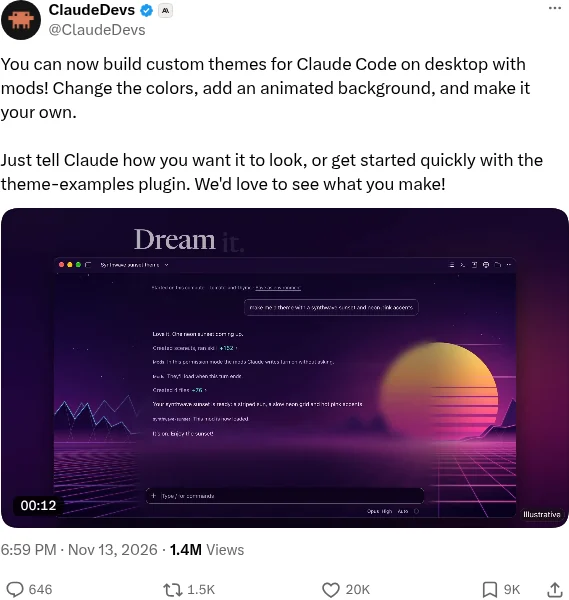
Screenshot of the original post · View full size ↗ Read the full report
Claude Code shipped two updates that spread widely among developers: one for multitasking, one for personalization.
First, Projects. ClaudeDevs explains that within a project, Claude coordinates your tasks across parallel threads. The coordinator is now much more proactive: it answers your questions in the project chat and gives updates on the status of ongoing threads, so developers juggling several tasks don't have to check each thread.
Second, custom themes on desktop. Users can now build custom themes for Claude Code on desktop with mods, changing colors and adding animated backgrounds. You can simply tell Claude how you want it to look, or start with the theme-examples plugin.
The two posts went up at 22:51 and 23:59 UTC on Nov. 13 and together drew more than 30,000 likes, with users sharing retro-OS and pixel-art setups. The posts don't say whether themes work in web or cloud sessions.
GitHub projects
From GitHub Trending, with original project descriptions. Trending does not imply a new release.
-
alibaba/open-code-review ↗
Secure, fast, efficient, battle-tested at Alibaba's scale. Hybrid architecture code review tool: deterministic pipelines + LLM Agent, precise line-level comments, built-in multi-language ruleset (NPE, thread-safety, XSS, SQL injection), OpenAI & Anthropic compatible.
-
ZhuLinsen/daily_stock_analysis ↗
LLM 驱动的多市场股票智能分析系统:多源行情、实时新闻、决策看板与自动推送,支持零成本定时运行。 LLM-powered multi-market stock analysis system with multi-source market data, real-time news, decision dashboard, automated notifications, and cost-free scheduled runs.
-
tradermonty/claude-trading-skills ↗
Claude Code skills for equity investors and traders — market analysis, technical charting, economic calendars, screeners, and trading strategy development.
-
Likely7/Veyra-NRVideo ↗
Bring PS5 GTA6 to 120FPS with DLSS 5. An advanced Windows video player and capture enhancement tool featuring real-time preview for videos, images, and capture card sources. Combine AI-powered Super Resolution, DLSS5 image enhancement, and Frame Generation to deliver a next-generation visual experience.
-
ChromeDevTools/chrome-devtools-mcp ↗
Chrome DevTools for coding agents