AI Daily · November 23 Monday
2026-11-22 08:00 — 2026-11-23 08:00 (UTC+8)
- 01
Signed contracts, rising prices: Dell, HPE, Lenovo and Supermicro are asking AI server buyers for 25%-45% more at delivery, FT reports
Dell, HPE, Lenovo and Supermicro are demanding 25% to 45% more at delivery than the prices in signed contracts for Nvidia-based AI servers, citing memory and circuit-board shortages, according to AI Weekly citing the Financial Times. HPE has written a repricing right into its terms, and XTX Markets is suing Dell in Ireland.
Read the full report
The bill for AI compute is spreading from chips to whole servers. According to AI Weekly, citing the Financial Times, Dell, HPE, Lenovo and Supermicro are asking customers to pay 25% to 45% more at delivery for Nvidia-based AI servers whose contracts were signed months earlier, blaming severe shortages and soaring costs for memory and circuit boards.
HPE has made the practice a contract term. CEO Antonio Neri told investors the company has amended its quoting terms "with a right to reprice existing orders for commodity cost increases between quoting and shipment," and expects elevated memory and storage prices to persist well into 2027.
The clearest dispute involves trading firm XTX Markets. According to the FT, XTX is suing Dell in an Irish court, saying the two sides agreed a fixed price of $549 million and that XTX paid an extra $5 million for price certainty, but Dell later said the order needed another $62 million to $70 million to cover component costs.
The cost pressure is steep: AI Weekly cites JPMorgan figures putting memory cost inflation at more than 400% since early 2024, with GPU-server prices up at least 20% to 30%. For AI companies and cloud providers expanding capacity, a signed contract no longer guarantees a locked budget, and the ruling in XTX v. Dell may shape how far such after-the-fact increases can go.
- 02
After 'zero data retention' promises were found wanting, OpenRouter off-boards three inference providers and strips ZDR eligibility from 125 endpoints
After researchers found some AI inference providers were not upholding their data policies, OpenRouter said it was not breached but has off-boarded three providers, removed 125 endpoints from Zero Data Retention eligibility and notified all potentially affected customers. Novita, Phala and Together have posted their own incident notices.
Read the full report
Earlier this week, security researchers who planted canary credentials in requests sent through AI routing services found that many inference providers were not keeping their privacy promises. OpenRouter, one of the largest model routing platforms, has now announced its response: three providers off-boarded and 125 endpoints removed from Zero Data Retention (ZDR) eligibility.
ZDR means a provider promises not to keep users' prompts and responses, and many companies rely on it before sending sensitive data to third-party models. OpenRouter stressed the findings showed no breach of or unauthorized access to OpenRouter itself; the problems were with specific inference providers. The removed endpoints include providers flagged by researchers plus others removed as a precaution.
OpenRouter says it notified all potentially affected customers, whether or not the provider posted publicly. Its announcement lists provider notices received so far: Novita's privacy notice regarding MiniMax requests, Phala's preliminary November incident report, and Together's disclosure of prompt leakage for requests in June and July 2026.
Going forward, OpenRouter says it is adapting the researchers' testing approach to run continuously, verifying network paths to detect requests and responses forwarded to third parties, and requiring assurances and validation before any removed endpoint regains ZDR eligibility. Developers using routing platforms may want to check whether the endpoints they rely on are still ZDR-eligible.
- 03
GPT-6.2 answers got shorter and more direct but admit uncertainty far less, a third-party style benchmark comparing it with Claude finds
According to The Decoder, Artificial Analysis's personality evaluation shows OpenAI's GPT-6.2 Astra and Sol give answers 34%-40% shorter than their predecessors with far fewer headings and much higher Answer First scores, but Astra's Admits Uncertainty score fell from 96 to 24 and both trail Anthropic's Claude models on a Transparency Index.
Read the full report
Users have complained lately that GPT-6.2 is "lazy." A third-party style evaluation offers another angle: it has become more concise and direct, but also less willing to admit uncertainty. According to The Decoder, Artificial Analysis data shows GPT-6.2 Astra's average answer fell from 352 to 210 words, down 40%, and Sol's from 337 to 223 words, down 34%, with far fewer headings and em dashes.
The biggest shifts are in structure and getting to the point. Astra's average headings per answer dropped from 1.99 to 0.11; on Answer First, which measures whether a model immediately addresses the question, Astra rose from 49 to 89 and Sol from 64 to 87. Natural-sounding scores also climbed.
The trade-off shows in Admits Uncertainty: Astra fell from 96 to 24 and Sol from 98 to 51. On a Transparency Index compiled by The Decoder, Anthropic's Claude Fable 5.2 and Opus 5.5 scored 81 and 90, well above Astra's 41 and Sol's 57.
These scores are relative rankings from 1 to 100 among all tested models, produced by a panel of three AI judges comparing anonymized answers to 900 English questions; a score of 24 does not mean Astra admits uncertainty in only 24% of answers. The Decoder also notes the scores describe communication style, not overall answer quality, and a lower Transparency Index does not necessarily mean more wrong answers.
- 04
An AI safety march in London: PauseAI walks to Downing Street to demand a pause on frontier AI
On Saturday, November 21, PauseAI UK led a 'March Against AI Extinction' in London from near the BBC's headquarters to Downing Street, calling for tougher regulation and a pause on the most advanced AI systems. Media reports described hundreds of marchers.
Read the full report
The AI safety debate moved onto London's streets. According to Anadolu Agency and Türkiye Today, on Saturday, November 21, the British group PauseAI UK organized a march focused specifically on AI. Participants gathered near the BBC's headquarters in central London and marched to the entrance of Downing Street, home of the prime minister's office, demanding tighter regulation and a pause in developing the most advanced AI systems.
Marchers carried signs such as "Just don't build AGI," "AI is an extinction threat" and "It's not too late to regulate," while speakers warned of risks from the fast pace of AI development and urged the government to prepare stricter rules.
Both outlets put the turnout at "hundreds." The reports note that in February about 300 people marched in London's King's Cross area, near the offices of OpenAI, Google and Meta, urging their CEOs to publicly back a pause on advanced AI.
Türkiye Today added that the UK Parliament's Joint Committee on Human Rights has urged the government to legislate on AI and create an independent regulator for the sector.
- 05
Tesla starts rolling out FSD v15, rendering a photorealistic third-person view of the road; Musk says 'It's like GTA'
Tesla on Saturday began rolling out FSD (Supervised) v15, adding Tesla Reality View, a photorealistic, full-motion view of the car's surroundings from a virtual camera above and behind the car that lets drivers see and control what FSD plans to do. Tesla claims 25x better handling of safety-critical cases; Musk posted 'It's like GTA.'
Read the full report
The most eye-catching part of Tesla's new driver-assistance release is not the driving but the screen. According to Gizmodo, Tesla announced on Saturday, November 21, that FSD (Supervised) v15 is rolling out, including Tesla Reality View, which renders a movable, photorealistic, full-motion view of the car's surroundings from a virtual camera just above and behind the vehicle, much like a game's chase camera.
Tesla's post says the visualization "lets you see & control what FSD is planning to do," and claims 25x better handling of safety-critical cases along with upgrades to every part of the end-to-end driving network. Earlier versions drew the car and a few key features against a mostly empty background; the new view renders the whole world around the car. Musk wrote, "It's like GTA," a line that drew attention with GTA VI just released.
Gizmodo suggests a familiar, game-like view might make the system easier to understand, while raising concerns about the psychology of gamifying real roads. Gizmodo also cites Electrek's Fred Lambert, who wrote that the list of upgrades "reads like a list of FSD's biggest current weaknesses," covering potholes, school zones, speed cameras and standing water, but cautioned that FSD has never improved in a straight line and each major version brings new problems. The 25x figure is Tesla's own claim.
- 06
Speak a draft, translate and polish on the fly: Tencent opens Android beta of its AI keyboard Chatterfly
According to IT Home, Tencent's Chatterfly keyboard has opened an Android beta, with iOS listed as coming soon. It turns speech directly into polished text, translates after you speak, offers scenario-based 'Skills' for work reports, meeting notes and AI prompts, and lets users issue spoken commands via a shortcut.
Read the full report
Tencent has put large models into a keyboard. According to IT Home, Tencent's Chatterfly input method has opened an Android beta, with the iOS version listed as "coming soon."
Unlike traditional voice typing that only transcribes, Chatterfly focuses on understanding context and intent: users don't need to organize their words first, and it recognizes the situation and turns speech into clear, appropriate text. A translation mode can be called up with one tap to translate speech directly into a chosen language.
It also offers expression "Skills" that detect scenarios such as work reports, meeting notes, AI prompts and marketing copy and polish text accordingly, plus an "AI command" feature: press a shortcut and speak to have the keyboard write, translate or summarize and output the result. Tencent says it also learns users' typing habits.
AI keyboards are becoming a new battleground because they sit inside every app's text box, letting users call a model without switching to a separate chat app. Feature descriptions come from Tencent; real-world performance remains to be tested by beta users.
- 07
Audio files tagged 'made with suno': Binding of Isaac's GTA VI tribute update hit by player backlash over AI-generated music
According to IT Home citing Kotaku, players found metadata from the AI music tool Suno in the background music of The Binding of Isaac: Repentance+'s new 'Vice City' free update, triggering a wave of negative Steam reviews. The music has been removed in a hotfix; the developers have not formally responded.
Read the full report
An indie game's easter-egg update backfired over a few music tracks. According to IT Home citing Kotaku, the new "Vice City" free update for The Binding of Isaac: Repentance+ appears to use AI-generated background music, prompting a wave of negative Steam reviews.
The update is a tribute to GTA VI: entering a code before a run unlocks a Vice City-themed version with its own weapons and music. The problem was in the audio files themselves. Players inspecting file comments with tools like VLC found Suno generation metadata; a file named drivingsong1.ogg, for example, contains "made with suno" along with an October 30, 2026 creation timestamp and a generation ID.
The discovery spread quickly on the game's Reddit community, where some players called AI-generated music lazy and said it would have been better not to release the update. The AI music has since been removed in a temporary update, but as of the report, creator Edmund McMillen and publisher and co-developer Nicalis had not formally addressed it or explained how the content got into the game.
The episode shows how metadata left by AI tools is becoming direct evidence for players calling out AI-generated content.
- 08
Bubble or buying opportunity? Musk replies to Chollet that AI's cash shortage next year will be 'nuts'
Keras creator François Chollet posted that GPU spot prices keep rising and HBM and DRAM output is effectively sold out through 2029, so the AI pullback is either the end of a bubble or a rare buying opportunity. Musk replied that getting that much compute powered, cooled and running reliably is incredibly hard, and that next year's cash shortage will be 'nuts.'
Read the full report
After the sharp drop in AI stocks, a debate over "bubble or opportunity" drew a more practical worry from Elon Musk: money.
It started with a post by Keras creator François Chollet: either you believe the AI buildout is over, AI was a flash in the pan and compute demand has peaked, or this is a rare buying opportunity. He noted that GPU spot prices keep rising, capacity is hard to secure, and HBM and DRAM production is effectively sold out through 2029; according to IT Home, he also said frontier training compute doubles roughly every five months and AI inference margins can reach 70% to 85%.
Musk replied that getting that amount of compute turned on, cooled and working reliably is "incredibly hard," and that "the cash shortage is also going to be nuts next year." According to IT Home, he went on to say that even cumulative industry delays of a few months between paying for compute and getting it to generate revenue could require hundreds of billions of dollars in extra working capital, asking where that money would come from. The reply drew more than ten thousand likes.
The two views are not fully opposed: Chollet points to strong demand, while Musk flags the difficulty of deployment and the cash-flow strain. That fits recent reports of AI server vendors asking buyers to pay more because of memory and circuit-board shortages: compute counts only once it is actually running.
- 09
20 million online consultations a day, 16% after midnight: Ant Group's AI health app Afu reaches 150 million users
According to IT Home citing Sina Tech, Ant Group health unit vice president Yang Meng said at the Ant Afu health ecosystem conference that Afu has 150 million users and more than 20 million online consultations a day; 55% come from third-tier and smaller cities, a quarter are elderly, and 16% occur between midnight and 6 a.m.
Read the full report
AI health consultation is becoming one of China's largest AI use cases. According to IT Home citing Sina Tech, Yang Meng, vice president of Ant Group's health business, said at the 2026 Ant Afu health ecosystem conference, which opened in Guangzhou on November 22, that Ant Afu has 150 million users and handles more than 20 million online consultations a day.
The user mix stands out: 55% of consultations come from third-tier and smaller cities, a quarter of users are elderly, and 16% of consultations happen between midnight and 6 a.m., when clinics are closed and doctors are hard to reach.
Yang said doctors' time is extremely scarce, and AI's opportunity is to handle repetitive administrative work in advance so doctors can spend more time on judgment and patients.
Growth has been fast. In February, Ant Afu said it had passed 100 million users; nine months later it is at 150 million. Afu grew out of Ant's AI health app AQ, rebranded last December around health companionship, Q&A and services. All figures were disclosed by Ant.
- 10
Fields medalist James Maynard on the AI-assisted Riemann Hypothesis proof: he believes it is correct, but understanding why matters more
According to IT Home citing National Business Daily, 2022 Fields medalist and Oxford professor James Maynard said he is highly confident the Riemann Hypothesis proof by Levent Alpöge with Claude is correct, but stressed that it will be fully accepted only once someone truly understands it and can explain it to others.
Read the full report
After the Lean community certified the formal Riemann Hypothesis proof, leading number theorists have begun to weigh in. According to IT Home citing National Business Daily, James Maynard, the 2022 Fields medalist and Oxford mathematics professor, said in an interview that he believes the proof by Anthropic mathematician Levent Alpöge, made with Claude, is correct.
Maynard gave two reasons: the result has been formally verified and that verification independently checked, and Alpöge has a reliable record on major claims of this kind. Together, he said, they make him very confident the result is right. Maynard works on the distribution of primes and is one of the leading figures in analytic number theory.
But he tempered the excitement: "Understanding why a theorem is true is far more important than merely proving that it is true." The Riemann Hypothesis is considered so important mainly because people expected that explaining the deep structure of the primes would require new mathematics. Until the ideas and framework of the proof are understood, it is unlikely to bring the transformation people expect.
He added that he believes mathematicians will eventually understand the proof, and that it will fundamentally change how the related problems are viewed.
- 11
A techno landmark turned 'war room': defense AI firm Helsing's launch at Berlin's Kraftwerk sparks protest and an apology from the venue
According to IT Home citing The Guardian, German defense AI company Helsing launched its AI targeting system Clarity at Berlin venue Kraftwerk Berlin on November 11, prompting strong protest from the city's electronic music community. Helsing says Clarity finds objects like radars, missile sites and ships, not individuals; the venue called the booking a 'serious error of judgment.'
Read the full report
Europe's defense AI push has collided with Berlin's electronic music scene. According to IT Home citing The Guardian, German defense startup Helsing held a launch for its AI targeting system Clarity on November 11 at Kraftwerk Berlin, a famous art and music space, drawing strong protest from local music fans and the techno community.
Kraftwerk Berlin hosts the experimental Atonal festival and shares a site with the Tresor club. Attendees said the venue was turned into a "war room," with maps and aerial footage projected on concrete walls, drones hanging from the ceiling, and guards in body armor patrolling with sniffer dogs. Clarity is an AI agent-driven intelligence platform that uses drone, satellite and sensor data to identify targets, with humans still approving strikes.
Berlin curator and DJ Michail Stangl worried such systems could eventually be sold to police or border agencies for use against migrants, and Tresor publicly condemned the event. Helsing said its system is not designed to identify individuals and that Clarity finds objects such as radar systems, missile launch sites and ships.
Under public pressure, Kraftwerk Berlin admitted the booking was a "serious error of judgment" and promised to change its commercial rental policy. The report notes European governments are seeking homegrown alternatives to Palantir, but backing the defense industry clashes with a long anti-military culture in the city.
- 12
OpenAI's chief scientist publishes internal perplexity numbers and proposes industry-wide limits pegged to the metric
OpenAI chief scientist Jakub Pachocki published OpenAI's internal perplexity trend for the first time and argued that perplexity should become a shared cross-lab metric for AI progress. He proposed common limits developers would not cross until monitoring reaches a concrete milestone, warning of a possible 2027 'avalanche' of pretraining advances.
Read the full report
To put a speed limit on AI you first need a shared speedometer. In a November 22 post, OpenAI chief scientist Jakub Pachocki proposed perplexity, a measure of how well a model predicts the next token (lower is better), as a common metric for comparing progress across labs and as the basis for industry-wide development limits.
To make the case, OpenAI published its own models' perplexity on its internal codebase starting from GPT-3.5. According to the post, GPT-3.5 sat at a log-perplexity of about 0.99 and GPT-4 at about 0.91; below 0.8, models showed "transformative capabilities" in areas such as cybersecurity and mathematics. Pachocki writes that after upgrading to a model at about 0.76, it began producing groundbreaking results on open math problems, and he expects further new capabilities in the 0.68-0.7 window. He acknowledges the disclosure gives competitors a clearer view of OpenAI's position, but says shared safety measures are more urgent.
Two points drew the most attention. He argues AI's participation in pretraining research could cause a step change, with an "avalanche" of pretraining advances conceivable "as soon as 2027," while alignment and monitoring are unlikely to keep pace. And he proposes that developers commit to a first common limit, based on perplexity and other measurements, that they would not cross until the ability to understand and monitor AI behavior reaches a concrete milestone, such as a successor to chain-of-thought monitors.
Pachocki also lists weaknesses: datasets differ across labs, perplexity does not map to a specific task, and gains outside pretraining such as chain-of-thought reasoning do not show up in it. TechCrunch reports Sam Altman called it "the most important thing OpenAI has published in a while." It remains a proposal; whether other labs sign on, and where thresholds would sit, is open.
- 13
How far did Anthropic go to stop leaks? Reuters says it capped some IPO bank teams at four and sought six-month bans on advising rivals
Reuters reports that, amid leak fears, Anthropic limited some of its IPO underwriters to four-person deal teams, asked some bankers to accept six-month restrictions on working with rivals including OpenAI, Cursor, DeepSeek and Hugging Face, and shared documents via a platform that logged page views. The IPO generated more than $500 million in bank fees.
Read the full report
Days after Anthropic's market debut, details of its tightly controlled IPO process have surfaced. Reuters reported on November 22 (as summarized by Unite.AI) that Anthropic capped deal teams at four senior bankers at some of its 22 underwriters and asked some bank staff to sign documents accepting six-month restrictions on work with AI rivals. The documents named OpenAI, Cursor, DeepSeek and Hugging Face.
According to the report, Anthropic shared materials with most underwriters through NetRoadshow rather than ordinary PDFs. The platform logged who opened documents and which pages they viewed, watermarked them with individual bankers' names and blocked saving copies. One person said the cap was meant to prevent leaks and that banks found workarounds; leaks still appeared in the press. Reuters had earlier reported details of Anthropic's finances and risk factors nearly four weeks before the registration statement became public.
Bankers and lawyers said managing conflicts and confidentiality is routine, but such broad exclusivity in an IPO, binding individual bankers, is rare. One banker who declined to sign said it was hard to find staff who could promise not to work with Anthropic's peers, several of which are pursuing their own offerings. The report also describes a compressed timeline, late financial projections and rushed document approvals.
The IPO, known internally as Project Lantern, still generated more than $500 million in bank fees. Anthropic rose 17% on its first trading day before falling on November 20 amid a broader AI sell-off. The details come from people cited by Reuters; an Anthropic response was not found in the material reviewed.
- 14
Should Jensen Huang return to Nvidia? Treasury Secretary Bessent says first find out 'where the buck stops' on China chip sales
Asked on CBS's Face the Nation on November 22 whether Jensen Huang should return to run Nvidia, Treasury Secretary Scott Bessent said 'we have to see where the buck stops' on improper chip sales to China, at lower, middle or top levels. He said Treasury and other departments have pushed to blacklist Singapore-based Megaspeed.
Read the full report
A week after urging a shake-up at Nvidia, Treasury Secretary Scott Bessent declined to give a clear answer on Jensen Huang's return. On CBS's Face the Nation on November 22, host Margaret Brennan noted that President Trump has said Huang should get his job back and asked whether Bessent thought it would be a good idea for him to run the company again. "I think we have to see where the buck stops," Bessent replied.
Bessent said the question is whether there was a culture of noncompliance around chip sales to China and which level knew, "the lower levels," "the middle levels," or "all the way to the top," adding he is confident Nvidia's board committees will deliver "fulsome and robust answers." On Huang's relationship with Alice Huang, who is reportedly linked to Chinese security, he said, "I assume he didn't know that she was an alleged spy," framing the issue as company culture rather than one person's foibles. He noted Nvidia's CFO is now in charge.
On Megaspeed, the Singapore company at the center of the scandal, Bessent said officials will see whether it was a pass-through used to get high-end chips to Chinese entities. Nvidia removed it from its sales list in August 2025, and Treasury and several other departments have pushed for it to be blacklisted. He also pointed to last week's remote-access rule restricting certain countries and entities from accessing chips through leased capacity, which he said may be more important.
For investors and the AI industry, Huang's fate still hinges on internal investigations, while U.S. scrutiny of chip flows to China keeps tightening.
- 15
AI is improving faster than safety testing can keep up, METR warns, with task length doubling every 3.6 months
According to The Decoder, AI evaluation group METR warns that current public data cannot rule out a drastic acceleration of AI research in the next few years, which could leave humans unable to assess catastrophic risks. Task length models can handle doubles about every 3.6 months; a naive extrapolation reaches 50% success on 200-hour tasks by July 2027.
Read the full report
The people testing AI for safety are falling behind the pace of AI itself. According to The Decoder on November 22, AI evaluation organization METR warns that current public data is not enough to rule out a drastic acceleration in AI research over the next few years, which could leave humans unable "to meaningfully understand, assess, and react to catastrophic risks posed by new AI systems."
METR found that on clearly defined coding and computational tasks with direct feedback, models already beat experienced human professionals most of the time, though not yet large groups of top experts. For longer tasks, the task length models can handle doubles about every 3.6 months. A naive extrapolation puts them at a 50% success rate on the longest, 200-hour tasks by July 2027; that is an extrapolation, not a forecast.
Weaknesses remain: models still struggle with open-ended questions lacking immediate feedback that require real judgment, and with situations hard to recreate in training. METR also warns that common, easy-to-run tests may overestimate real-world performance because developers train models in very similar environments.
The warning echoes OpenAI chief scientist Jakub Pachocki's same-day post about a possible 2027 wave of pretraining advances: both suggest that measurement and monitoring are becoming the bottleneck in AI safety.
- 16
MiniMax says its internal model broke several NIST competition candidates, while mainstream standards like AES and RSA are unaffected
MiniMax says it used its latest internal model for automated cryptanalysis, practically breaking several past NIST competition candidates with no previously known practical attack and solving dozens of open public challenge instances. It says the findings do not affect AES, RSA or SHA-256, that authors were notified in advance, and that reports and code are public.
Read the full report
AI's knack for finding flaws is reaching cryptography. On November 22 MiniMax announced that its research team used its latest internal model to run systematic automated cryptanalysis of modern schemes, finding previously unknown construction flaws and turning several attacks that existed only on paper into practical breaks that run in seconds to minutes.
According to the company, results fall into three groups. Against candidates from past NIST (U.S. National Institute of Standards and Technology) standardization competitions, the model for the first time practically broke several with no previously known practical attack. Against peer-reviewed schemes from top cryptography venues and competition winners, it achieved ciphertext forgery or key recovery and set a new record for the number of rounds broken in new block ciphers. On classic hard math problems underpinning public-key cryptography, it solved dozens of high-order public challenge instances without public solutions, with measured speedups of hundreds to tens of thousands of times over the best existing solvers.
Scope matters: MiniMax stresses the work targets academic frontier schemes, historical competition candidates and public-parameter challenges, and does not affect mainstream standards such as AES, RSA and SHA-256. The company says it notified the relevant authors in advance and has published verified reasoning traces as a technical report and code on GitHub. All results are MiniMax's own claims pending independent review by cryptographers.
- 17
Bilibili comment sections are filling up with AI 'Big Fat Fish' agents, and the platform is asking users how to govern them
Bilibili has seen a surge of hobbyist-built AI agent accounts with names like 'Big Fat Fish' that comment and hype each other, prompting some users to build blocking plugins. On November 20 the platform's community account launched a feedback survey, urging AI accounts to label themselves and limit posting frequency.
Read the full report
If you browse Bilibili comments, you may already have chatted with plenty of AI. The Chinese video platform has recently seen a wave of hobbyist-built AI agent accounts, often named "Big Fat Fish" or "Little Flying Whale" and using a DeepSeek whale-girl avatar, posting across comment sections and tagging and cheering each other on.
According to IT Home, the trend began with an account whose topics, video production and daily operation were all handled by Claude. After it caught on, accounts like one run by "DeepSeek whale girl" followed, its first video passing 3 million views. As the practice spread, some users grew tired of the flood of AI comments and built a plugin called the "Big Fat Fish removal plan" to hide them.
On November 20 Bilibili's official community-management account posted a survey asking users what they think of the AI accounts. It urged civil use: clearly label AI identity in names and bios, keep posting frequency reasonable, and avoid flooding human communities with AI content. The platform said it will advance governance based on the feedback.
The issue is not unique to Bilibili. As the cost of agent-written comments approaches zero, telling humans from AI and preserving trust in comment sections is becoming a challenge for every content platform.
- 18
AI on a floppy disk: a developer squeezes a 367K-parameter Transformer onto 486-era PCs, complete with PC-speaker voice
Developer WollyMonjac released Tiny 2.1, a tiny question-answering Transformer written in Turbo C 2.0 with 367,000 parameters and about 380KB after 8-bit quantization, small enough to run from a floppy on DOS 486DX and Pentium PCs. The project says it was written by Fable 5.2 and trained by Opus 5.5, and is MIT-licensed.
Read the full report
In an era of models with hundreds of billions of parameters, one developer went the other way: fitting a Transformer onto a floppy disk so DOS-era 486DX and Pentium PCs can "use AI."
The project, Tiny 2.1 by developer WollyMonjac, uses the same Transformer architecture as large models at a tiny scale: 367,000 parameters, 4 layers, hidden size 96, reading and generating one character at a time. With 8-bit quantized weights the model is about 380KB, comfortably within a floppy's roughly 1.47 million bytes. It was trained on about 3,500 facts, each phrased several ways, and needs about 540KB of free conventional memory.
The interface is surprisingly complete, with a conversation history window, a neural-network monitor panel, an Ask Tiny input box, DOS-style F-key shortcuts and robotic speech through the PC speaker. According to the GitHub page, the program was written by Fable 5.2 and trained by Opus 5.5, using today's AI to build a very old-school one.
The author admits that beyond its training data it will "very confidently make things up." Released under the MIT license with a training folder, it lets users add their own data and retrain. It is not practical, but it shows how small a working Transformer can get.
- 19
A 'Human Made' postcard on an AI-generated site: New York venue Domino swaps out its website after errors are spotted
Domino, a New York music venue founded by Mumford & Sons member Ben Lovett and slated to open next year, had AI-generated images on its website, including a ticket for a Strokes show that never happened, blurry text and typos, beside a 'Human Made' postcard. After Business Insider flagged it, the venue said AI was a stopgap and replaced the site with a human-made one.
Read the full report
A venue selling retro authenticity got caught using AI in exactly the wrong place. Domino, a music hall in Williamsburg, Brooklyn, set to open next year and founded by Mumford & Sons member Ben Lovett, built a website evoking the neighborhood's indie past with nods to The Strokes and warehouse parties.
According to IT Home, citing Business Insider, the site's AI-generated images had problems: a ticket for a Strokes concert that never took place, blurry text and misspellings, and an artificial "vintage" texture layered on top. Most ironic of all, a postcard reading "Human Made" sat in the middle of the page.
After Business Insider pointed out the issues, a Domino representative said the design team had not had time to finish when the venue was announced, so AI was used as a "stopgap" until a truly handmade version was ready. "This approach does not reflect what Domino stands for, and we have replaced it with a fully human-made website," the representative said.
The episode resonated because it hits a sore spot in marketing: quietly using AI for a brand built on human creativity and music history damages trust more than any single bad image. It echoes the recent backlash over AI music found in The Binding of Isaac.
- 20
An AI designed a CPU from scratch: startup says Frostbite hits 4.59x performance per watt in simulation, but it hasn't taped out
Palo Alto startup Architect Labs says its AI system autonomously designed and verified Frostbite, a general-purpose CPU with a new instruction set, starting from 'zero architectural priors.' In 25 workloads on a simulated 7nm design, a four-tile cluster delivered 4.59x the performance per watt and 8.77x the performance per area of a comparable in-order core. The chip has not taped out and the baseline core is unnamed.
Read the full report
What does an AI design when it starts a processor from a blank page? Palo Alto startup Architect Labs says in a research blog that its AI system autonomously discovered, designed and verified Frostbite, a general-purpose CPU with an entirely new instruction set.
Its core idea, "Multithreading for Free," has programs expose parallel work directly rather than relying on power- and area-hungry out-of-order hardware, multi-level caches and cache-coherence protocols to find parallelism at runtime. Frostbite is built from identical small compute tiles linked by an on-chip network, each with its own small local memory.
The company says that across 25 workloads, a four-tile cluster achieved 4.59 times the performance per watt and 8.77 times the performance per area of a similarly sized, silicon-proven dual-issue in-order CPU core. The caveats are important: the figures come from a simulated 7nm design that has not taped out, clock speed fell from 800MHz in early synthesis to 500MHz in final layout, and the baseline core cannot be named for legal reasons.
The process is notable too. AI agents read papers, built Python models and picked a direction, producing a 141-page design document they deleted after the first RTL because many estimates were far from physically achievable. The agents then wrote specs in the company's own hardware language, ASL, which can be translated into the Lean proof system for machine verification and to reduce reward hacking. They also built a whole-chip model about 200 times faster than RTL simulation and iterated its power estimates from errors near 250% to within 5%. All claims are the company's and await real silicon.
- 21
An open medical model that reads scans, drafts reports and searches evidence: Ant Ling releases LingSante-3.1-air-VL with 5.5B active parameters
Ant Group's Ling team open-sourced LingSante-3.1-air-VL, a medical multimodal MoE model with 124B total and 5.5B active parameters that combines medical image understanding, report generation and reasoning with multimodal search and tool use. The team's evaluation says it leads GPT-6.1 Sol and Gemini 3.8 Flash on four medical benchmarks. It is on Hugging Face under the MIT license.
Read the full report
Medical AI is moving from recognizing images to reading scans, writing reports and checking evidence in one pass. Ant Group's Ling team announced LingSante-3.1-air-VL on X on November 22 (UTC), an open-source medical multimodal model that folds medical image understanding, report generation and medical reasoning together with multimodal search and tool use.
It uses a mixture-of-experts design with 124 billion total parameters but only about 5.5 billion active per inference, making it much cheaper to run than a dense model of the same size. The weights are on Hugging Face under the MIT license, and a community 4-bit quantized version appeared the same day.
In the team's evaluation, it leads the compared GPT-6.1 Sol and Gemini 3.8 Flash on all four medical benchmarks: AFUMED-Derm (dermatology), AFUMED-Report (report generation), MIMIC-CXR (chest X-rays) and medical VQA. On general tasks it scores above GPT-6.1 Sol on BrowseComp-VL and above Gemini 3.8 Flash on AndroidWorld, and is competitive on MMSearch. Note that the comparison models are not the latest flagships, all results are self-reported, and independent evaluations have not yet appeared.
For developers, a locally deployable open medical multimodal model with tool use lowers the bar for imaging-assist and report-drafting applications, though real clinical use still requires regulatory and clinical validation.
- 22
India's Sarvam releases a new 105B checkpoint aimed at the fast, cheap Flash-Lite tier, with Indian languages and tool calling as selling points
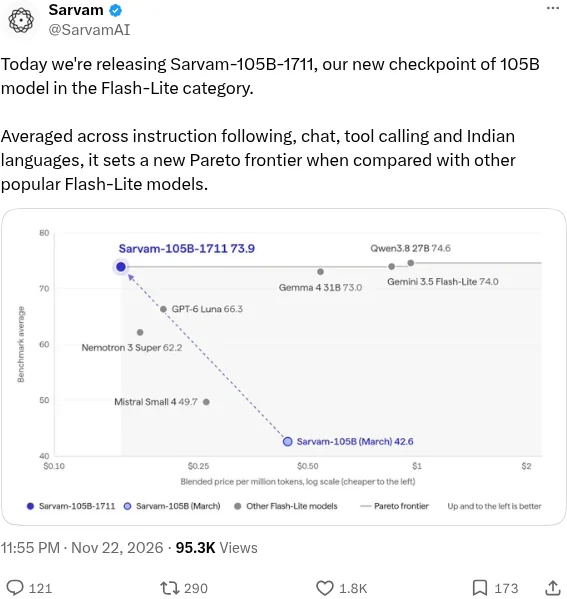
Indian AI company Sarvam released Sarvam-105B-1711, a new checkpoint of its 105-billion-parameter model positioned in the Flash-Lite category. It says that averaged across instruction following, chat, tool calling and Indian languages, the model sets a new Pareto frontier versus popular Flash-Lite models. Weights are on Hugging Face under Apache 2.0.
Screenshot of the original post · View full size ↗ Read the full report
Indian AI company Sarvam announced Sarvam-105B-1711 on X on November 22, a new checkpoint, or newly trained version, of its 105-billion-parameter model. It targets the Flash-Lite tier: not maximum reasoning power, but speed and cost suited to high-volume, lightweight workloads.
Sarvam says that averaged across instruction following, chat, tool calling and Indian languages, this version sets a new Pareto frontier compared with other popular Flash-Lite models, meaning better results at a given cost or speed. The company's chart shows the new version averaging 73.9 on its benchmark mix, up from 42.6 for the March version; Qwen3.8 27B (74.6) and Gemini 3.5 Flash-Lite (74.0) score slightly higher but cost more per the chart's blended price. All scores are self-reported.
The weights are on Hugging Face under the Apache 2.0 license, in BF16 and quantized formats including NVFP4 and MXFP8 for deployment on different hardware.
After the release, some users asked in replies why it was not compared with flagships like Claude Opus, while others noted that Flash-Lite-class models are built for high-concurrency, low-latency use and a flagship comparison would not be like for like. For developers working across Indian languages, a commercially usable open model optimized for local languages offers another option beyond big-tech APIs.
- 23
Will using Antigravity in T3 Code get you banned? A Google DeepMind engineer says 'never'
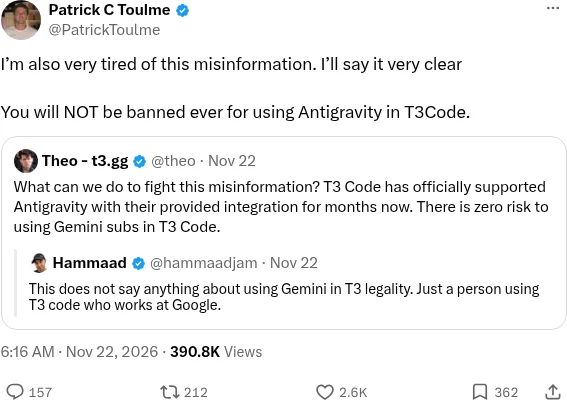
Developers worried that using Gemini/Antigravity subscriptions in the open-source T3 Code client could get Google accounts banned. T3 Code creator Theo said T3 Code has officially supported Antigravity via Google's integration for months with 'zero risk,' and Google DeepMind engineer Patrick Toulme posted that users 'will NOT be banned ever for using Antigravity in T3Code.'
Screenshot of the original post · View full size ↗ Read the full report
A ban scare among developers was defused by a single post from a Google engineer. Early on November 22 Beijing time, screenshots and claims circulated that connecting personal Gemini or Antigravity subscriptions to the open-source coding client T3 Code could violate Google's terms and get accounts banned.
T3 Code creator Theo responded first, saying T3 Code has officially supported Antigravity through Google's provided integration for months and that there is "zero risk" to using Gemini subscriptions in it. Minutes later, Google DeepMind engineer Patrick Toulme quoted him: "I'm also very tired of this misinformation. I'll say it very clear You will NOT be banned ever for using Antigravity in T3Code." The post drew thousands of likes and spread through Chinese- and Japanese-speaking developer circles.
The boundaries matter. This is a statement on Toulme's personal account and covers T3 Code's official route through Antigravity's ACP (agent client protocol). Community members noted that T3 Code is not a separate agent harness, as requests are still handled by Antigravity, and that third-party bridges such as proxying OAuth tokens are outside this clarification.
For developers juggling Claude Code, Codex and Antigravity, it means they can manage them in one workspace; for any other unofficial integration, Google's terms of service still apply.
GitHub projects
From GitHub Trending, with English descriptions where available. See each project for details. Trending does not imply a new release.
-
jingyaogong/minimind ↗
Train your own 64M LLM from scratch in 2 hours.