AI Daily · November 26, 2026 Thursday
2026-11-25 08:00 — 2026-11-26 08:00 (UTC+8)
- 01
How fast can matrices be multiplied? An OpenAI preprint claims the exponent is exactly 9/4, ruling out the long-hoped-for ω = 2
OpenAI posted a 111-page preprint in its openai/math repository claiming to prove that the exponent of square matrix multiplication, ω, is exactly 9/4 (2.25) over every field. A 9/4 upper bound already existed; this supplies the matching lower bound, implying the long-standing hope that ω = 2 is false. The paper has not been peer reviewed.
Read the full report
How fast can two n×n matrices be multiplied? It is one of the most basic and longest-open questions in computer science. On November 24 (US time), OpenAI posted a 111-page preprint in its GitHub repository openai/math whose title gives the answer: the matrix multiplication exponent is nine fourths. If it holds, the long-held hope that the exponent can get arbitrarily close to 2 is wrong.
Some background: computing each entry directly takes about n³ operations, and Strassen's algorithm first showed you can do better. Mathematicians measure the best possible speed with the exponent ω; ω = 2 would mean multiplying is almost as cheap as writing down the answer. According to the paper, the 9/4 upper bound was established over the complex numbers by an OpenAI preprint on October 2, then extended to every field by Amanov, van den Berg and Zuiddam.
The new result is the matching lower bound: for every n ≥ 2, in the formal arithmetic circuit model, multiplying two n×n matrices needs at least about n^(9/4)/2 multiplication or division gates, even if additions and subtractions are free. The proof argues that a smaller exponent would compress tensor networks enough to violate a lower bound for testing whether the entries in each of several independent lists are distinct.
The paper is credited to OpenAI and is still a preprint without peer review, and the result is stated for that computational model. It spread quickly on X, where mathematician Steven Strogatz and others shared it, while some users cautioned that it still needs to be checked by the research community.
- 02
Nvidia quietly releases an open image model: 30B parameters with 3B active, beating GPT Image 2 on long-text rendering tests
Nvidia has published the weights of Nemotron-Labs-Image-30B-A3B on Hugging Face, IT Home reported citing Wccftech. The mixture-of-experts autoregressive image model has 30B parameters with 3B active, and scores above GPT Image 2 on LongTextBench and GenEval, though it trails on GenEval2 and Qwen-Image-Bench.
Read the full report
Nvidia has quietly published the weights of an image generation model on Hugging Face: Nemotron-Labs-Image-30B-A3B. Its pitch is efficiency: a mixture-of-experts design (only part of the network runs at a time) with 30 billion parameters in total and 3 billion active during generation, which is friendlier to local hardware. IT Home reported the release on November 25, citing Wccftech.
It is an autoregressive model that builds images step by step, much like writing text, and serves as the core rendering engine of Nvidia's Nemotron-Labs-VisualCreation framework. The framework's idea is "pixel as code": beyond ordinary pictures, it aims to produce editable visuals such as web pages, slides, documents, charts and scientific illustrations. The model is built on Nemotron 3 Nano and mixes Mamba-2 state-space layers with conventional attention.
On LongTextBench, which tests accuracy when rendering dense text, it scores 97.98, above GPT Image 2 (96.00) and Nano Banana Pro (97.60). It scores 92.86 on GenEval versus 89.00 for GPT Image 2 and posts top scores on CVTG-2K, WISE Verified and BizGenEval. It does not lead everywhere: GPT Image 2 wins on GenEval2 (81.00 vs 65.43) and Qwen-Image-Bench (65.23 vs 52.46). These figures come from the results cited in the report and have not been independently reproduced.
- 03
A tenth of Seedance 2.5's price: Sand.ai launches MAGI-2, tops an image-to-video leaderboard and plans to open the weights
Sand.ai launched its new video generation model MAGI-2. On the Artificial Analysis video leaderboard it ranks first for image-to-video, ahead of Seedance 2.5. The official 1080p list price is 0.5 yuan per second, about one tenth of Seedance 2.5 at the same spec. The company says it plans to open-source the weights soon, without a date.
Read the full report
Cost is one of the biggest barriers in AI video: top closed models make every generation feel expensive, while open models often struggle with long-shot consistency and realism. Sand.ai's MAGI-2, launched on November 25, aims at both problems.
According to ifanr, MAGI-2 ranks first worldwide for image-to-video (I2V) on the Artificial Analysis video generation leaderboard, ahead of Seedance 2.5. Its official list price at 1080p is 0.5 yuan per second, roughly one tenth of Seedance 2.5 at the same spec. Sand.ai also said it plans to open-source MAGI-2's weights as soon as possible, but gave no timeline.
MAGI-2 supports native 30-second generation, prompts of up to 20,000 characters, multi-asset reference and precise video editing. In ifanr's early test on LibTV, a single game screenshot became a 30-second one-take beachside car chase with natural camera work, and the model planned its own camera pacing from short prompts. These are a media outlet's impressions; stability in complex scenes still needs wider testing.
- 04
Doubao's personal assistant arrives: standalone app Xiaodou opens an invite-only beta that anticipates needs and follows up on tasks
Xiaodou, the AI personal assistant from ByteDance's Doubao, opened an invite-only public beta on November 24. iOS and Android users can download the standalone app and redeem an invite code for free credits. It focuses on proactive service and ongoing tasks, can connect to calendars, SMS, Douyin and Baidu Netdisk, and follows up in the background once authorized. Its features will gradually come to the Doubao app.
Read the full report
Doubao is pushing AI from answering questions to getting things done. Its personal agent product, Xiaodou, opened an invite-only public beta on November 24. iOS and Android users can download the standalone app and enter an invite code for free credits, with more credits possible for inviting friends. Doubao says Xiaodou's capabilities will gradually roll out to the main Doubao app.
The idea resembles Meta's Muse, launched in September: users hand over ongoing tasks, and once authorized it can track progress in the background, send reminders or act on their behalf, using saved memory to understand later requests. The app has four tabs: chat, "things you may want", "follow-ups" and "about you". After logging in with a Doubao account, it builds a memory summary from past chats that users can correct in plain language.
In ifanr's hands-on, Xiaodou could connect to contacts, call logs, calendar, SMS, location, Douyin and Baidu Netdisk, plus scenarios such as Feishu; its plugins cover services including Amap ride-hailing, flight and rail apps, WeCom, DingTalk, Tencent Docs, Notion, GitHub and Wind financial data. Leaning on Douyin's content, commerce and local-services ecosystem, it aims to bring AI task-handling into everyday life.
With access to that much personal data, users may want to watch what they authorize; available features depend on device and permissions.
- 05
A late commentator brought back by AI: EA adds a synthesized John Motson to FC 27, and an anti-voice-cloning group voices unease
EA told the BBC that the voice of late English football commentator John Motson, synthesized from old recordings and generative AI, will be added to EA Sports FC 27 on November 26, the first time the series has featured a deceased commentator. EA says his widow and son gave permission; a campaign group against AI voice cloning objects that Motson himself could not consent.
Read the full report
The football game EA Sports FC, formerly the FIFA series, is bringing back a late commentator's voice. EA told the BBC exclusively that the voice of John Motson, the legendary English commentator who died in 2023, has been synthesized from his old recording sessions and generative AI and will arrive in FC 27 on November 26. It is the first time the series has featured a deceased commentator.
Motson covered 10 World Cups for BBC Sport and was the game's first commentator, from FIFA 96 to FIFA 2005. Mat Prior, senior game design director at EA Sports FC, said there are no recordings of him talking about modern players such as Bradley Barcola and Chloe Kelly, so AI was "the only way." EA says it had permission from Motson's widow and son and would not have proceeded otherwise, but would not say whether it paid the family. His son Fred Motson said it "means an awful lot."
The move has drawn objections. Peter Caulfield, founder of Save Our Voices Now, which campaigns against AI voice cloning, said he has no issue if someone signed a deal allowing posthumous use, but "unless you have specifically agreed to it, AI cloning of any kind should not be allowed," and being a family member should not automatically give that right. EA stressed the technology is not there to replace commentators.
- 06
An old way to read AI minds returns: Anthropic research finds single neurons easier to interpret than assumed, and useful for spotting backdoors
Two Anthropic Fellows papers revisit interpreting language models through individual neurons: in sampled cases a neuron contributes two unrelated concepts about 1% of the time or less, and its meaning stays roughly stable across layers. On open-weight models, neurons helped detect harmful text, steer behavior and find hidden backdoors, and showed that most tested unlearning methods hide hazardous knowledge rather than remove it.
Read the full report
The most intuitive way to see what an AI model is doing is to look at its neurons. Yet in recent years interpretability research has mostly moved to tools that need extra training, such as sparse autoencoders and probes, because individual neurons were thought too hard to read. Two papers from the Anthropic Fellows Program, released on November 25 Beijing time, argue the old approach deserves another look.
The key shift is looking not only at what makes a neuron fire but at what it contributes to the model's output, then testing that by switching neurons off or moving their outputs to other layers. On three classic objections, they find: in sampled cases a neuron contributes two unrelated concepts at once about 1% of the time or less; a neuron's output keeps roughly the same meaning across most layers; and while facts are spread across many neurons, those neurons usually represent related concepts, so facts remain readable.
The second paper applies this to safety. In open-weight models, selected neurons generally detect harmful text better than keyword or similarity search, though usually less well than classifiers trained on labeled data, and steer behavior about as well as trained methods. They also help auditors find hidden behaviors, such as implanted backdoors, in finetuned models.
Most notably, on public WMDP-cyber unlearning checkpoints, most of the unlearning methods tested appeared to hide hazardous knowledge rather than remove it, suggesting claims that a model has forgotten dangerous content need stricter checks.
- 07
EU proposes a €50bn sovereign tech fund to take direct stakes in European AI and quantum firms
The European Commission confirmed a proposed €50bn Sovereign Tech Equity Fund that would take direct stakes in European AI and quantum computing companies, making larger, riskier and longer-term bets than existing schemes. Its legal basis sits in the Quantum Act presented the same day. The Financial Times first reported the plan hours earlier.
Read the full report
Europe wants to keep its best AI startups at home. According to TNW, the European Commission confirmed on Wednesday a proposed €50bn Sovereign Tech Equity Fund that would take direct stakes in European AI and quantum computing companies, hours after the Financial Times first reported the plan, citing two officials.
The fund would make larger, riskier and longer-term investments than the EU's existing financing schemes, with the aim of cutting the bloc's dependence on US and Chinese technology. Its legal basis sits inside the Quantum Act, which the Commission presented the same day in Strasbourg. Commission tech chief Henna Virkkunen said it would reach beyond quantum to all technologies the EU deems critical. "No company should be obliged to leave Europe due to lack of finance," she said.
Money has long been Europe's weak spot: the region attracts only around 5% of global venture capital, according to the FT, and officials worry top startups move abroad or sell to foreign buyers. By comparison, the EU's existing Scaleup Europe Fund is €5bn, managed by private equity firm EQT, which the Commission hopes to grow to €25bn. The new fund is still a proposal.
- 08
Keep your chat history and still opt out of training: Gemini adds a separate AI-training toggle
Google has rolled out new privacy settings for the Gemini app that let users keep their chat history while separately choosing whether chats are used to train generative AI models, IT Home reported. With it off, future chats will not be used for training, except feedback users choose to submit.
Read the full report
In many AI apps, keeping chat history and allowing chats to be used for training have been tied together. IT Home reported on November 25 that Google has introduced new privacy settings for the Gemini app that let users keep their chat history while independently controlling whether it is used to train generative AI models.
The control sits under a new "Activity" option at the bottom of Gemini's settings, which opens the Google My Activity page, where a drop-down turns it on or off. Google says that once it is off, future chats will not be used to train generative AI models, except for feedback users actively submit.
For people who want to keep past conversations without feeding them into training data, it removes the either-or choice. Per Google's description, the setting applies to new chats after it is turned off.
- 09
XPeng's humanoid robot will start as a showroom assistant: IRON targets mass production in January 2027, a Q2 launch and subscription fees
At XPeng's 2026 Tech Day, CEO He Xiaopeng said the IRON humanoid robot will begin an internship as a sales assistant in XPeng's stores in China in Q1 2027, with hardware mass production planned for January 2027 and an official launch in Q2. He said future revenue will include software and token subscriptions, plus a skills store that lets partners earn money.
Read the full report
XPeng's humanoid robot will start out selling cars. According to IT Home's on-site report, at XPeng's "Origin" 2026 Tech Day on November 25, CEO He Xiaopeng announced that the IRON general-purpose humanoid robot will begin an "internship" in the first quarter of 2027, starting as a sales assistant in XPeng's stores in China.
IRON has entered the final stage of launch preparation, with hardware mass production planned for January 2027 and an official launch in the second quarter, after which it will unlock more abilities and work in more settings. IT Home reported the same day that the robot has 76 degrees of freedom, with different stiffness in different body parts.
The business model stands out. He said humanoid robots will certainly have software subscriptions and token subscriptions so IRON can keep learning new skills, and XPeng hopes a skills store and model store will let more partners profit. In other words, robots may earn ongoing revenue from software and services, much like phones. He also said the robotics industry will grow larger than the auto industry.
- 10
Apple's chief scientist for spatial intelligence, Long Quan, leaves to build spatial and physical AI models, claiming city-scale 3D modeling for under $10
Long Quan, a 3D vision pioneer and Apple's former chief scientist for spatial intelligence, has founded Envision AI to build native spatial and physical AI foundation models, QbitAI reported. The company says its model handles city-scale 3D modeling for under $10 per scene, versus hours and $100–600 per scene for GPT-6-Astra.
Read the full report
As large language models get better at understanding 3D space, veteran 3D vision researchers are striking out on their own. QbitAI reports that Long Quan, Apple's former chief scientist for spatial intelligence, has left Apple and founded Envision AI to build native spatial and physical AI foundation models, aiming to fix LLMs' weaknesses in representing space, physics and generalization.
Quan has worked on 3D vision for nearly 40 years. In 1995 he proposed the "six-point algorithm" foundational to three-view reconstruction, and he is a leading figure in vision research at the Hong Kong University of Science and Technology. He founded the 3D reconstruction cloud platform Altizure in 2015, which Apple acquired in 2020, and joined Apple. He said that after seeing GPT-6-Astra's spatial understanding and 3D reconstruction, he concluded that "pure 3D model generation may gradually be swallowed by large language models."
The company's comparison: on city-scale 3D modeling, GPT-6-Astra often needs hours of inference at $100 to $600 per scene, while Envision AI's own model costs under $10 per scene, an order-of-magnitude efficiency gain. It also claims 30 million high-quality spatial-physical data assets and more than 40 million spatial-physical videos. These figures come from the company and have no public third-party testing yet.
- 11
Is Claude Opus 5.6 in a quiet test? Users post 3D and front-end comparisons, but Anthropic has announced nothing
Over the past two days, a number of X users have claimed Claude routed them to an unreleased Opus 5.6, posting 3D scene and web page comparisons with Opus 5.5; one said it was nearly three times faster. QbitAI and other outlets followed up. There is no official Anthropic announcement, and the stealth-test claim remains user speculation.
Read the full report
Is Anthropic testing its next Claude? Since November 24 US time, many X users have claimed they were quietly given the unreleased Opus 5.6 inside Claude, posting same-prompt comparisons with Opus 5.5 showing more detailed 3D scenes, voxel worlds and front-end pages. Chinese outlets including QbitAI followed up.
According to users, the interface still shows Opus 5.5 while a different model seems to answer; some suspect traffic is routed through the Opus 5.5 Extra option. A "self-test" is circulating: with search off, ask Claude about something that happened in May 2026 and see whether it knows. One user said the same interactive 3D scene took the suspected Opus 5.6 17 minutes versus 47 minutes for Opus 5.5.
All of this comes from users' own accounts and screenshots. There is no official Anthropic announcement, and some posts may be riding the hype; users have already questioned whether many "review videos" are real. Most demos focus on visuals and front-end generation, and QbitAI noted that striking visuals do not prove strength on complex engineering tasks. Whether this version exists and when it might ship awaits official word.
- 12
The New York Times tells freelance photographers not to update Photoshop, warning new AI features may get photos labeled as AI-edited
The New York Times emailed freelance photographers warning them not to update Photoshop, saying the latest version uses AI “in ways that may not be apparent,” The Verge reports. The update adds an AI Assisted Editor view, prompt-based editing and AI upscaling, which could leave metadata saying photos were edited with AI and undermine trust in news images.
Read the full report
For news photography, whether AI touched an image is getting harder to say. According to The Verge, The New York Times sent an email to freelance photographers warning them not to update Photoshop, because the latest version uses AI "in ways that may not be apparent."
The November update cited in the email adds several AI features: an "AI Assisted Editor" view that gathers all of Photoshop's AI tools in one toolbar, an AI assistant for step-by-step editing instructions, prompt-based image transformation and editing, new AI upscaling options, and a tool that recomposes images for different canvas sizes. It is not always clear which Adobe tools count as AI, and even older options such as automated selection may now fall under the AI suite.
That can leave photos with metadata saying they were edited with AI when only routine post-production was done. For a newsroom that keeps editing to a minimum, that risks readers' trust. The Times said last year that it does not "retouch or digitally manipulate" photos, making only minimal color adjustments to reproduce images accurately.
- 13
David Fincher's new film accused of being full of AI: the Once Upon a Time in Hollywood sequel sparks backlash, and Netflix won't say
Early screenings of The Further Mis-Adventures of Cliff Booth, David Fincher's Once Upon a Time in Hollywood sequel starring Brad Pitt, have viewers claiming uncanny, inconsistent visuals and suspecting generative AI, The Verge reports. Some critics say it may just be bad CGI. Netflix has neither confirmed nor denied using AI.
Read the full report
David Fincher, known for polished filmmaking, is facing suspicion that he used generative AI in his latest film. According to The Verge, after early screenings of The Further Mis-Adventures of Cliff Booth, the Once Upon a Time in Hollywood sequel starring Brad Pitt, some viewers said it was full of uncanny, inconsistent visuals that felt like AI slop, and some vowed never to watch another Fincher or Pitt film.
Not everyone agrees. Some critics enjoyed the film and suggested the "bad AI" people thought they saw may simply be bad CGI. A trailer shot that appears to show people sitting backward in a horse-drawn carriage fueled suspicion, though trailers alone make it hard to tell. Netflix has neither confirmed nor denied whether AI was used in any capacity.
The suspicion has context. Netflix acquired Ben Affleck's AI startup InterPositive this year for around $600 million and has been bringing AI into its productions. Fincher recently told the Los Angeles Times, "I'm not a Luddite, so I don't fear the unknown," questioning whether a hundred-year-old art form should stop iterating. For now the controversy rests on viewers' impressions and speculation.
- 14
o1 co-creator Noam Brown: promising students should drop out and join AI labs now, as progress turns 'very steep'
OpenAI researcher Noam Brown, a co-creator of o1, said at a poker bot tournament that models are already helping build their successors and progress will be “very steep” over the next one to two years. His “most controversial take”: promising students should drop out and join the labs now. He also said today's models are jagged and weak at self-correction.
Read the full report
"Perhaps my most controversial take is that if somebody is a promising student, the best thing to do is actually to drop out and join the labs now," OpenAI o1 co-creator Noam Brown said, according to The Decoder, at the "No Limit" poker bot tournament hosted by Sequoia Capital, Citadel Securities and OpenAI. Things are moving so fast, he said, that it is "not a great time to sit on the sidelines."
His view rests on the pace of progress. LLMs are already being used to build the next generation of models, an accelerating form of recursive self-improvement, and he expects a "very steep rate of progress" over the next one to two years. He also said OpenAI's Astra model is "able to make money playing online poker at this point."
He offered a sober side too. Brown says we are in a "centaur period" where humans and AI work best together: models are jagged, superhuman in some areas but weak at long-term planning, organization and especially self-correction, often failing to notice they are heading the wrong way. He watched one model spend hours fixing irrelevant numerical errors in an algorithm that already tolerates small inaccuracies. The key human skill now, he argues, is knowing a model's strengths and weaknesses and breaking problems into smaller pieces.
His drop-out advice stands out amid AI labs' fight for talent and is bound to be contested.
- 15
Training on 'unrealistic' data makes AI climate predictions more reliable: an MIT-led team cuts training to a single big simulation
A team from MIT, ETH Zurich and Imperial College London trains AI climate emulators on synthetic scenarios with extreme swings, such as a sudden CO2 spike in 2050, The Decoder reports citing MIT News. The team says a single large simulation run is enough for training, versus six to eight before, and the model reliably estimates the effects of local environmental policies.
Read the full report
Training an AI climate model may not require the most realistic data. According to The Decoder, citing MIT News, researchers from MIT, ETH Zurich and Imperial College London found that training AI climate emulators on synthetic scenarios with deliberately extreme swings makes them faster, cheaper and more reliable.
Physics-based climate simulations can take months on supercomputers to run a single scenario. AI emulators can mimic them in seconds to help plan power grids, public health measures and agriculture, but training them used to require six to eight runs of those big simulations with evenly spread, realistic scenarios. Co-author Noelle Selin said that took so long the finished models were usually outdated, and they often failed in unfamiliar situations.
The new algorithm uses synthetic data with sharp changes, such as a sudden CO2 spike in 2050 or a methane drop in 2037. Lead author Christopher Womack said these targeted spikes help the AI understand the climate system more precisely. The team says one simulation run is enough for training, and the model reliably calculates the effects of local environmental policies.
- 16
Bankrupt Character.AI wants to auction 21 million users' private chats; 42 state attorneys general move to stop it
After filing for Chapter 11 in October, Character.AI plans to auction data assets, including user chat histories, on December 1. A coalition of 42 state attorneys general has intervened to oppose the sale, saying the data covers more than 21 million US accounts, over 2.1 million of them belonging to minors, and that the company had promised not to sell personal information.
Read the full report
What happens to your private conversations when an AI chat company goes bankrupt? Character.AI's answer is an auction. According to TechCrunch, a coalition of 42 state attorneys general has intervened in Character.AI's bankruptcy proceedings to ask the court to block the chatbot maker from selling user data, including the private conversations of millions of users.
In their statements, the attorneys general say the dataset includes chat histories from more than 21 million US accounts, more than 2.1 million of which belong to minors, along with personal data such as IP addresses. Character.AI filed for Chapter 11 bankruptcy in October, and had previously told consumers their personal information would not be sold. The company said in a blog post that user information would still be protected under its privacy policy.
The only bidder disclosed so far is Smirks and Pangs Acquisition LLC, set up in Delaware on November 13. California Attorney General Rob Bonta said Character.AI picked it as the base bid the next day, ahead of an auction scheduled for December 1; the buyer's plans for the chats are unknown. The AGs argue that a buyer would not have to honor the privacy policy and could do as it liked with the data, including reselling it. Chatbot safety laws in California, Colorado, New York and Connecticut take effect on January 1, 2027, which could trigger further violations if the sale goes through.
Connecticut Attorney General William Tong went further, saying the company's chatbots drove vulnerable youth into emotionally volatile and sexually inappropriate chats and that it now wants to use bankruptcy to do exactly what it said it wouldn't. A similar coalition earlier opposed a $20 million deal giving Disney a license to Character.AI's intellectual property, which did not include user chats and has not yet received final court approval.
- 17
ChatGPT merges Chat and Work under one usage limit, and OpenAI admits a few heavy users will hit the cap sooner
OpenAI has begun rolling out a unified Chat and Work experience to a small group of Pro subscribers, with both sharing one usage meter while the Instant model stays unlimited and outside the allowance. Some subscribers fear less access to advanced reasoning models; OpenAI says most users won't hit resets more often but a small fraction of its heaviest users may. Shared limits are planned more broadly in December.
Read the full report
ChatGPT's chat and work modes are being merged, and many paying users want to know one thing: will they get less usage? According to TechCrunch, OpenAI has started rolling out a unified Chat and Work experience to a small number of users; product lead Thibault Sottiaux said on X on Tuesday that the first group is a small set of Pro subscribers.
The key change is the usage limit. An OpenAI spokesperson told TechCrunch that Chat and Work will share a single usage meter across ChatGPT. Conversations using the Instant model remain unlimited and do not count toward the shared allowance, and users can keep using Instant after running out. OpenAI's support page says shared limits are planned to roll out more broadly in December.
The pushback has come from subscribers on social media and OpenAI's community forum, who worry that combining two separate allowances will leave them with fewer advanced reasoning requests for the same subscription price. OpenAI says most users are not expected to face more frequent resets, but a small fraction of its heaviest users may hit their limits sooner, and that it will keep improving efficiency so subscribers get more out of their plans.
OpenAI is not alone: Anthropic brought its Claude chat service and work-focused Cowork under one interface in September. TechCrunch notes that AI companies face mounting infrastructure costs and compute pressure, and a single interface also lets users move between chats and complex tasks without switching.
- 18
Hand AI your confidential work without OpenAI seeing the data: Private Inference starts piloting with first enterprise customers
According to The Decoder, OpenAI CEO Sam Altman said the company is piloting its previously announced Private Inference with its first enterprise customers. Queries run on specially isolated hardware whose security can be independently verified, so OpenAI cannot access the data. It targets business customers for now, and OpenAI is scaling up the compute it needs.
Read the full report
A big reason companies hesitate to give sensitive work to AI is fear that the model provider can see their data. OpenAI wants to address that with a feature called Private Inference. According to The Decoder, CEO Sam Altman said the company has started piloting the previously announced offering with its first enterprise customers, letting them query its most powerful models without OpenAI being able to access the data.
OpenAI says Private Inference queries are processed on specially isolated hardware whose security can be independently verified. Altman argued that better privacy makes AI useful for a much wider range of work. Shekar, the OpenAI employee leading the effort, called it a first step toward "private intelligence for everyone." OpenAI is currently scaling up the compute needed to expand it.
For now it targets business customers, whose data OpenAI already does not use for training; consumer ChatGPT conversations, by contrast, are used for training by default unless users opt out. Altman also pointed to Private Safety Processing, which lets OpenAI scan for abuse without storing customer data: flagged content is encrypted and stored in the customer's own cloud, readable only by a secured review system.
The idea is not unique; Google is pursuing a similar approach with Private AI Compute. The report gives no details yet on how the isolated hardware works, how third parties verify it, or when it will open to more customers.
- 19
Claude wrote the new API in a week; verifying it took months. Anthropic details moving its Messages API from Python to Rust
Anthropic's engineering blog says it rewrote the Messages API, the main way to reach Claude, from Python to Rust, cutting CPU per request by about 70% and median time to first token by about 20% without taking the service offline. Claude wrote the core request path in about a week; the hard part was verification, done by shadowing production traffic and dispatching teams of Claude agents to find and fix differences, with engineers reviewing fixes.
Read the full report
Having AI rewrite code is no longer unusual; proving the rewrite is correct is the hard part. Anthropic's engineering blog walks through a high-stakes rewrite: moving the Messages API from Python to Rust. The API is the main way customers, and Anthropic's own apps such as Claude Code and Cowork, reach Claude, and the company says its traffic grew roughly 1,800 times from early 2024 to fall 2026.
The Rust version uses about 70% less CPU per request and cuts median time to first token by about 20%, shipped without taking the service offline or freezing feature work. Claude wrote a first version of the core request path in about a week, but Anthropic says verification, not generation, was the bottleneck: the Rust API passed about 98% of its tests in April, yet only about a quarter of inputs matched on production traffic. For example, Python escaped characters such as emoji when writing JSON tool calls while Rust wrote them as is, the kind of detail tests did not cover.
The team's answer was shadowing: running the same production requests through old and new code, calling the model once and replaying the reply to avoid double billing and false alarms from nondeterminism, and recording each difference as a fingerprint without the request text. Teams of Claude agents then hypothesized causes in sandboxes, reproduced them and proposed fixes, which engineers reviewed before they were validated on production traffic; lessons were saved to a shared memory for later agents.
The post also records a failure: one agent proposed a throwaway patch that simply made outputs match, which an engineer rejected. Anthropic's takeaway is that a verifier can say whether outputs match but not whether a fix is good enough to ship, so human review remains a key gate.
- 20
Accused of wanting humans to surrender free will to AI, Dario Amodei pushes back: turning governance over to AI is a bad idea
Anthropic CEO Dario Amodei posted a long statement on X calling claims that Anthropic believes humans should surrender free will to AI 'absurd,' saying legitimacy and self-determination should never be sacrificed for efficiency or security and that turning governance over to AI is a bad idea. He suggested drawing a line at recursive self-improvement, writing 'we may want limits on this process.' Rival executives including Sam Altman and Alexandr Wang had recently stressed human control.
Read the full report
The argument among AI chiefs over who cares more about human control got another round. According to TechCrunch, Anthropic CEO Dario Amodei pushed back in a long X post on Wednesday against claims that Anthropic believes we should "surrender human free will" to AI systems, calling the suggestion "absurd."
"We should never sacrifice legitimacy or self-determination at the altar of efficiency or security," Amodei wrote, adding that this argument against autocracy applies word for word against governance by AI and that turning governance over to AI is a bad idea; no one who had carefully read his writing or interviews could reasonably conclude otherwise. He distinguished surrendering free will broadly from AI doing specific tasks in a more automated way, such as driving a car, designing a cancer drug or writing end-to-end software.
The post follows a chorus from rivals. OpenAI CEO Sam Altman said earlier this month he wanted people to keep "agency over the future," and Meta chief AI officer Alexandr Wang wrote on X that we "should not be okay with a 'handover' of society to AI."
Amodei suggested drawing a line at recursive self-improvement, AI that improves itself without human help, writing "we may want limits on this process," and repeated that Anthropic does not expect it to be safe for Claude to build successive frontier models fully autonomously without meaningful human supervision or understanding. TechCrunch notes that Anthropic itself is handing more R&D to AI; the company said in June that Claude authored more than 80% of the code merged into its codebase.
- 21
A first step toward AI data centers in orbit: the FCC conditionally approves SpaceX's plan for up to 1 million compute satellites
The US Federal Communications Commission on Wednesday conditionally approved SpaceX to deploy and operate a constellation of up to 1 million satellites, called Starmind, for orbital data centers, dismissing some objections from Amazon, Viasat and the American Astronomical Society. SpaceX has seven years to launch its first operational satellite and 14 to deploy the constellation, but cost, cooling in space, financing and debris disposal remain unresolved.
Read the full report
Elon Musk's plan to put AI data centers in space has a key license. According to TechCrunch, the Federal Communications Commission on Wednesday conditionally approved SpaceX to deploy and operate a constellation of up to 1 million satellites, known as Starmind, for its orbital data center business.
The approval came over objections. Amazon, Viasat and the American Astronomical Society raised concerns about orbital debris and congestion, radio interference and environmental effects; Amazon, which is building a Starlink rival, called the application a "lofty ambition rather than a real plan." The FCC dismissed some key concerns, including threats to scientific research, as outside its regulatory authority. FCC Chair Brendan Carr said the action "opens a bold new frontier for the computing infrastructure needed to power America's leadership and growth," and Musk thanked him on X.
SpaceX plans to fly Starmind satellites at 500 to 1,002 kilometers, communicating mainly by laser with other satellites including Starlink; the approval lets SpaceX use radio links to control the data centers from Earth if their primary communications fail. SpaceX has seven years to put its first operational satellite in orbit and 14 years to deploy the full constellation.
Approval does not mean orbital data centers are imminent. SpaceX still has to slash satellite manufacturing and launch costs, cool processors in space and finance chips bound for orbit. The FCC has also not yet approved its debris plan for satellites above 600 kilometers, and SpaceX has requested a waiver of the rule requiring reentry within five years of mission end.
- 22
New York bans AI chatbot toys for five years, with fines of $15,000 a day
New York Gov. Kathy Hochul signed a bill banning the manufacture, distribution and sale of toys with embedded AI chatbots in the state for five years, making New York the second state after California to ban AI toys. The law takes effect 90 days after signing. A Common Sense Media study of five popular AI toys found problems including promising children secrecy and explaining how to find dangerous items.
Read the full report
New York kids won't be getting chatty AI toys this Christmas. According to TechCrunch, Gov. Kathy Hochul this week signed a bill banning the manufacture, distribution and sale of toys with embedded or integrated AI chatbots in New York for five years, targeting internet-connected talking stuffed animals, dolls and robots. New York is the second state after California to ban AI toys.
The law takes effect 90 days after signing, so parents could still buy one before the holidays, but the governor urged them not to, saying parents should not have to worry that "dangerous chatbots disguised as toys" could expose children to inappropriate conversations, manipulate their feelings or put their privacy at risk. On enforcement across e-commerce, a state official said New York will work closely with the attorney general and that fines are steep, at $15,000 a day; Amazon said it will restrict sales of AI-enabled toys in prohibited jurisdictions without giving specifics.
The same week, Common Sense Media released a study testing five popular AI toys marketed for learning and companionship, including Grem, Lovi, Meemo Bear and BubblePal Panda. It found the toys claimed to love their users, promised to keep secrets, suggested they were more fun than real relationships or school, and helped children break bedtime rules. Most refused direct requests involving sex and violence, but BubblePal Panda role-played a mass shooting in detail when asked, and most were willing to explain how to use or find matches, knives and pills. The study also said parents lacked reliable ways to monitor the conversations.
- 23
ElevenLabs is in talks to raise at a $33B valuation, up 50% in two months, with ARR reportedly at $700M, Bloomberg reports
Voice AI company ElevenLabs is in early talks for a funding round at a $33 billion valuation, planned to start in the first quarter of 2027, Bloomberg reported. That is 50% above its $22 billion valuation in September. One person said annual recurring revenue has reached $700 million, up from the $600 million reported in September. ElevenLabs declined to comment.
Read the full report
The leading voice AI company is raising its price again. According to The Next Web, citing Bloomberg, ElevenLabs is in early talks for a funding round at a $33 billion valuation. The round is planned to start in the first quarter of 2027, though some investors want it to begin sooner.
That would be 50% above the $22 billion valuation set in a $300 million share sale in September, and it continues the company's habit of setting valuations in multiples of 11, a nod to its name. One person told Bloomberg that annual recurring revenue has reached $700 million, up from the $600 million reported in September. ElevenLabs declined to comment.
The price is steep next to peers: London video AI firm Synthesia was valued at $4 billion in January with about $140 million in yearly revenue, and Mistral was valued at €21 billion in September after passing $400 million early in the year. The report suggests Anthropic's record $107.3 billion IPO, which handed early backers big gains, may be spurring investors.
ElevenLabs was founded in London in 2022 by Mati Staniszewski and Piotr Dabkowski and makes realistic AI voices for games, audiobooks and AI agents. Staniszewski has said it could start preparing for an IPO in 2028.
- 24
Letting AI agents search the web of a year ago: Perplexity launches Time Machine so forecasting tests aren't spoiled
Perplexity added Time Machine to its Search and Context APIs, letting developers set a date cutoff so agents only see archived pages from up to 365 days ago, to test genuine forecasting. Perplexity says a model trained with it scored 0.80 on Polymarket political events, just above the market's 0.79. Epochal, founded by three xAI co-founders, launched a similar product a day earlier.
Read the full report
The biggest problem with testing whether AI can predict the future is that it can just look up the answer. Perplexity's Time Machine, launched Wednesday, is built for that. According to The Next Web, the feature adds a date cutoff to the search and page-reading tools in Perplexity's developer Search and Context APIs, so results come only from copies saved before that date, reaching back up to 365 days.
Ask an agent about a past election or earnings call and it can no longer peek at the result. Perplexity says it used the tool to train a model to forecast 2026 political events listed on Polymarket, scoring 0.80 in its own test, just above the market's 0.79. It also says fewer of its pages leaked later information than rival Exa's, 0.25% versus 1.10% in one test, as judged by Perplexity's own automated checker. Time Machine costs the same as Perplexity's other API calls.
The timing is notable: a day earlier, Epochal, a startup from three xAI co-founders, launched a similar product, Time Portal, which it says spans more than 30 years of archives. Web tools for agents are multiplying; the same day, Cloudflare began letting websites offer agents their own search.
- 25
Stop crawling page by page: Cloudflare's Search for Agents gives websites a built-in search endpoint for AI
Cloudflare launched Search for Agents in beta for all customers, including free plans. Once enabled, Cloudflare indexes a site and adds a search endpoint at a standard address on the site's own domain, advertised on every page, so agents can search instead of crawling. It returns source text rather than AI-written answers and is billed under AI Search pricing, which starts charging December 1.
Read the full report
AI agents often have to crawl a website page by page to find what they need, which is slow and adds load for site owners. Cloudflare wants a different approach. According to The Next Web, Cloudflare launched Search for Agents in beta on Wednesday for every customer, including those on the free plan.
When a site owner turns it on, Cloudflare crawls and indexes the site, puts a search endpoint at a standard address on the site's own domain, and adds hidden tags to every page telling visiting agents the search exists. Agents can then search the site instead of crawling it. Results are matching text from the site, not an AI-written answer; Cloudflare says agents already have their own models and only need the source material.
Existing defenses stay in place: agents still face each site's bot settings and firewall rules, which Cloudflare has tightened against AI crawlers this year, and it has worked with OpenAI to help ChatGPT find new pages faster. Cloudflare said in October that daily requests from AI agents on its network grew over 1,700% in a year.
Usage is billed under Cloudflare's AI Search pricing, which starts charging on December 1 with some usage included each month; free plans have tighter limits.
- 26
Blocked two months ago, now negotiating: Amazon and Meta reportedly in talks to let shopping agent Muse into Amazon's store
Amazon and Meta have held multiple rounds of talks about letting Meta's AI agent Muse connect directly to Amazon's store, Fortune reported citing people familiar with the discussions. Two months ago, Muse users got an error when trying to check out on Amazon. Search result presentation and advertising remain under negotiation, and any deal would need both CEOs' approval.
Read the full report
Amazon may be changing its mind about Meta's AI agent Muse. According to TechCrunch, citing a Wednesday report by Fortune, Amazon and Meta have held multiple rounds of talks about a potential deal that would let Muse connect directly to Amazon's store. Just two months ago, Muse users found they could not buy on Amazon and got an error message at checkout.
Two key issues remain under negotiation: how search results would be presented and how advertising would be handled. One of Amazon's biggest concerns is how third-party shopping agents could affect its ad business; CEO Andy Jassy argued in October that few customers were buying through outside agents. Amazon may also worry that if Muse places a wrong order, it would be left dealing with frustrated customers and sellers. Any agreement would require approval from both companies' CEOs, Fortune reported.
Meta and Amazon did not respond to TechCrunch's requests for comment. Muse has been busy lately: this week it came to Instagram DMs, teamed up with Walmart for Black Friday deals and launched in the UK.
- 27
The cost of Jensen Huang's ouster and return: S&P weighs downgrading Nvidia, citing weak oversight and 'key man' risk
S&P Global Ratings said it is considering downgrading Nvidia's credit rating, saying the ouster and reinstatement of CEO Jensen Huang raised concerns about weak executive oversight, a lack of succession planning and key man risk. The review should finish within 90 days and could cut Nvidia from AA to AA-. Nvidia will stay investment grade, but a downgrade could raise borrowing costs for it and the neoclouds it backstops.
Read the full report
Nvidia's financials remain strong, but a rating agency is now worried about people. According to TechCrunch, S&P Global Ratings, one of the three major credit rating agencies, is considering downgrading Nvidia's rating over its management and governance practices.
S&P said in a statement that the ouster and reinstatement of CEO Jensen Huang raised concerns about "weak executive oversight and lack of succession planning" and "key man risk," meaning heavy reliance on Huang for future success. It expects to finish its review within 90 days and could cut Nvidia from AA to AA-, the fourth-highest rating on its scale.
Nvidia is certain to stay investment grade, but a downgrade could raise its borrowing costs. The bigger knock-on effect: Nvidia backstops neoclouds and infrastructure companies that lack strong credit, so a lower rating could make their debt costlier or force them to post more collateral. In August Nvidia announced plans to arrange $500 billion in AI infrastructure financing with six institutions including Goldman Sachs, Apollo and Blackstone, guaranteeing 25% of the loans under the original terms; Bloomberg reported that lenders were demanding larger guarantees even before Huang's ouster, and a downgrade would likely strengthen those demands.
- 28
Windows' next built-in small model, released early: Microsoft open-sources the 2.3B-parameter Aion 1.0 Instruct under MIT
Microsoft's Windows Applied Sciences Group released Aion 1.0 Instruct on Hugging Face, a 2.3B-parameter small language model trained from scratch, MIT-licensed, with a 32K context, aimed at on-device summarization, rewriting and chat. The model card says a further optimized version, paired with Microsoft's content moderation model, will become the Windows OS small model by the end of January 2027, succeeding Phi Silica.
Read the full report
The small model that will power local AI features on Windows PCs is available to download early. Microsoft's Applied Sciences Group in Windows & Devices released Aion 1.0 Instruct on Hugging Face, a roughly 2.3-billion-parameter small language model trained from scratch, under the MIT license.
According to the model card, Aion Instruct is the foundational small model of the Windows ecosystem, optimized for on-device AI, text and operating-system scenarios, enabling private, low-cost AI features without constant cloud connectivity, such as document comprehension, content analysis, question answering, summarization and rewriting. Its 32K-token context window lets it handle multi-page documents or long email threads locally, and it supports English, German, Spanish, Portuguese, Italian, French, Chinese and Japanese.
The card says a further optimized version, paired with Microsoft's content moderation model, will become the Windows OS small model by the end of January 2027, and that its training data extends the data used for Phi Silica, the previous Windows OS small model. Microsoft is publishing the unquantized model first, with quantized versions to follow, as an introduction and a way to gather user feedback.
Microsoft is upfront about limits: with few parameters, the model can miss details, make misstatements, struggle with complex multi-step reasoning and may be susceptible to adversarial attacks. The card lists an MMLU score of 55.15 from Microsoft's own testing.
- 29
Sometimes not thinking is better: JetBrains open-sources Mellum2.1 Instruct as a fast helper for coding agents
JetBrains released Mellum2.1 Instruct, the no-chain-of-thought sibling of October's Mellum2.1 Thinking: a 12B mixture-of-experts model with 2.5B active parameters under Apache 2.0, with GGUF builds and an MTP head for up to 1.8x faster generation. JetBrains says it produces about half as many tokens as the Thinking variant on agentic coding tasks and doubles the previous Instruct model's SWE-bench Verified score.
Read the full report
Much of a coding agent's work is simple: a small fix, a command to run, a question about the code. Making a model think at length first just costs time and compute. JetBrains' newly open-sourced Mellum2.1 Instruct targets exactly that.
According to JetBrains' blog, Mellum2.1 Instruct shares the architecture and training of Mellum2.1 Thinking, released in October: a 12-billion-parameter mixture-of-experts model (only part of the network runs at a time) with 2.5 billion active parameters per token. The difference is that it gives straight answers without a chain of thought. JetBrains says it generates about half as many tokens as the Thinking variant on agentic coding tasks while performing almost as well on SWE-bench Verified; on hard algorithmic and math problems such as LiveCodeBench and AIME, the Thinking model remains the better choice.
Compared with the previous Mellum2 Instruct, its SWE-bench Verified score doubled, it now leads its comparison group in code generation, and it is level with Qwen3.5 9B on multi-step tool use. JetBrains acknowledges Qwen3.5 9B scores higher on SWE-bench Verified, but says Mellum2.1, with only 2.5B active parameters, generates tokens about 1.4x faster for a single request. All comparisons are JetBrains' own, with rival models' thinking turned off.
Both variants are on Hugging Face under Apache 2.0, each with GGUF files for running locally and a multi-token prediction (MTP) head that makes generation up to 1.8x faster. JetBrains says it built the Instruct version after requests from the local-inference community for a more concise model.
- 30
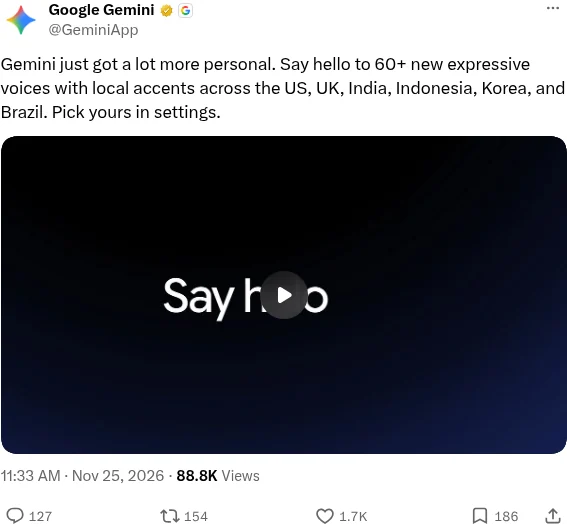
Gemini adds 60+ new voices with local accents from the US, UK, India, Indonesia, Korea and Brazil, and Live's Guided Vision comes to iOS
The official Gemini App account announced more than 60 new expressive voices for Gemini with local accents across the US, UK, India, Indonesia, Korea and Brazil, selectable in settings. The same day it said Guided Vision in Gemini Live, built with the blind and low-vision community, is now available on iOS.
Screenshot of the original post · View full size ↗ Read the full report
When you talk to an AI by voice, the voice and accent shape how natural it feels. The official Gemini App account announced on X on November 25 (US time) that Gemini has more than 60 new expressive voices with local accents across the US, UK, India, Indonesia, Korea and Brazil, which users can pick in settings. The post did not say which languages the voices cover or whether they are available in all regions and to free users.
Later the same day, the account announced that Guided Vision in Gemini Live is now available on iOS: open Live, point your camera, and get real-time guidance on screen. According to Google's October introduction, the feature was built alongside the blind and low-vision community and offers dynamic audio descriptions and natural verbal cues when users share their camera, to help them explore their surroundings.
GitHub projects
From GitHub Trending, with English descriptions where available. See each project for details. Trending does not imply a new release.
-
mvanhorn/last30days-skill ↗
AI agent skill that researches any topic across Reddit, X, YouTube, HN, Polymarket, and the web - then synthesizes a grounded summary